
What are Communities of Practice?
Communities of Practice (CoPs) are peer-led groups that bring together individuals facing shared challenges within a common job function, aiming to exchange knowledge, reflect on practice, and collaboratively improve how those challenges are addressed.
‘groups of people who share a concern or passion for something they do and learn how to do it better as they interact regularly’ (Wenger, 2009:1)
The Communities of Practice Model
There are three key elements to Communities of Practice: Domain, Community, Practice.
The shared area of interest that brings participants together (e.g. academic writing, research methods, career development, etc.)
The group of individuals, who share a function, engage regularly, build relationships, and develop trust.
The shared repertoire of existing knowledge, tools, experiences, as well as future approaches developed through interaction.
- What are the benefits of engaging with Communities of Practice?
-
CoPs can help address common issues in research including isolation, limited peer exchange, and uneven access to informal knowledge. By bringing people together regularly around shared topics, they support learning from others, testing ideas, and finding practical ways to improve work.
Organisational research suggests that effective CoPs help with:
- overcoming institutional isolation and increasing collaboration
- enable collective problem-solving around shared challenges
- improved processes and procedures by generating tangible outputs, such as resources, strategies, or recommendations
- encourage reflective practice and critical thinking
- leadership development & member empowerment
- encouraging Interdisciplinary collaborations and exchanges
- creating a more open, collaborative, and supportive research culture
- Where do Communities of Practice fit in the structure of the University?
-
Communities of Practice operate outside the University’s formal decision-making structures despite having a function in addressing institutional challenges. They use a collegial, bottom-up approach to problem solving and culture change. CoPs are usually supported by a sponsor who champions their work to senior leaders to help drive improvements in processes, practices, and culture.
Are CoPs just another University committee?
While CoPs are peer-led, improvement-focused groups that often emerge organically in response to a need or gap, committees are structured, mandate-driven, and focused on governance, decision-making, accountability, and delivering predefined outputs within formal institutional frameworks. CoPs should not replicate formal institutional processes. Their value lies in providing a semi-structured, low-barrier environment that enables open discussion, reflection, and collaborative learning
The table below compares CoPs with other university groups and structures
Group Purpose Membership What holds it together Lifecycle Community of Practice To produce, extend, and exchange knowledge and to develop processes and members’ capabilities
Self-selection
Passion, commitment and identification with group’s expertise
As long as there is interest in maintaining the group or until the issue is successfully resolved
Network To collect and pass on business information
Colleagues, business acquaintances, friends Mutual Needs
As long as people have a reason to connect
Project Team To deliver a product or service and accomplish a specific task
Employee assigned based (e.g. people who have a direct role in a set task) Project milestones and goals
Until project completion
Committee To assist in decision-making and problem-solving for organisational governance
Role Based Bureaucracy and organisational structure
Indefinite or until business needs change
- What roles do members play in a Communities of Practice?
-
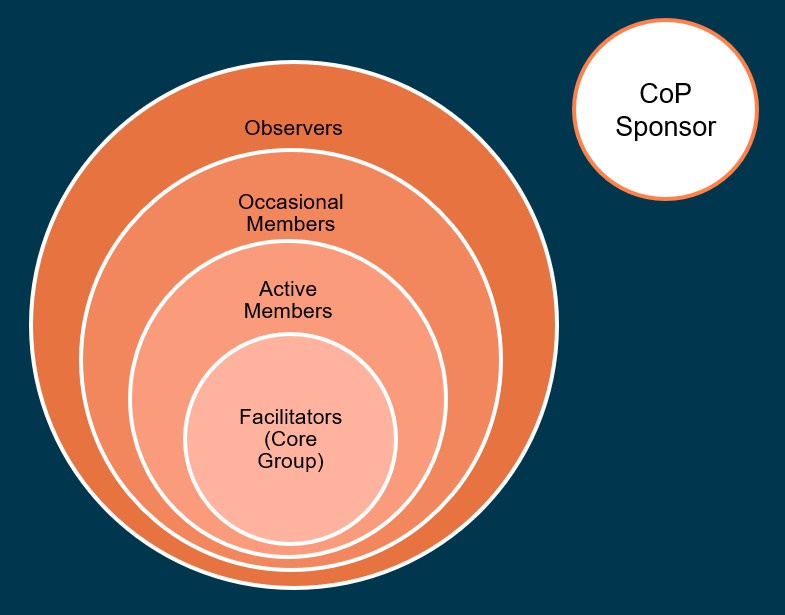
For a CoP to be effective it requires a critical mass of engaged participants. There are several different roles members can have based on their level of involvement in the CoP:
- Facilitator/s - Guide and coordinate the CoP by organising meetings and activities, driving participation, and keeping the group focused on its objectives.
- Active Members - Regularly participate in discussions, share knowledge and experiences, contribute ideas, and help drive the CoPs outcomes and work.
- Occasional Members - Engage with the CoP on an as-needed basis, attending selected meetings and activities and contribute then topics align with their interests and experiences.
- Observers - Follows the work of the CoP to stay informed and benefit from its outputs but don't engage and participate in meetings and discussion/
- Sponsor/s - Provides strategic support, advocacy, and sometimes resources for the CoP, helping ensure its visibility and legitimacy within the organisational management structure.
- Further Reading
-
Bicchi, F. (2024) ‘Cultivating Communities of Practice: From Institutions to Practices’, Global Studies Quarterly, 4(1), ksad076. Available at: https://doi.org/10.1093/isagsq/ksad076.
Bourhis, et al. (2005) ‘The success of virtual communities of practice: The leadership factor’, E J Knowl Manag, 3.
Cox, M.D. (2013) ‘The impact of communities of practice in support of early-career academics’, International Journal for Academic Development, 18(1), pp. 18–30. Available at: https://doi.org/10.1080/1360144X.2011.599600.
McDonald, J. and Cater-Steel, A. (eds.) (2017) Communities of Practice: Facilitating Social Learning in Higher Education. 1st ed. 2017. Singapore: Springer Nature Singapore.
Ng, L.L. and Pemberton, J. (2013) ‘Research-based communities of practice in UK higher education’, Studies in Higher Education, 38(10), pp. 1522–1539. Available at: https://doi.org/10.1080/03075079.2011.642348.
Ortquist-Ahrens, L. and Torosyan, R. (2009) ‘The role of the facilitator in faculty learning communities: Paving the way for growth, productivity, and collegiality’, Learning Communities Journal, 1.
Wenger-Trayner, E. and Wenger-Trayner, B. (2015) An Introduction to Communities of Practice: A Brief Overview of the Concept and Its Uses. Available at: https://www.wenger-trayner.com/introduction-to-communities-of-practice.
Wisker, G., Robinson, G. and Shacham, M. (2007) ‘Postgraduate research success: communities of practice involving cohorts, guardian supervisors and online communities’, Innovations in Education and Teaching International, 44(3), pp. 301–320. Available at: https://doi.org/10.1080/14703290701486720.
Establishing and Maintaining a Community of Practice
- Starting a Community of Practice
-
Most Communities of Practice (CoPs) emerge organically when a shared challenge or need becomes apparent among individuals who perform similar roles or tasks. Often, people do not realise they have formed a CoP while actively participating in one. To establish a Community of Practice, it usually takes one individual to identify an area where practice could be improved and bring this issue to colleagues facing similar challenges in their work. Once there is buy-in from peers, the foundations of a Community of Practice are in place.
Organisations may also recognise the value of collective problem-solving, knowledge sharing, and cultural development, and therefore intentionally support or cultivate Communities of Practice. These are typically classified as either intentional or nurtured CoPs.- An intentional Community of Practice is created when an organisation identifies a specific problem or opportunity and actively establishes a community to address it. This may involve advertising the community, allocating resources, and appointing sponsors or facilitators to help maintain and support its activities.
- A nurtured Community of Practice, on the other hand, develops more organically but receives active support from the organisation. While the organisation may suggest potential areas of focus and provide resources or encouragement, it does not direct or control the community's agenda to the same extent as an intentional CoP.
- Structure and Format
-
While CoPs vary in size, structure, and purpose, evidence shows that the most successful and effective CoPs have a semi-structured format that combine intentional design with flexibility. Consider these core principles when you are planning and designing your CoP:
- Clarity of purpose: Each session should have a defined focus or guiding question
- Flexibility: Participants should be able to explore related topics where appropriate
- Consistency: Regular scheduling supports habit formation and ongoing engagement
- Time-bounded sessions: Meetings should be structured to respect participants’ time
- Facilitated discussion: A facilitator helps maintain direction and inclusivity
Example of a CoP Meeting Structure:
Opening (5–10 minutes)
- Welcome and introductions (if needed)
- Outline of the session topic and objectives
- Brief framing or context-setting
Focused Discussion (30–50 minutes)
- Introduction of a prompt, question, or case study
- Structured discussion guided by the facilitator
- Exploration of experiences, challenges, and approaches
Open Discussion (15–20 minutes)
- Opportunity to raise related issues or expand on themes
- Space for participant-led contributions
Closing and Reflection (5–10 minutes)
- Summary of key points and insights
- Identification of practical takeaways or next steps
- Agreement on potential future topics
- Facilitating a Community of Practice
-
Good facilitation is key for the successful operation of a Community of Practice with the facilitator’s primary role being not to lead and direct content, but rather to enable productive and meaningful discussion.
Good facilitation is key to the successful operation of a Community of Practice (CoP). The facilitator’s primary role is not to lead or direct the content of discussions, but to create the conditions for productive and meaningful participation. By encouraging engagement, fostering collaboration, and supporting knowledge exchange, facilitators help ensure that the CoP remains active, relevant, and valuable to its members. Other core responsibilities of the Facilitator include:
- Maintain focus on the session’s purpose
- Support balanced participation
- Encourage constructive and respectful dialogue
- Help the group identify key insights and outcomes
Some best practices for facilitators include:
Active Listening
- Demonstrate attentiveness through verbal and non-verbal cues
- Reflect or summarise contributions to confirm understanding
- Avoid interrupting or prematurely redirecting discussion
Encouraging Participation
- Use open-ended questions to prompt reflection
- Invite contributions from quieter participants
- Allow time for participants to think before responding
Managing Group Dynamics
- Be aware of dominant voices and ensure space for others
- Gently steer discussion back to topic when needed
- Acknowledge differing perspectives and find common ground
Maintaining Direction
- Keep discussion aligned with the session’s objectives
- Allow relevant deviations, but avoid sustained drift
- Highlight connections between contributions
Focusing on Outcomes
- Draw attention to practical insights or emerging themes
- Encourage participants to reflect on how discussions apply to their work
- Summarise key takeaways at the end of the session
- Cultivating a Welcoming Environment
-
A positive and welcoming environment is important for encouraging participation and sustaining engagement within a Community of Practice. Participants should feel comfortable contributing, regardless of their level of experience or confidence and at the same time they should not feel pressured into contributing every session. Sitting in and listening to discussion is also valid engagement with the CoP community. The below outline is a good starting point for facilitators on how to make their CoP inclusive and welcoming:
Setting the Tone
- Adopt a semi-formal, approachable style that balances professionalism with openness
- Clearly communicate that all contributions are valued
- Establish a shared understanding of respectful discussion
Supporting Participation
- Encourage contributions from all participants, without pressure
- Allow space for reflection before responses
- Offer different ways to engage (e.g. speaking, chat functions, follow-up input)
Building Trust and Engagement
- Be consistent in tone and structure across sessions
- Acknowledge and build on participants’ contributions
- Avoid dismissing or overlooking ideas
- Encourage constructive discussion rather than critique of individuals
Practical Considerations
- Schedule sessions at accessible times where possible
- Provide clear information in advance (e.g. topic, format)
- Ensure online or hybrid participation options where appropriate
- Utilise the University Dignity at Work and Study toolkit in your facilitation practice
- Promotion and Engagement
-
Good promotion is key for growing and sustaining a Community of Practice. Utilise University of Aberdeen Commination channels like Staff Hub, MS Teams groups and email lists. Don't forget the power of word of mouth. Straightforward communication helps ensure that potential participants understand the purpose and value of the promoted group. Promotional materials and copy should emphasise that:
- CoPs provide practical, relevant benefits to participants roles and development
- Sessions are structured and purposeful, not purely social
- Sessions are also collaborative and participation-driven
- Topics are relevant to participants experiences and challenges
Once your CoP has a critical mass of members you will need to sustain engagement. The best way to do this is by continuously demonstrating the value created by the CoP by publishing information on activities and publicly sharing best practices and other forms of outputs with the University. Other ways to keep members engage include:
- Maintain a consistent schedule and format
- Adapt topics in response to participant needs
- Encourage ongoing input into session themes
- Foster a sense of shared ownership within the group
- Evaluation and Continuous Improvement
-
Opportunities for reflection and improvement should be embedded within all Communities of Practice in order to ensure their ongoing effectiveness and relevance. Regular evaluations help determine whether a CoP should continue operating, adapt its focus, or conclude naturally due to either declining engagement or the successful achievement of its objectives. The following considerations are a good starting point for evaluating and reflecting on the progress and effectiveness of a CoP.
Some good ways to gather information on the impact and success of the CoP would be to:
- Regularly gather informal feedback from participants
- Use short surveys periodically to assess value creation and interest
- Keep track of attendance and engagement patterns
- Encourage open discussion of feedback during sessions and activities
When reflecting on the success of a CoP the most important questions to ask would be:
- Has the CoP achieved its mission and objective? (e.g. Have the needs and challenges that prompted the creation of the CoP been addressed?)
- Has the CoP created value for its participants? (e.g. Have members benefited from their participation through learning, collaboration, networking and/or professional development? Did participants perceive the CoP as a worthwhile use of their time?)
- Has the CoP had a positive impact on its domain of practice? (e.g. Can tangible examples of positive influence be identified? Has the CoP contributed to improving knowledge sharing, best practice development, and/or problem-solving within the identified domain?)
- Organisational Support for Communities of Practice
-
While Communities of Practice (CoPs) are typically peer-developed, member-led, and operate largely outside the University's formal organisational structure, there are a range of University resources and support services available to assist with organising and sustaining your CoP.
Rooms and Facilities
The University provides a variety of rooms and facilities that can be booked for CoP meetings, workshops, and events. Further information is available through the University's Room Bookings website. Individual Schools may also have meeting rooms available for booking; please contact your School's administrative team for guidance on local arrangements.
Communications Support
Staff can utilise StaffHub and other University communication channels to promote their Communities of Practice, advertise events, and share announcements. You can submit request by using the dedicated MS Form available via StaffHub
Dignity at Work and University Policies
Community members are expected to always treat one another with respect and fairness. Although CoPs are informal and member-led, they remain subject to the University's policies, procedures, and behavioural expectations.
All University policies can be accessed through Policy Zone. The Dignity at Work and Study Toolkit is also available for staff to utilise.School-Level Support
Communities of Practice that are focused on a particular School or discipline may wish to speak with their Head of School and School Administration Manager about any support that may be available locally. This might include access to meeting spaces, assistance with communications and event promotion, or other practical support to help establish and sustain the Community of Practice.
Funding and Other Support
While there is currently no dedicated funding stream specifically for Communities of Practice, there may be opportunities to access financial or in-kind support depending on your CoP's area of focus.
- For example, PGR students who wish to establish or sustain a Community of Practice that benefits the wider PGR community may be eligible to apply for support through the PGR Community Fund.
In addition, the PGR College may be able to offer access to community spaces and provide other forms of practical support. PGR students are encouraged to contact the College directly to discuss available opportunities.
- For example, PGR students who wish to establish or sustain a Community of Practice that benefits the wider PGR community may be eligible to apply for support through the PGR Community Fund.