
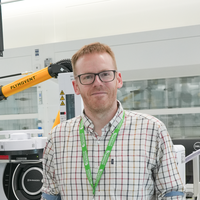
BSc, PhD, MRSC
Senior Lecturer
- About
-
- Email Address
- a.mccue@abdn.ac.uk
- Office Address
- School/Department
- School of Natural and Computing Sciences
Biography
I recieved both my undergraduate and postgraduate degrees from the University of Aberdeen. I am heavily involved in the Department of Chemistry's undergraduate and postgraduate teaching and am the programme director our MSc in 'Chemistry for Sustainable Energy'.
My research interests lie in the field of heterogeneous catalysis, with a particular emphasis on how activity and selectivity of hydrogenation catalysts can be manipulated by careful design. Catalytic materials of interest include supported metal catalysts, metal sulfides and metal phosphides. I am also broadly interested in carbon capture, storage and utilisation. I am also passionate about outreach work and enjoy working with schools.
Qualifications
- BSc Chemistry2008 - University of Aberdeen
- PhD Chemistry2012 - University of Aberdeen
Memberships and Affiliations
- Internal Memberships
-
Academic Line Manager for Chemistry (Head of Department).
Programme director - Chemistry for Sustainable Energy MSc
- External Memberships
-
Member of the Royal Society of Chemistry
Latest Publications
Melamine-doped plastic-derived adsorbents for carbon capture: the influence of plastic type on textural properties and CO2 uptake
Journal of CO2 Utilization, vol. 102, 103262Contributions to Journals: ArticlesRoadmap for enhanced CO2 transfer hydrogenation with bio-derived glycerol over Ni-zeolite catalysts: Influence of zeolite structure and Si/Al ratio
Journal of CO2 Utilization, vol. 101, 103199Contributions to Journals: ArticlesStructural and Surface Modifications of Zeolite to Tailor Its Catalytic Properties
ChemistrySelect, vol. 10, no. 38, e04324Contributions to Journals: Review articles- [ONLINE] DOI: https://doi.org/10.1002/slct.202504324
- [ONLINE] View publication in Scopus
Microwave Heating as an Energy-Efficient Route for Waste Valorisation and Carbon Capture: Invited Keynote
Contributions to Conferences: Oral PresentationsOn the potential of microwave heating to convert waste into added-value chemicals and materials: a review
The Royal Society Scientific Meeting on Microwave Science in Sustainability, 20240071Contributions to Journals: Review articles
- Research
-
Research Overview
My principle research interests lie in the field of heterogeneous catalysis, with a particular emphasis on how activity and selectivity of hydrogenation catalysts (typically supported metals) can be manipulated by careful design. This can be achieved by a number of methods which include:
- Alloy formation and controlling surface composition
- Modifying surface properties by adsorption of organic ligands
- Incorporation of an inorganic element to change the structure (i.e., Pd + S)
Prepared catalysts can be characterised by a number of different techniques which range from routine (i.e., XRD, microscopy, physisorption or chemisorption) to more specialised (i.e., in-situ FTIR, temperature programmed methods and XAS). Catalyst performance is then evaluated by testing in either the liquid or gas phase at either ambient or elevated pressure/temperature. The most common reaction of interest is the selective hydrogenation of an alkyne to an alkene without over-hydrogenation to the alkane. This is a process of importance with regards to polymer production (i.e., polyethylene or polypropylene) and commodity chemicals in a number of areas.
Other reactions of interest include CO2 hydrogenation and biomass utilisation. This interest therefore includes the general theme of carbon capture, utilisation and storage. Within this area I am interested in the preparation of materials for carbon capture (i.e., gas separation) as well as the catalytic conversion of CO2.
Research Areas
Accepting PhDs
I am currently accepting PhDs in Chemistry.
Please get in touch if you would like to discuss your research ideas further.

Current Research
- Selective alkyne hydrogenation
- Development of CO2 hydrogenation catalysts
- Catalysts for biomass upgrading
- New and improved materials for gas separation
Funding and Grants
Industrial Biotechnology Innovation Centre - Separation of Organic Platform Chemicals from Spent Lees
UKRI New Horizons - New route to zero carbon hydrogen (with Lancaster University as PI)
UK Catalysis Hub - Plasma-catalytic upgrading of biogas (with Dr Panos Kechagiopoulos as PI)
ScotChem - ATR for FTIR
UK Catalysis Hub - A supported molten-salt membrane reactor (with Newcastle University as PI & Glasgow University as CI)
Royal Society of Chemistry - Combining pulse chemisorption and FTIR into a single low-cost measurement
Carnegie Trust - Palladium sulphide as a hydrogenation catalyst
- Teaching
-
Programmes
- Postgraduate, 3 semester, September start
- Postgraduate, 3 semester, January start
- Undergraduate, 5 year, September start
- Undergraduate, 4 year, September start
Courses
Graduate employability
Topic - Carbon Capture
Topic - Heterogeneous Catalysis
Topic - Catalysis
Topic - Employability
Topic - Hydrogen Generation & Liquid Storage
Topic - Renewable Chemical Production
Theme - Employability
Entire course - all aspects of Carbon Capture, Storage & Utilisation (CCSU)
Topic - Various lab experiments
Topic - Exploring sustainability within a business setting
Teaching Responsibilities
I currently coordinate our Chemistry for Sustainable Energy MSc. This programme gives students a high level understanding in the areas of electrochemical conversion devices (such as battery and fuel cell technology), carbon capture technologies and the hydrogen economy, amongst other topics.
- Publications
-
Page 2 of 4 Results 26 to 50 of 80
Investigation of support effects during ethanol steam reforming over a Ni/Sepiolite catalyst
Reaction Chemistry & Engineering , vol. 8, no. 12, pp. 2984-2999Contributions to Journals: ArticlesDevelopment of sustainable adsorbents for post combustion carbon capture using conventional and microwave heating
Chapters in Books, Reports and Conference Proceedings: Conference ProceedingsInfluence of microwave activation time on CO2 uptake capacity of PET-derived adsorbents
Chapters in Books, Reports and Conference Proceedings: Conference ProceedingsMetal-Organic Framework-Derived Ni-S/C Catalysts for Selective Alkyne Hydrogenation
ACS Applied Materials & Interfaces, vol. 15, no. 41, pp. 48135–48146Contributions to Journals: ArticlesSelective hydrogenation of stearic acid to stearyl alcohol over cobalt alumina catalysts
Applied Catalysis A: General, vol. 666, 119437Contributions to Journals: ArticlesCheap, Green, and Efficient: Microwave-assisted production of value-added carbons from ‘real-world’ mixed plastics for CO2 capture
UoA Interdisciplinary Challenge Open SessionContributions to Conferences: PostersPost-combustion CO2 application of sustainable hybrid adsorbent derived from bio-conjugated amino acid on MCM-41
UoA Interdisciplinary Challenge Open SessionContributions to Conferences: PostersGlucose isomerisation into fructose over alkali/alkaline-earth metal-supported NaY zeolites
David Jackson Retiral MeetingContributions to Conferences: PostersTransfer hydrogenation of carbon dioxide with bio-derived glycerol over zeolite-based catalysts
Contributions to Conferences: Oral PresentationsMelamine-Doped PET-derived Adsorbents for Post-Combustion CO2 Capture
Contributions to Conferences: Oral PresentationsFeasibility of amino acid functionalized mesoporous silica synthesis and application for post-combustion CO2 capture
Contributions to Conferences: Oral PresentationsMelamine-Doped PET-Derived Adsorbents for Post-combustion CO2 Capture
Contributions to Conferences: Oral PresentationsSelectivity of reaction pathways for green diesel production towards biojet fuel applications
RSC Advances, vol. 13, no. 20, pp. 13698-13714Contributions to Journals: Review articles- [ONLINE] DOI: https://doi.org/10.1039/d3ra02281a
- [OPEN ACCESS] http://aura.abdn.ac.uk/bitstreams/b8c3dcb1-4752-480a-8034-7505c0e25c1a/download
- [ONLINE] View publication in Scopus
Sustainable microcrystalline cellulose-based activated carbons for a greener carbon capture at post-combustion conditions
International journal of greenhouse gas control, vol. 125, 103876Contributions to Journals: ArticlesUnderstanding the Role of Coordinatively Unsaturated Al3+ Sites on Nanoshaped Al2O3 for Creating Uniform Ni–Cu Alloys for Selective Hydrogenation of Acetylene
ACS Catalysis, vol. 13, no. 3, pp. 1952-1963Contributions to Journals: Articles- [ONLINE] DOI: https://doi.org/10.1021/acscatal.2c06091
- [OPEN ACCESS] http://aura.abdn.ac.uk/bitstreams/d75dba49-fc30-4451-bb22-774444699c7e/download
- [ONLINE] View publication in Scopus
Mitigating catalyst deactivation in selective hydrogenation by enhancing dispersion and utilizing reaction heat effect
AIChE Journal, vol. 69, no. 2, e17874Contributions to Journals: Articles- [ONLINE] DOI: https://doi.org/10.1002/aic.17874
- [OPEN ACCESS] http://aura.abdn.ac.uk/bitstreams/9d511d86-9dc9-4975-bdcb-92759757a505/download
Development of Sustainable Adsorbents for Post Combustion Carbon Capture: Conventional vs. Microwave-Assisted Activation
Chapters in Books, Reports and Conference Proceedings: Conference Proceedings- [ONLINE] DOI: https://doi.org/10.5281/zenodo.10125116
- [OPEN ACCESS] http://aura.abdn.ac.uk/bitstreams/72572e06-ce20-4ec4-93bb-db0fcf2aae06/download
- [ONLINE] View publication in Scopus
Supported Pt Enabled Proton-Driven NAD(P)+ Regeneration for Biocatalytic Oxidation
ACS Applied Materials & Interfaces, vol. 14, no. 18, pp. 20943-20952Contributions to Journals: ArticlesHighly Selective and Stable Isolated Non-Noble Metal Atom Catalysts for Selective Hydrogenation of Acetylene
ACS Catalysis, vol. 12, no. 1, pp. 607-615Contributions to Journals: Articles- [ONLINE] DOI: https://doi.org/10.1021/acscatal.1c04758
- [OPEN ACCESS] http://aura.abdn.ac.uk/bitstreams/d6babcb6-acc3-46cb-a98c-1fa8a1039519/download
- [ONLINE] View publication in Scopus
Directing the H2-driven Selective Regeneration of NADH via Sn-doped Pt/SiO2
Green Chemistry, vol. 24, no. 4, pp. 1451-1455Contributions to Journals: ArticlesMetal Phosphides and Sulfides in Heterogeneous Catalysis: Electronic and Geometric Effects
ACS Catalysis, vol. 11, no. 15, pp. 9102–9127Contributions to Journals: Review articlesAdsorbate-Induced Structural Evolution of Pd Catalyst for Selective Hydrogenation of Acetylene
ACS Catalysis, vol. 10, no. 24, pp. 15048–15059Contributions to Journals: Articles- [ONLINE] DOI: https://doi.org/10.1021/acscatal.0c03897
- [OPEN ACCESS] http://aura.abdn.ac.uk/bitstreams/1cf9c5bc-b02c-439a-83a5-a1b5883ea197/download
- [ONLINE] View publication in Scopus
Rapid scan FTIR reveals propane (am)oxidation mechanisms over Vanadium based catalysts
Journal of Catalysis, vol. 390, pp. 72-80Contributions to Journals: Articles- [ONLINE] DOI: https://doi.org/10.1016/j.jcat.2020.07.031
- [OPEN ACCESS] http://aura.abdn.ac.uk/bitstreams/99655043-0cff-436d-89f0-4a3adcc46d4a/download
- [ONLINE] View publication in Scopus
Comparison of Pd and Pd4S based catalysts for partial hydrogenation of external and internal butynes
Journal of Catalysis, vol. 383, pp. 51-59Contributions to Journals: Articles- [ONLINE] DOI: https://doi.org/10.1016/j.jcat.2020.01.010
- [OPEN ACCESS] http://aura.abdn.ac.uk/bitstreams/ed94db29-d913-4d47-8bac-a26cd466275f/download
- [ONLINE] View publication in Scopus
Influence of pretreatment on surface interaction between Cu and anatase-TiO2 in the simultaneous photoremediation of nitrate and oxalic acid
Journal of Environmental Chemical Engineering, vol. 7, no. 2, 103029Contributions to Journals: Articles


