

How AUCEL researchers are linking local experiences to global energy transition and climate debates.
Although separated by geography, Khana, Aberdeenshire, Eti-Osa, and Port Harcourt share a common significance in contemporary energy transition and climate governance debates. These locations formed the basis of two research outputs recently presented by AUCEL researchers Tayo Gbemi and Belema Ibim at international academic events in Scotland and South Africa.
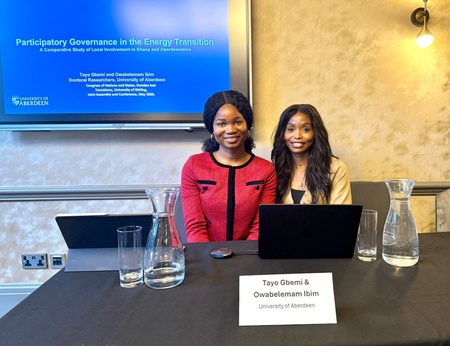
The first of these studies focused on Khana and Aberdeenshire and examined how local communities engage with energy transition processes in two distinct governance contexts. In May 2026, the researchers presented their findings in a paper titled “Participatory Governance in the Energy Transition: A Comparative Study of Local Involvement in Khana and Aberdeenshire,” at the Congress of Nations and States and Dundee Just Transitions Joint Assembly and Conference. The event, held in Dundee, convened indigenous peoples, minority communities, academics, and practitioners to discuss the interconnected challenges of environmental degradation, climate change, human rights, and community participation.
Their paper examined how local communities engage with energy transition processes in Khana Local Government Area in Nigeria and Aberdeenshire in Scotland. Using these case studies, the research analysed the commonalities and differences in participatory approaches across the Global South and Global North. The paper has been earmarked for publication in the University of Stirling Human Rights Journal.
The connection between local governance and global climate objectives was also explored in another research output that focused on decentralised, multi-level climate governance using case studies of Eti-Osa and Port Harcourt Local Government Areas. Their book chapter, “Integrating Global Climate Objectives into Local Policies: An Analysis of Climate Action Plans in Nigerian Municipalities through a Case Study of Eti-Osa and Port Harcourt Local Government Areas,” was presented by Ms Ibim on behalf of both authors at an author’s workshop funded and hosted by The South African Research Chair in Cities, Law and Environmental Sustainability (SARChl CLES) within the Faculty of Law, North-West University in Potchefstroom, South Africa, from 27 to 29 May 2026. In attendance were the editors of the book and other co-authors, comprising professors, researchers and interdisciplinary experts. The chapter forms part of the forthcoming volume, Research Companion on Local Governments and Climate Change Governance in Africa.
These research outputs illustrate the contribution of cross-jurisdictional research to understanding governance challenges and opportunities associated with community participation, energy transitions, and climate policy implementation.
As energy and climate challenges increasingly transcend national borders, AUCEL continues to champion research that connects diverse jurisdictions and perspectives to advance international discussions on just transitions, climate governance, and environmental justice.