
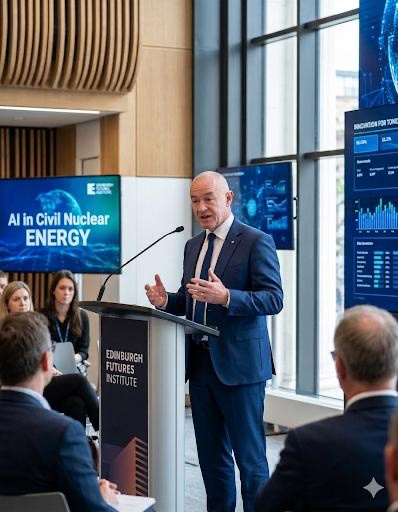

AUCEL PhD Researcher Andrew Walters presented at the JEL Workshop, “‘New’ Environmental Problems: From AI to Removals,” held at the Edinburgh Futures Institute on the 16th April, as part of a panel examining the integration of AI into environmental and energy‑transition governance; the discussion drew a strong interdisciplinary audience and generated constructive engagement on regulatory risk, institutional capacity, and future research directions, with particularly useful feedback from legal and policy scholars working at the intersection of AI, infrastructure, and environmental decision‑making.
Andrew's paper — “AI in Civil Nuclear Energy: Threats, Legal Challenges, and International Regulatory Pathways” — examines a question that I believe will define the next chapter of international nuclear governance: what happens when autonomous algorithmic systems begin participating in safety-critical regulatory reasoning at nuclear installations? One finding that generated particular interest from the environmental law community: the doctrinal tension between the EU AI Act’s distributed compliance obligations and the nuclear liability conventions’ channelling principle. When an AI provider’s regulatory non-compliance is the proximate cause of a nuclear incident, the channelling principle shields the defaulting party from civil liability — a structural misalignment that neither framework was designed to address.
Interested in pursuing a PhD in Law? Find information on PGR opportunities and how to apply here.