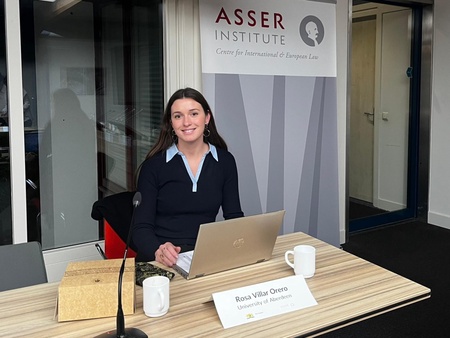

Hallam Burnapp, a doctoral researcher at the Law School and Aberdeen Centre for Constitutional and Public International Law who is specialising in space and cybersecurity law, recently attended and presented at the International Astronautical Congress (IAC) 2025 in Sydney, Australia — the world’s largest annual gathering of space professionals, policymakers, and researchers.
Hallam presented three academic papers.
The first presentation,“AI-driven cybersecurity for satellite systems: Simulating attacks, legal accountability, and strategic stability in space”, explored how artificial intelligence can both enhance and challenge the security of satellite infrastructures, as well as legal accountability in this critical domain.
The two other papers were co-authored with Dr Maria Maonoli. The first, presented during the International Institute of Space Law (IISL) session on Small Satellites, examined the following topic:“Private space entities, satellite constellations, and the public-private divide in international state responsibility for space activities: Towards a paradigm shift?” The paper interrogated how the rapid growth of private satellite constellations is reshaping traditional notions of state responsibility under international space law.
The last presentation, “From Sputnik I to SpaceX: The evolution of space governance from state-centered law to actor-centered norms of behavior,” was delivered during the International Academy of Astronautics (IAA) History of Astronautics Symposium. It traced the transformation of global space governance from the Cold War to today’s increasingly diversified ecosystem of actors and norms.
Reflecting on the experience, Hallam described the IAC 2025 as “a real pleasure — an incredible opportunity to share research, connect with colleagues across disciplines, and be part of conversations shaping the future of space governance.”