
Human language allows us to communicate our thoughts to others. The process of producing language seems fast and easy when you use your first (or “native”) language to communicate. For many of us, it’s only when we need to switch to a different language – e.g., alanguage that we use less often or a language that we tried learning but do not feel comfortable using yet – that we notice that producing language is not as simple as it mightfirst seem.
One of the differences we might notice is in our ability to plan what we want to say. How far ahead do we tend to plan? Researchers agree that we rarely prepare everything we want to say ahead of time. Instead, we prepare our utterances incrementally, i.e., in small increments or chunks. This means that, to produce an utterance that consists of several increments, we typically need to think and speak “at the same time”: when we start producing the first chunk that we have prepared, we are already busy preparing what we are going to say next.
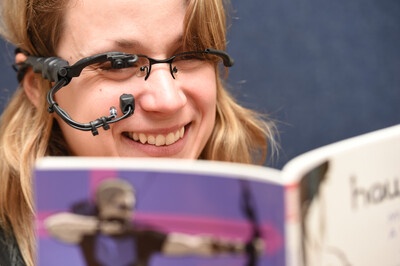
In the lab, we can track this interleaving of thinking and speaking by asking participants to produce language (for example, to describe pictures of simple events) while we track their eye movements. Tracking a participant’s eye movements tells us what information they are encoding with priority at different points in time. Dr Konopka’s research shows the timing of utterance preparation is different when participants use their first language (which is often their stronger or dominant language) and when they use a second language (which is often a weaker language) to communicate. When we use our stronger language, we are more likely to prepare our utterances in small increments. This is because it is relatively easy to prepare such increments on the fly and to keep preparing new increments while speech is already underway – i.e., to think and speak “at the same time”. It is more difficult to do this in a weaker language, whereproduction costs and the potential for errors ishigher. Thus, to maintain fluency, speakersprepare larger chunks when they use a weaker language.
Interestingly, because our cognitive system is remarkably adaptive, the same speakers can adopt different planning strategies in different production contexts. For example, we switch to preparing smaller chunks when we speak under time pressure. Planning strategies can also differ across languages that have different grammatical requirements: for example, some languages (like English) have relatively strict word order, while other languages allow more structural flexibility. Understanding the consequences of such cross-linguistic differences for language production is an important aspect of understanding how language “works”.
Read more about this research here.
Dr Agnieszka Konopka, School of Psychology