
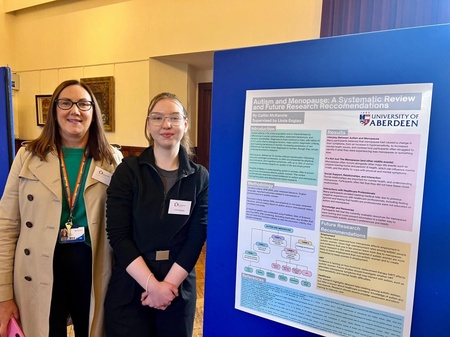
Caitlin McKenzie, a third-year Neuroscience and Psychology student, completed a summer internship project titled “Do Autistic Women Experience Menopause Differently?" Caitlin carried out this project under the supervision of Linda Engles, CPsychol (School of Psychology) and Dr Shannon Babbie (School of Education). Find out about their findings below.
Introduction
Menopause is an important and inevitable life stage for most women, transgender men and non-binary people assigned female at birth; however, until recently, there was little research looking into how autistic women experience menopause. Do they experience it differently from neurotypical women? Do they have different symptoms, or do they have more severe symptoms? To investigate this, I conducted a systematic review with the aim of collecting and analysing the existing research and highlighting areas for further study. This review was the result of my 2025 summer internship. Throughout the internship I was able to improve my skills and confidence in researching, in reading and evaluating papers and in writing, I was given the opportunity to present my findings to an audience of researchers which helped my confidence in presenting and public speaking.
The Findings
Of the nine studies that were included, six used interviews, focus groups, or surveys to collect participant experiences and analysed the data using thematic analysis (which involved identifying and analysing recurring themes in the data). One was a retrospective cohort study that analysed patient data from medical files and two quantitatively analysed participant symptoms for occurrence and severity. From this, I organised the results into five themes.
- The interplay between autism and menopause
A key finding in the literature was how many women felt that their symptoms of menopause and their autism traits were intertwined, with one affecting the other. As a result, they sometimes felt unable to determine whether a symptom or feeling was due to menopause or autism.
In interviews, focus groups, and surveys, many participants believed that menopause had caused a change in their autism traits, which ranged from heightened hypersensitivity to increased mental health issues. Some participants described how this additional hypersensitivity affected their everyday lives, including their relationships and mental health. An interesting finding was the numbers of participants who were diagnosed after menopause onset; in three of the studies some participants cited menopause as a factor in recognising that they were autistic.
In interviews, participants also described how some menopause symptoms, such as ‘brain fog’, could be debilitating - negatively impacting their employment, mental health, and daily life. Qualitative studies comparing symptoms between menopausal autistic women and non-autistic women found that autistic women may experience more severe menopause symptoms than non-autistic women; the autistic participants reported higher rates of psychological and physical symptoms.
Many participants described the worsening of preexisting mental health issues or the development of new mental health issues. The most commonly cited were depression and anxiety. An analysis of US medical data showed that autistic menopausal women have a 41% higher instance of anxiety and a 44% higher instance of depression than non-menopausal autistic women. Combined with evidence that autistic women experience more psychological symptoms during menopause than neurotypical women, this suggests that menopause may play a stronger causal role in worsening or triggering mental health issues in autistic women than it does in neurotypical women.
- 2. It’s not just the menopause (and other midlife events)
Participants highlighted how menopause often occurs alongside other major life events, such as children leaving home and parents' ill health, which can influence mental health and the ability to cope with physical and mental symptoms. Some participants had to reduce the hours they worked, or leave their jobs completely, due to the detrimental effects of menopause.
- 3. Social support, relationships, and interaction
This theme highlighted the importance of social relationships for mental health and for shaping how women experience menopause. When comparing the experiences of autistic and non-autistic women, both groups described how close friendships and relationships were important to them, but only participants in the autistic group described how they felt that they lacked those close social bonds. Some of the autistic participants reported how they withdrew from friends, partners and family due to menopause.
- 4. Interactions with healthcare professionals
Another key finding from interviews and focus groups was that many autistic women had complex relationships with, and negative feelings towards, healthcare professionals, such as GPs, nurses or consultants.
For participants that had sought medical help, they often found that there were significant barriers leading to psychological distress, or delayed and avoided treatment. However, many participants described avoiding or delaying seeking medical help, citing previous negative experiences with healthcare professionals. Common experiences included feeling ignored, dismissed, or belittled by doctors. Some participants believed that being autistic was a factor in this, causing healthcare providers to not take them seriously. Participants also described how they felt that healthcare professionals were not sufficiently educated on autism (especially autism in women), or on menopause. In a survey, 95.8% of participants felt that primary care staff didn’t seem to understand how autism could affect the experience of menopause.
- 5. Knowledge and resources
The final theme outlined how many participants felt that currently available resources for menopause were lacking. Information could be improved by presenting it in a way that accommodated autistic women’s preferences and needs, for example making the language less emotive and more objective. Many participants expressed that they were uninformed about many aspects of menopause, such as what perimenopause was, that some women may experience heavier or irregular periods during perimenopause, and about some of the more infrequent symptoms.
The Implications
This review highlighted that autistic women may experience menopause symptoms differently than neurotypical women and may experience more severe, or more debilitating, symptoms. Menopause may trigger the development of new autism traits or change preexisting ones and could be a factor in the development of, or worsening, mental health issues. Many autistic women reported feeling let down by healthcare professionals and, therefore, were unable to receive the quality of care they require. The currently available resources about menopause are lacking, and are non-existent for autistic menopause women. The research completed so far represents the first step on a long journey, and sets the stage for further research to investigate the role of hormone replacement therapy (HRT) in negating some of the negative symptoms autistic women experience, how to keep menopausal autistic women in employment, and to understand why so many autistic women are not receiving the medical care they require.
References
Benevides, T. W., Cook, B., Klinger, L. G., McLean, K. J., Wallace, G. L., Carey, M. E., Lee, W., Ventimiglia, J., Schiff, L. D., & Shea, L. (2024). Brief Report: Under-Identification of Symptomatic Menopause in Publicly Insured Autistic People. Journal of Autism and Developmental Disorders. https://doi.org/10.1007/s10803-024-06516-x
Brady, M. J., Jenkins, C. A., Gamble-Turner, J. M., Moseley, R. L., Van Rensburg, M. J., & Matthews, R. J. (2024). “A perfect storm”: Autistic experiences of menopause and midlife. Autism, 28(6), 1405–1418. https://doi.org/10.1177/13623613241244548
Charlton, R. A., Happé, F. G., Shand, A. J., Mandy, W., & Stewart, G. R. (2025). Self-Reported Psychological, Somatic, and vasomotor symptoms at different stages of the menopause for autistic and non-autistic people. Journal of Women’s Health. https://doi.org/10.1089/jwh.2024.0784
De Visser, R. O., Moseley, R., Gamble-Turner, J., Hull, L., Sedgewick, F., Featherstone, C., Obe, C. Q., Freeman, E., & Karavidas, M. (2024). Unmet need for autism-aware care for gynaecological, menstrual and sexual wellbeing. Autism. https://doi.org/10.1177/13623613241290628
Groenman, A. P., Torenvliet, C., Radhoe, T. A., Van Rentergem, J. A. A., & Geurts, H. M. (2021). Menstruation and menopause in autistic adults: Periods of importance? Autism, 26(6), 1563–1572. https://doi.org/10.1177/13623613211059721
Karavidas, M., & De Visser, R. O. (2021). “It’s not just in my head, and it’s not just irrelevant”: Autistic negotiations of menopausal transitions. Journal of Autism and Developmental Disorders, 52(3), 1143–1155. https://doi.org/10.1007/s10803-021-05010-y
Moseley, R. L., Druce, T., & Turner‐Cobb, J. M. (2020a). Autism research is ‘all about the blokes and the kids’: Autistic women breaking the silence on menopause. British Journal of Health Psychology, 26(3), 709–726. https://doi.org/10.1111/bjhp.12477
Moseley, R. L., Druce, T., & Turner-Cobb, J. M. (2020b). ‘When my autism broke’: A qualitative study spotlighting autistic voices on menopause. Autism, 24(6), 1423–1437. https://doi.org/10.1177/1362361319901184
Piper, M. A., & Charlton, R. A. (2025). Common and unique menopause experiences among autistic and non-autistic people: A qualitative study. Journal of Health Psychology. https://doi.org/10.1177/13591053251316500