
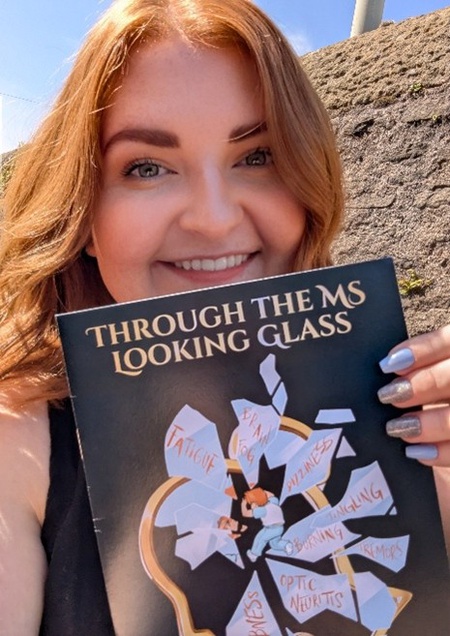

Claire Robertson is a third-year interdisciplinary PhD student in the School of Psychology. Her PhD research focuses on evaluating public health comics as a means of delivering accessible, engaging health information, and is supervised by Professor Ben Tatler, Professor Chris Murray (University of Dundee) and Dr Clare Kirtley. In Claire’s project Comics & Health: Informing and Evaluating the Design of Public Health Information Comics, she is targeting three key research areas: comic design, target audience, and medium of delivery, and mapping the resulting outcomes to explore how they impact engagement with, attitudes towards and understanding of public health information.
The aim of Phase 1: Comic Design, was to better understand how people engage with and interact with comics, using subjective questionnaires and objective eye-tracking data to explore how different combinations of design elements impact reader understanding. In Phase 2: Target Audience, the focus was on understanding how health comics facilitate learning and memorability of health information among groups at risk of health inequalities and low health literacy.
In Phase 3: Medium of Delivery, Claire led a health comic project on Multiple Sclerosis and developed a multidisciplinary team in partnership with the MS Trust and the Anne Rowling Regenerative Neurology Clinic, comprising healthcare professionals, MS information specialists, and comic artists, to create Through the MS Looking Glass: Navigating the Unseen. The comic has now been integrated into national MS training and has been received very positively by local and national MS groups and individuals impacted by MS. The comic was subsequently tested alongside an information leaflet, highlighting how individual preferences affect understanding and attitudes towards novel and traditional communication resources.
Reflecting on her PhD journey, Claire comments “I have thoroughly enjoyed my interdisciplinary PhD research at the University of Aberdeen; it's been really rewarding, and while I’ve led the direction of this research, it’s been a team effort. Having a supervisory team with both social sciences and humanities backgrounds has provided a great sounding board to help me shape ideas and focus. It’s been really useful to see how these different fields complement each other, giving the research more depth. I have been fortunate to engage in meaningful outreach and collaborate with a diverse range of organisations, which has helped ground my work in practical challenges”.