

A 3,000-year-old mystery at the heart of Homer's Odyssey has been given a dramatic new twist as scientists unveil evidence that challenges long-held assumptions about the location of Odysseus' homeland.
Shared today (Wednesday 10 June) at a major international conference in Aberdeen, the study combines cutting-edge geoscience with classical scholarship to overturn previous theories and strengthen the case for Kefalonia’s Paliki peninsula being ancient Ithaca.
Homer’s epics, The Iliad and The Odyssey, recount Greek King Odysseus’ 20-year journey to and from the Trojan War, describing a network of Bronze Age (Mycenaean) locations. While sites such as Troy, Mycenae and Tiryns have been identified and excavated, the location of Odysseus’ homeland has long remained unresolved.
Although a modern island named Ithaki exists, it lacks evidence of major Bronze Age settlements and does not align with Homer’s description of Odysseus’ Homeland, Ancient Ithaca which Homer describes as low-lying and positioned furthest west of the neighbouring islands of Same (Kefalonia), Doulichion and Zakynthos. In contrast, Kefalonia’s western peninsula of Paliki matches the geographic and topographic description.
Professor John Underhill, who has led the geoscientific research since its inception, said: “For centuries scholars have tried to reconcile Homer’s descriptions with real-world geography. Our research strengthens the case for Paliki as Odysseus’ homeland, but challenges previous assumptions about its separation from the rest of Kefalonia.
“With renewed global interest in Homer’s epics driven by the upcoming release of Christopher Nolan’s The Odyssey adaptation later this year, the findings offer a timely reminder that the boundary between myth and reality may be closer than once thought and demonstrate the power of geoscience in reconstructing ancient landscapes.”
To investigate the long-standing hypothesis that Paliki could once have been an island a suite of geoscientific techniques were deployed in Kefalonia with an especial focus on the Thinia Valley, a narrow 6km by 2km land bridge that connects Paliki to Kefalonia today.
Although earlier interpretations suggested this valley concealed a former marine channel, the new data tells a different story.
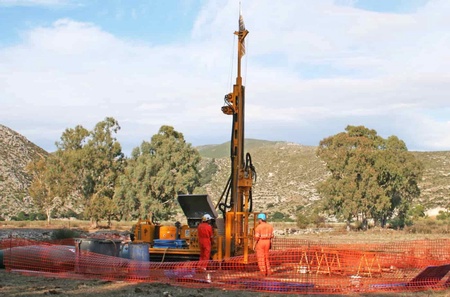
Using seismic imaging, airborne geophysics, borehole data, subsurface rock cores and geomorphological analysis, the researchers found marine sediments dating to the Late Pleistocene but no evidence for a throughgoing channel dating to the Bronze Age.
Instead, Thinia was shaped by an ancient overland drainage system consisting of an upland lake and meadows from which north and southward-flowing rivers flowed to the coasts at either end of the valley.
These findings align with the ancient Greek geographer Strabo’s accounts of the Thinia Valley from Roman times, who described water going from end-to-end from time-to-time and provide a more coherent geological explanation for the region’s evolution.
“The marine channel hypothesis does not hold up under scrutiny,” Professor Underhill explained. “What we see instead is a landscape carved not by a Bronze Age seaway but by rivers, most likely filling valleys carved during the last Ice Age. This resolves a key geological question while still supporting the geographic description of Paliki as the most plausible setting for Homer’s Ithaca.”
The research highlights how scientific investigation can refine - and sometimes overturn - longstanding theories, offering new direction for archaeological exploration and highlighting the importance of classical scholarship.