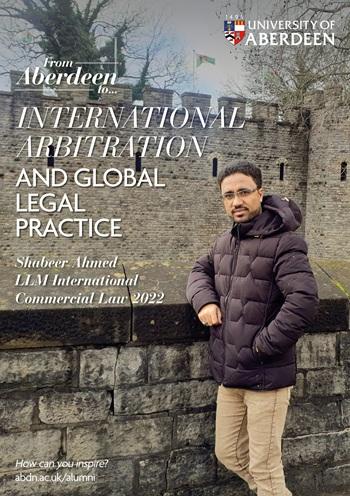
LLM International Commercial Law 2022 From Aberdeen to International Arbitration & Global Legal Practice
Your Time at Aberdeen
Why did you choose to study at Aberdeen? Aberdeen's LLM programme in International Commercial Law offers a strong focus on international arbitration, comparative legal analysis, and cross-border dispute resolution areas directly relevant to my work as a practicing advocate and arbitrator. The opportunity to study under scholars with expertise in arbitration law, particularly within the UK legal framework, was especially important to me as I am also admitted as a Solicitor in England and Wales.
In addition, the University's long-standing academic tradition, research-led teaching approach, and strong emphasis on critical legal analysis provided the rigorous intellectual environment I was seeking. Studying in Scotland also allowed me to experience a distinct yet influential legal system within the broader UK context, enriching my comparative legal understanding.
Ultimately, Aberdeen offered the ideal combination of academic excellence, practical relevance, and international perspective necessary to strengthen my expertise in international commercial arbitration and support my long-term academic and professional ambitions.
Why did you choose your particular course? I chose my LLM in International Commercial Law because it directly aligned with both my professional practice and my long-term academic ambitions in international arbitration.
As a practicing advocate and a registered arbitrator, I was increasingly involved in commercial disputes that required a deeper understanding of cross-border transactions, enforcement of arbitral awards, and comparative arbitration frameworks. The course allowed me to critically engage with core areas such as international arbitration, international sale of goods, corporate governance, and transnational commercial regulation.
More importantly, the specialisation in international arbitration provided advanced doctrinal and comparative insights into the UK framework, including the operation of the Arbitration Act 1996, and its interaction with global enforcement mechanisms like the New York Convention. This was particularly relevant to my research interests in arbitrator integrity and comparative arbitration law.
The course was therefore not just an academic qualification for me; it was a strategic step toward strengthening my expertise in international commercial dispute resolution and preparing for doctoral research in the field.
What did you most enjoy about your time at Aberdeen? Did you have any particularly memorable student experiences? What I most enjoyed about my time at the University of Aberdeen was the intellectually stimulating environment and the diversity of perspectives within the classroom. The LLM programme encouraged rigorous critical thinking, open debate, and comparative legal analysis, which significantly strengthened my analytical skills and deepened my understanding of international commercial arbitration.
One of the most memorable aspects of my experience was engaging in seminar discussions on complex arbitration problems, where students from different legal systems shared practical insights from their jurisdictions. These exchanges made the study of law dynamic and globally relevant.
I also particularly valued the opportunity to participate in academic workshops and networking events, which allowed me to interact with practitioners and scholars in the field of international arbitration. These experiences not only expanded my professional network but also reinforced my aspiration to pursue advanced research and contribute meaningfully to the development of arbitration law.
Beyond academics, the supportive academic community and the historic atmosphere of the campus made my time in Aberdeen both enriching and personally rewarding.
If talking to a group of prospective students, what advice would you give them to help them make the most of their time at the University of Aberdeen? If I were speaking to prospective students, I would offer three key pieces of advice to help them make the most of their time at the University of Aberdeen.
First, fully engage with the academic experience. Prepare thoroughly for seminars, participate actively in discussions, and do not hesitate to challenge ideas respectfully. The University's teaching approach rewards critical thinking and independent analysis, and the more you contribute, the more you gain.
Second, build relationships beyond the classroom. Connect with professors during office hours, attend guest lectures and academic workshops, and collaborate with classmates from different jurisdictions. Aberdeen's diverse student body is one of its greatest strengths, and learning from peers can be just as valuable as formal lectures.
Third, take advantage of the broader professional and personal development opportunities. Join student societies, attend networking events, and explore Scotland's legal and cultural landscape. Balancing academic focus with community involvement creates a richer and more memorable experience.
Ultimately, my advice would be simple: be proactive, stay curious, and treat your time at Aberdeen not just as a degree programme, but as an opportunity to grow intellectually, professionally, and personally.
Your Time After Aberdeen
What was your first job after graduating from Aberdeen? I was a Solicitor with City Law Practice, located on Soho Road in Birmingham, which involved advising clients on commercial and contractual matters, drafting and reviewing legal agreements, and assisting in dispute resolution proceedings. I worked on cross-border commercial issues, conducted legal research, and supported arbitration and litigation processes in line with UK legal standards.
What is your current job? I have started my own law firm and my current role as an Advocate at the High Court of Balochistan in Pakistan involves representing clients in civil and commercial matters, preparing legal pleadings, and presenting arguments before the court.
Please briefly describe the journey from your first job after graduating to where you are now After graduating I gained experience in commercial law, contract drafting, and dispute resolution in the UK. Building on this foundation, I returned to Pakistan and became an Advocate at the High Court of Balochistan, expanding my practice to include civil, commercial, and arbitration matters. Eventually, I established my own law firm, CLP, in Quetta, Balochistan, where I now lead a team, manage complex cases, and provide comprehensive legal services both domestically and in cross-border matters.
Was your degree at Aberdeen essential for getting to where you are now? If so, in what way? Yes, my degree at the University of Aberdeen was essential in shaping my career. The LLM in International Commercial Law provided advanced knowledge of commercial and arbitration law, critical analytical skills, and a comparative understanding of international legal frameworks. It was invaluable for qualifying as a Solicitor in England and Wales and for my work as an Advocate and arbitrator in Pakistan, enabling me to handle complex cross-border disputes and establish my own law firm with a focus on commercial and arbitration matters.
One Top Tip
Please share your one top tip that you think is most important for our current students or recent graduates that will help them when starting out on their career paths. My top tip for current students and recent graduates is to be proactive in seeking practical experience and building a professional network. Academic knowledge is essential, but engaging with real-world cases, internships, workshops, and professional events will give you practical skills, insights, and connections that are invaluable when starting your career. Always take initiative, ask questions, and learn from every opportunity, as this will set a strong foundation for long-term success.