
PhD Project – Lucy Halamova
With the increasing number of older adults in the UK needing some level of care, it is important to understand the processes that happen as older adults need to make a transition to various care facilities. One key part of this is planning. Being able to plan for care transitions has been shown as helpful to older adults as well as their carers [1]. On the flip side, not having plans in place can lead to tough emotional and practical challenges during these transitions [2].
The absence of planning not only complicates transitions but also introduces an additional challenge by potentially excluding older adults from decision-making. Studies show that older adults, especially those who are very old, frail, or have dementia, are often excluded from decision-making [3, 4, 5]. In contrast, older adults with milder care needs tend to be involved more [6]. So, it seems that planning early, when older adults are more likely and able to be involved in decisions, would be helpful. To do this well, it's important to hear from older adults who've been through this transition as well as those involved in the decision-making process.
To explore this, we set up a project in three stages to explore this and attempt to find a potential solution for Scotland. Stage 1 comprised my master's year (MRes in Psychology) literature review (now published) on older adults' and stakeholders' experiences of decision-making around care home transitions [7]. Stage 2 involved semi-structured interviews with three core groups: (i) older adults residing in care homes, (ii) family or friend carers actively involved in the decision to move, and (iii) professionals participating in that process. Interviews explored decision timelines, involvement levels, emotional impacts, systemic influences, and post-move reflections, analysed thematically to identify patterns like crisis triggers, constrained planning, and identity shifts.
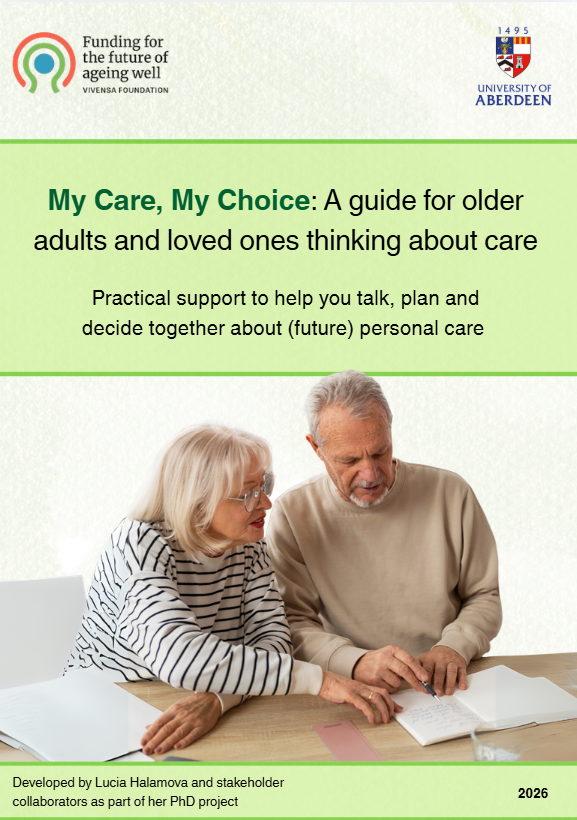
Findings from stage 2 now directly inform stage 3: co-designing an early planning tool ('My Care My Choice') with stakeholders (professionals, policymakers) and the general public (older adults, carers). The tool provides an overview of a spectrum of care options and includes prompts and reflective questions, drawing directly from the lived experiences of previous participants. More than just a documenting tool, it is intended to serve as an accessible starting point for conversations. It aims to help older adults take early ownership of care planning and prepare for times when they may no longer have the capacity to make decisions. The tool could also help reduce the emotional burden often placed on families when urgent care decisions arise later in life. In addition, it may support professionals, many of whom are not fully trained in the complexities of the care system, in keeping older adults at the centre of decision-making.
While it is still in its early stages, I have been in contact with various charities, interested organisations as well as policymakers to try and find a place for the tool so it is easily accessible to the public in the future.
Supervisors: Dr Stephen Makin, Prof Louise Locock, Prof Louise Phillips
Funder: Vivensa Foundation (previously known as The Dunhill Medical Trust)
References:
- S. Gilbert, E. Amella, B. Edlund, and L. Nemeth, “Making the move: A mixed research integrative review,” Healthcare (Switzerland), vol. 3, no. 3, pp. 757–774, Sep. 2015, doi: 10.3390/healthcare3030757.
- S. A. Wilson, “The transition to nursing home life: A comparison of planned and unplanned admissions,” J Adv Nurs, vol. 26, no. 5, pp. 864–871, 1997, doi: 10.1046/j.1365-2648.1997.00636.x.
- A. T. Larsson and J. H. Österholm, “How are decisions on care services for people with dementia made and experienced? A systematic review and qualitative synthesis of recent empirical findings,” Int Psychogeriatr, vol. 26, no. 11, pp. 1849–1862, 2014, doi: 10.1017/S104161021400132X.
- K. Samsi, L. Cole, and J. Manthorpe, “‘The time has come’: Reflections on the ‘tipping point’ in deciding on a care home move,” Aging Ment Health, vol. 26, no. 9, pp. 1855–1861, 2022, doi: 10.1080/13607863.2021.1947963.
- F. Scheibl, M. Farquhar, J. Buck, S. Barclay, C. Brayne, and J. Fleming, “When Frail Older People Relocate in Very Old Age, Who Makes the Decision?,” Innov Aging, vol. 3, no. 4, Aug. 2019, doi: 10.1093/geroni/igz030.
- A. K. Stevens, H. Raphael, and S. M. Green, “A qualitative study of older people with minimal care needs experiences of their admission to a nursing home with Registered Nurse care,” Qual Ageing Older Adults, vol. 16, no. 2, pp. 94–105, Jun. 2015, doi: 10.1108/QAOA-09-2014-0020.
- L. Halamová, L. Locock, A. Maclaren, S. Makin, and L. Phillips, “Involvement of older adults in shared decision-making on care transitions in the UK: an interpretative qualitative systematic review,” Ageing and Society, vol. 45, no. 11, pp. 2500–2525, 2025. doi:10.1017/S0144686X25100123
Contacts
- Lucy Halamova; l.halamova.23@abdn.ac.uk