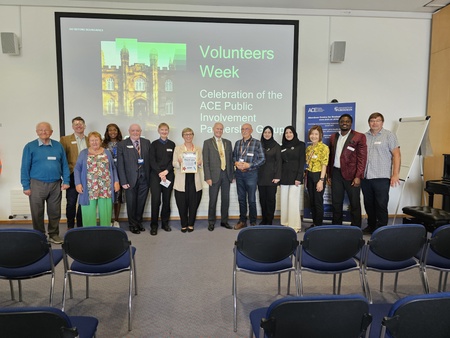

As part of National Volunteers’ Week (2–8 June 2025), the Lord Provost of Aberdeen, Councillor Dr David Cameron, visited the University’s Aberdeen Centre for Evaluation (ACE) to celebrate the vital contributions of volunteers in health and social care research - without whom, our research would not be possible.
Professors Peter Edwards (Vice-Principal for Regional Engagement) and Professor David Blackbourn (Interim Director of the School of Medicine, Medical Sciences and Nutrition) joined the event to share their thanks and support.
At the heart of the event was ACE's Public Involvement Partnership Group, established in 2017 as the first of its kind in Scotland. The group plays a vital role in supporting the entire Centre. Their diverse lived experience, critical insight, and constructive challenge ensure that research is shaped by the people it is ultimately meant to serve.
We introduced our distinguished guests to the group’s wide-ranging and outstanding contributions. Supporting, on average, 20 initiatives each year - some short-term, others spanning several years - members are involved across multiple stages of the research cycle. In group discussion formats, they contribute to idea generation and study co-design at the pre-funding stage, helping to ensure proposals are acceptable to participants and grounded in real-world relevance. As individuals, they act as active partners on research projects - contributing to ethics applications, troubleshooting recruitment challenges, collecting and analysing data, and communicating findings. The group also plays a strategic role: shaping internal policies and public involvement guidelines, mentoring early-career researchers, contributing to postgraduate teaching, and representing the University at national conferences and panels.
Researchers emphasised the group’s impact, with testimonials offering just a glimpse of the difference this group continues to make:
“They helped us identify outcomes that mattered to patients, not just clinicians, which is now shaping national guidance on robotic surgery,” said Professor Marion Campbell.
“Their input gave me confidence in my proposals and challenged me to consider perspectives I hadn’t thought of,” added Dr Callum Kaye.
Dr Ruari Jardine said: “As a clinician, I’m used to speaking with experts. Presenting to this group challenged my thinking. Their feedback will make our study more inclusive and more understandable to patients.”
“Liaising with this group has been invaluable in developing meaningful research questions,” noted Dr George Ramsay. “This kind of involvement is essential if we want to improve the patient experience.”
“Personally, the group has helped me become a better researcher and contributed to enhancing the relevance and impact of my research in public involvement in statistics”, remarked Dr Beatriz Goulao
We also warmly acknowledge and thank other equally valuable patient and public involvement groups from across the School of Medicine, Medical Sciences and Nutrition (SMMSN) - including the School PPI group and PPI groups from Biostatistics and Health Data Science (BHDS), and Ageing Clinical and Experimental Research (ACER) - for joining us for the recognition ceremony and networking event, during which certificates of acknowledgement from the School were presented.
This celebration highlighted SMMSN’s strong and growing commitment to ensuring health and social care research is inclusive, impactful, and grounded in the priorities of the communities it serves.