

FRSE
Chair in Zoology
- About
-
- Email Address
- x.lambin@abdn.ac.uk
- Telephone Number
- +44 (0)1224 273259
- Office Address
Room 408 Zoology building Tillydrone Avenue Aberdeen AB24 2TZ Scotland UK
- School/Department
- School of Biological Sciences
Biography
2016 Elected Fellow of the Royal Society of Edinburgh FRSE
2015 Elected Fellow of the Royal Society of Biology FRSB
2004 Professor of Ecology, University of Aberdeen
1994 Lecturer, Senior Lecturer (1999), Reader in zoology (2002) University of Aberdeen
1993 NATO/Royal Society Research Fellow at Institute of Terrestrial Ecology, Banchory field Station
1992 PhD University of Louvain & Univ British Columbia, Personal Reseach Fellowship National Foundation for Scientific Research (Belgium)
1988-1991 Visiting Graduate Student, University of British Columbia1986 BSc Zoological Sciences, University of Louvain, First class
1988 MSc Biology, University of Louvain, First class
1987 Visiting Graduate Student, University of Oslo
Recruiting a PhD student in population ecology for October 2026 Start
We are inviting applications for our fully funded, cross institution PhD on
Predicting and managing the spatially asynchronous pulses of herbivorous rodent abundance cascading through ecosystems.
Memberships and Affiliations
- Internal Memberships
-
Prof Lambin is currently:
A member of REF 2029 Strategy Group
A member of Anthony & Margaret Johnston Centre for Doctoral Training in Plant Executive Board
- External Memberships
-
Prof Lambin is currently:
A member of REF2029 subpanel A5 Biological Sciences
A member of NatureScot's Scientific Advisory Committee
A member of Orkney's Native wildlife Project Independent Technical Advisory Group
Scientific advisor to and a member of Scottish Invasive Species Initiative Steering Group
A member of the Flow Country World Heritage Site Advisory Group
A member of Cairngorm's National Park Authority and Nature Scot Capercaillie emergency plan scientific advisory Group
Prizes and Awards
2025 Nature of Scotland Awards: Innovation, Reducing the Impact of Predation with Diversionary-Feeding for work led by Jack Bamber Highly Commended
2024 Project CONTAIN Research prize - University of Aberdeen Principal's Prizes for Research & Engagement Interdisciplinary Research Award (joint winners) (2024)
2019 RSPB Nature of Scotland Conservation Science Award Highly Commended: Large scale participatory control of invasive mink in Scotland (representing consortium)
2017 Winner of the NE Scotland Biodiversity partnership 20th anniversary Collaboration project award.
2016 Watson Raptor Science Prize for the best paper on raptor science published in an international peer reviewed journal in 2015 as senior author of paper led by PhD student Sarah Hoy.
2015 University of Aberdeen Principal prize for public engagement with research “Outstanding achievement senior award”
2011 Certificate of recognition SNH “Special contribution to species conservation in Scotland”, Minister of the Environment, Scottish government.
- Research
-
Research Overview
I conduct ecological and multi-disciplinary socio-ecological research aimed at providing strong empirical evidence for practical solutions to pressing conservation issues.
My ecological research aims are to understand
the contribution of dispersal to the dynamics of populations,
to understand how the outcome of trophic interactions is modified by dispersal and
to apply population ecology to wildlife management and conservation.
I achieve these aims by conducting large scale, often long-term field studies with birds and mammals as well as by linking theoretical insights with empirical findings using state of the art statistical techniques.
I work with e.g. water vole metapopulations, cyclic field voles, their birds of prey predators, food plants and parasites in commercial forests and non-native American mink culled as part of conservation efforts, forest ecosystem managed for timber or transformed for rewilding, rats in Madagascar, non-native pines wasps and mink in South America and people.
I am invested in conservation biology, including the management of invasive species and rewilding. I research how to optimise the impact of conservation volunteers. I collaborate with multiple NGOs over many years.
Research Areas

Research Specialisms
- Applied Statistics
- Community Ecology
- Ecology
- Population Biology
- Population Ecology
Our research specialisms are based on the Higher Education Classification of Subjects (HECoS) which is HESA open data, published under the Creative Commons Attribution 4.0 International licence.
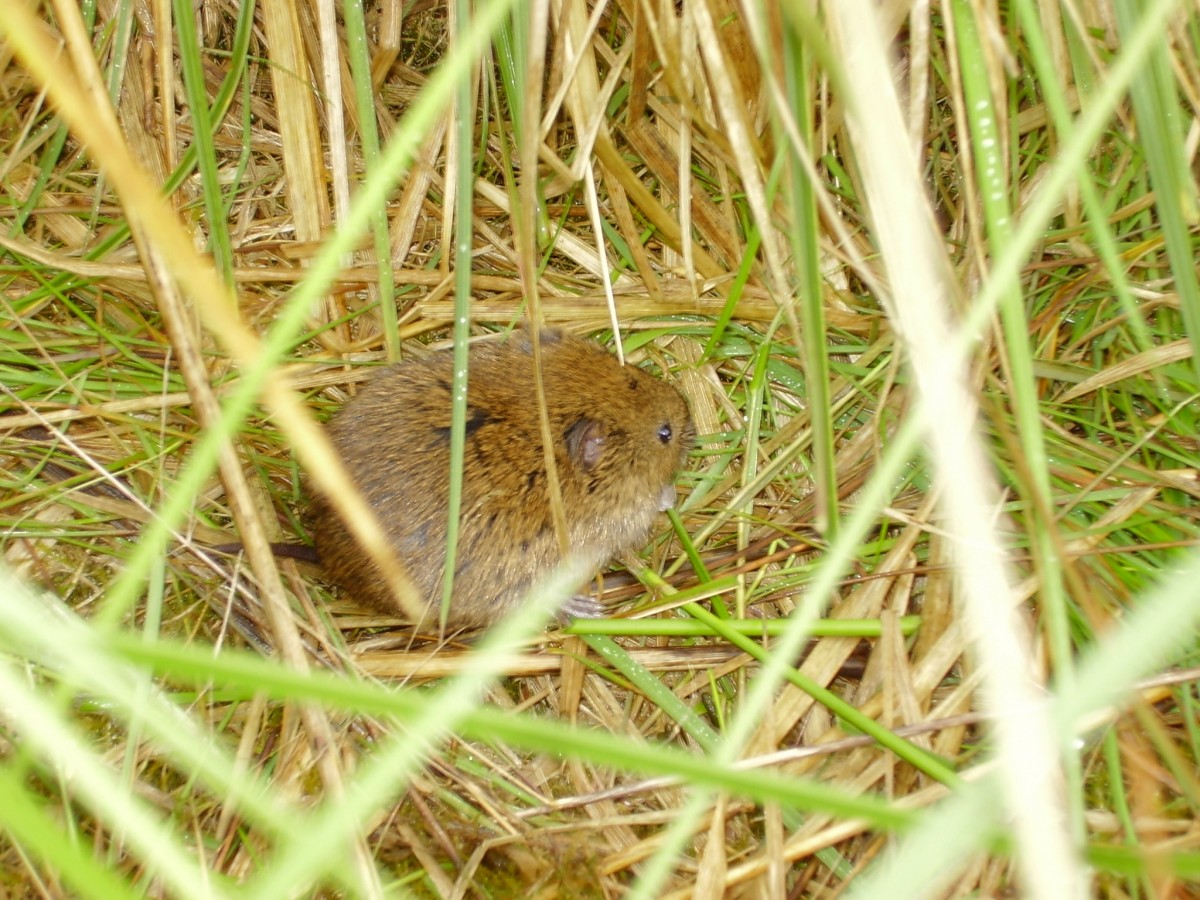
Density-dependent recruitment but not survival drives cyclic dynamics in a field vole population
For 101 years, ecologists have sought to explain the 3-4 years multi-annual cycles of voles and lemmings. Oddly, debates on the demographic phenomenon that underpin multi-annual cycles have largely taken place in the absence of demographic data. In our paper, we find that Density-dependent recruitment, especially early in the breeding season, but not survival drives cyclic dynamics in a field vole population, overturning accepted wisdom.
Collaborations
Dr Sandra Telfer (water vole metapopulations, disease dynamics); Prof Mike Begon (University of Liverpool)
Cyclic Vole demography
Prof Madan Oli University of Florida
Statistical ecology
Dr Chris Sutherland (Univ St Andrews);
Kenny Kortland (pine martens, wood ants, squirrels, Forest Scotland)
Supervision
My current supervision areas are: Biological and Environmental Sciences.
Current students
- Anna Kellner (2021-2026) Rewilding and the return of interacting meso-predators: Understanding, modelling and monitoring predator-prey dynamics in non-equilibrium ecosystems. Lead
- Elouise Mayall (2022-2026) Searching for a bit of peace and quiet despite unreliable cues: dispersal, settlement, and fitness of a top predator in multi-use forests. Lead
- Albert Bonet Bigata (2022-2026) Optimising the long-term control of invasive American mink from catchment to coast: how many mink is too many? Lead
- Leah Gray (2022-2026) Developing effective agricultural wetland management to reduce predation and improve wader breeding outcomes. 2nd supervisor
- Amber Cowans (2022-2026) How do recreational activities alter spatiotemporal species interaction networks, and can this knowledge assist in promoting pro-environmental behaviour? 2nd supervisor
- Emily Legge (2022-2026) The effect of Changing Soundscapes on Trophic Interactions. 2nd supervisor
- Rosie Irwin-Holbrey (2023-2027) When is a wild-living cat a wildcat? Using carnivore guild interactions to decipher ecological function. Lead
- Seunyeon Lee (2024-2028) The demography and dynamics of Tawny owl populations linked by dispersal and experiencing spatially variable food limitation and predation: a 40 year study. Lead
- Oliver Hartley (2024-2028) Developing an efficient and accessible “data-to-decision” pipeline for remotely sensed biodiversity monitoring data. 2nd supervisor
- Sarah Rehman (2024-2028) Dispersal and local selection in metapopulations 2nd supervisor
- Eleonor Foster Native, or invasive? Ancestry, drivers of population density, and public perceptions of feral pigs in Scotland. 2nd supervisor
Past PhD and MPhil students 42 PhD and 6 MRes students supervised with 100 % completion rate within 4 year timeline. 29 now as academic or researchers in universities private sector or government.
Sandra Telfer MSc (1997); Wendy Stewart MSc (1997); Jason Matthiopoulos (1998); Andrew DC MacColl (1998); James L MacKinnon (1998); Shahrul Anuar Mohd Sah (1998); Julie MacKnight (1999) MSc; Isla M Graham (2001); Sandra Telfer (2000); Arjun Amar (2001); Ann Humble MPhil (2002); John Durban (2002); Torbjørn Ergon (2003); Miriam Brandt (2003) MSc; Kerry Lock (2004); Stijn Bierman (2004); Sarah Burthe (2004); Sevvandi Jayakody (2005); Kenneth Kortland (2005) MSc; Ros Bryce (2005); Michelle Sims (2006); Matthew J Smith (2007); Eduardo Tedesco (2010); Ali Abdullah M Shati (2007); Anna Renwick (2009); Nacho Villar (2010); Anna Evely (2010); Chris Sutherland (2013); Elaine J Fraser (2013); Claire Davies (2014); Ewan Weston (2014); Sarah Hoy (2015); Marie Pages (2016); Rupert Houghton (2017); William Morgan (2018); Ewan McHenry (2018); Ruth Rodriguez (2018);Richard Hassall (2019); Deon Roos (2021); Ruben Bernardo Madrid (2021); Joseph Drake (2021); Cristian Navarro Waggershauser (2021); Kathryn Scobie (2022); Irilena Linardaki (2023) MRes; Keziah Hobson (2023); Katie August (2023); Laura MacKenzie (2023); Holly Accacia Broadhurst (2023); Jack Bamber (2025)
Funding and Grants
Current funding
2025-2028 Impact of mink on seabirds Ossian Offshore Wind Farm Limited
2024-2026 Ecosystems in flux: synthesising a 40 year multi species study Leverhulme Trust
2024-2031 NETGAIN: developing the science and practice of nature markets for a net positive future; NERC DLA Consortium PhD award
2024 Hebridean Mink Project – Strategic Review; Scottish Natural Heritage
- Teaching
-
Teaching Responsibilities
I am presently on research leave
- Publications
-
Page 4 of 23 Results 31 to 40 of 223
Patterns and drivers of vector-borne microparasites in a classic metapopulation
Parasitology, vol. 150, no. 10, pp. 1-57Contributions to Journals: Articles- [ONLINE] DOI: https://doi.org/10.1017/S0031182023000677
- [ONLINE] View publication in Scopus
The effect of climate change on avian offspring production: a global meta-analysis
PNAS, vol. 120, no. 19, e2208389120Contributions to Journals: ArticlesLiving with rodent pests: unifying stakeholder interests to prioritise pest management in rural Madagascar
People and Nature, vol. 5, no. 2, pp. 713-725Contributions to Journals: Articles- [ONLINE] DOI: https://doi.org/10.1002/pan3.10438
- [OPEN ACCESS] https://aura.abdn.ac.uk/bitstreams/f7f1b603-0e53-41c5-a973-c69d6b775d23/download
- [ONLINE] View publication in Scopus
From species detection to population size indexing: the use of sign surveys for monitoring a rare and otherwise elusive small mammal
European Journal of Wildlife Research, vol. 69, 9Contributions to Journals: Articles- [ONLINE] DOI: https://doi.org/10.1007/s10344-022-01634-2
- [OPEN ACCESS] https://aura.abdn.ac.uk/bitstreams/9d632637-6bf5-4abd-aefa-b204bb45e4b0/download
- [ONLINE] View publication in Scopus
Predicting the impact of invasive trees from different measures of abundance
Journal of Environmental Management, vol. 325, no. Part B, 116480Contributions to Journals: ArticlesSpatiotemporal connectivity dynamics in spatially structured populations
Journal of Animal Ecology, vol. 91, no. 10, pp. 2050-2060Contributions to Journals: ArticlesA temporal refuge from predation can change the outcome of prey species competition
Oikos, vol. 2022, no. 9, e08565Contributions to Journals: Articles- [ONLINE] DOI: https://doi.org/10.1111/oik.08565
- [OPEN ACCESS] https://aura.abdn.ac.uk/bitstreams/1d89e7cb-e32e-4f4f-bd8c-544f8b2e3714/download
- [ONLINE] View publication in Scopus
Restoring vertebrate predator populations can provide landscape-scale biological control of established invasive vertebrates: Insights from pine marten recovery in Europe
Global Change Biology, vol. 28, no. 18, pp. 5368-5384Contributions to Journals: Review articles- [ONLINE] DOI: https://doi.org/10.1111/gcb.16236
- [OPEN ACCESS] https://aura.abdn.ac.uk/bitstreams/314a657f-959f-4ff0-a268-1e29a912d2b3/download
- [ONLINE] View publication in Scopus
From pattern to process?: Dual travelling waves, with contrasting propagation speeds, best describe a self-organised spatio-temporal pattern in population growth of a cyclic rodent
Ecology Letters, vol. 25, no. 9, pp. 1986-1998Contributions to Journals: ArticlesInterspecific coprophagia by wild red foxes: DNA metabarcoding reveals a potentially widespread form of commensalism among animals
Ecology and Evolution, vol. 12, no. 7, e9029Contributions to Journals: Articles
