

From courtroom to consequence: what Bari taught us about the impact of climate litigation
Three keynote dialogues, four panels and a closing session at the Climpact Inaugural Conference circled one question: what does climate litigation actually change? The view that emerged: winning a case starts the story rather than ending it, and impact lasts only where someone measures the gap. Andrew Walters reports on what Bari suggested, and on TRACE, the open case law library that may help us find out.
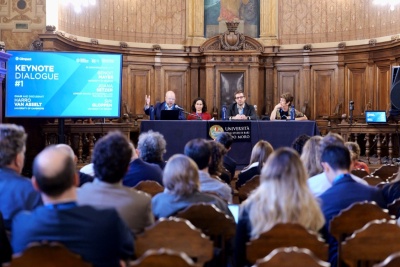
Climate cases keep growing in number, and some of them are now landmarks with global reach. But fame is not impact. A court can rule for the claimants and leave emissions, policy and public opinion much as they were. The Climpact Inaugural Conference, held at the University of Bari Aldo Moro on 12 and 13 October 2026, set out to test that gap. Climpact is an Italian Science Fund project led by Giuseppe Naglieri that studies some 500 cases from legal, sociological and economic angles.
I attended for the Aberdeen School of Law and the Aberdeen University Centre for Energy Law (AUCEL), and presented in Panel D, on how climate litigation affects projects and plans through authorisations, permitting and planning. What struck me most was how closely the panels tracked the keynote dialogues. Each keynote set a question, and the panel papers answered it with case evidence.
Day one: what has litigation achieved?
Keynote Dialogue 1: legal and policy impact
Harro van Asselt (Cambridge) chaired Joana Setzer (LSE), Benoit Mayer (Reading) and Siri Gloppen (Bergen). They began by unpicking the word "impact". It is not the same as winning or enforcement, and a gain for one party may be a loss for another. They offered a test instead: does litigation help deliver climate action that is timely, durable and fair, at reasonable cost and with political legitimacy?
By that test the record is mixed. Legal milestones are real: courts now treat climate policy as justiciable, frame it in human rights and widen standing, as Finch did in the UK. Real-world results are harder to prove. Urgenda served as the cautionary tale. The measures it prompted cut Dutch emissions by about one per cent, at a cost of some three billion euros, while carbon leakage may have left global emissions slightly worse. The panel also warned of "meta-backlash": attacks on standing, court funding and jurisdiction that change the conditions for all future cases.
A win in court is a beginning, not an outcome.
How Panel A answered
Panel A, chaired by Joana Setzer, took up each of these points with evidence. Eugenia Recio (Eastern Finland) found policy impact in 25 of 153 Latin American rulings, but warned of a four-year lag between judgment and implementation, so short studies undercount. Mariana Cirne (IDP), who also defends the Brazilian government in court, described the follow-up machinery the keynote had praised: specialist units, public dashboards and post-judgment hearings that put federal and state governments in one room until they agree.
Paulina Rundel (Vienna) tested durability. Germany amended its climate law within weeks of Neubauer, then weakened its sector targets in 2024, prompting a new complaint by more than 54,000 people. Clara Silvano (Padua) showed French enforcement rulings measuring compliance against targets that the law had since tightened. Durability, in other words, is the hardest of the keynote's tests to pass.
Keynote Dialogue 2: society, media and narrative
Anna Berti Suman (Padua) chaired Katrin Uba and Alexandra Segerberg (Uppsala) and Alison Anderson (Plymouth). A win can build coalitions and draw attention. It can also drain money, narrow the message to what works in court and hand control to lawyers. Litigation plays out in two arenas, inside the court and outside it, and needs "translators" to carry its meaning to the public. How people receive that meaning depends on whether they trust elites, and for some audiences both courts and activists count as elites.
The panels echoed this too. Lorenzo Serafinelli (Sapienza) found that attribution science reached Vermont's climate superfund law not through legal language but through people: scientists who had worked on litigation gave evidence to the legislature. They were the translators in practice. Cirne's televised Brazilian hearings showed a court building its own public arena.
Day two: how judgments travel
Keynote Dialogue 3: precedent and advisory opinions
Harro van Asselt chaired Francesco Sindico (Strathclyde), Ivano Alogna (BIICL) and Oliver Ruppel (Graz and Stellenbosch). Their message was that judgments rarely travel whole. Legal models do, such as rejecting the "drop in the ocean" defence, and receiving courts rebuild them in their own legal language. Citation is not reception. Advisory opinions gain force by building on one another, so arguments that once looked radical start to look orthodox. They also warned against copying form rather than function, and named China and the wider Global South as blind spots in the data.
How Panel D answered
Panel D, on projects, permits and plans, showed these models arriving in ordinary decisions. Michela D'Erchia (Bari) traced the advisory opinions into domestic courts. A Brazilian court suspended coal licences that lacked a climate assessment, and Norway's Borgarting Court of Appeal held three North Sea field approvals invalid. Valentina Eisendle (Innsbruck) showed climate reasoning entering Italian permitting disputes "through the side door", as courts moved from treating landscape and climate as incomparable to weighing them together.
My own paper followed Finch. It travelled within the UK in exactly the way the keynote described: Scotland's Court of Session applied its logic to Jackdaw and Rosebank in its own terms. Yet the ground is shifting, as Environmental Outcomes Reports replace environmental impact assessment and £250 to £300 billion of infrastructure spending presses for faster decisions. Maura Mattalia (Turin) supplied the sharpest answer to that question: litigation changes administration only when the objective can be measured and an independent body certifies the gap, as Germany's Expert Council on Climate Issues does. Emanuela Rassu (Siena) added that regional governments, not citizens, are driving Europe's renewables disputes.
Three threads that ran through both days
Impact needs a measure and a monitor. The keynote praised Brazil's supervision; Panel A showed how it works; Panel D showed why Germany succeeds and Italy stalls. Where no one measures the gap, a judgment fades.
Impact is unstable. Backlash, reform and remittal recur everywhere, from Neubauer's 2024 reform to the UK's new environmental regime. A study that stops at judgment day will overstate success.
The quiet cases matter. Routine permitting decisions, the "unsexy future" of the field, are where legal models land and where much of the real change happens.
The closing session: from citation to consequence
The rapporteurs' reports drew this together neatly. They noted that the advisory opinions are already cited in more than 100 filings, that judgments flow mostly from North to South, and that one LLM-assisted study of 2,924 decisions found the United States exporting reasoning and Brazil importing it. They also took up a coding problem from my paper: impact is never stable when the rules a court applied are later changed, so a case database must record whether and how those rules moved.
Their larger point was that counting citations is not enough. To understand impact, researchers need a wider and deeper collection of sources: not only judgments, but the policies, laws and decisions that respond to them. That is the direction TRACE is now taking.
TRACE: mapping how climate judgments travel
Spotlight: TRACE
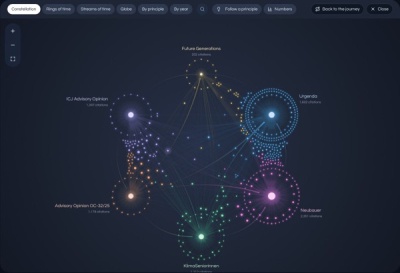
TRACE is Climpact's open, machine-assisted library for tracing how climate judgments are taken up in later litigation. Its first version is live, with code, case files and a codebook released under an MIT licence.
Its scale is striking. The constellation view links six landmark decisions through nearly 8,000 citations, led by Neubauer with 2,351 and Urgenda with 1,602. Users can view the network as rings or streams of time, on a globe, by year or by legal principle, and can follow a single principle from court to court.
Version 2, expected next year, aims to widen and deepen the sources it collects, reaching into policy and into how judgments are applied in practice. That would let TRACE show not just where a case is cited, but where it changes something. For anyone studying precedent, legal transplants or comparative climate law, it is a resource to watch.
Explore TRACE: climpact.it/site/data/trace
Why it matters for AUCEL
For those of us working on energy, infrastructure and consenting, Bari carried a clear message. The cases that shape outcomes are often the ordinary ones, the rules beneath them keep moving, and impact depends on whether someone measures the gap. Climpact has given the field the questions, and in TRACE the start of a tool to answer them. Recordings and papers will be available in the conference reading room.
_________________________________________________________________________________
About the author
Andrew Walters is a doctoral researcher at the University of Aberdeen School of Law and a member of AUCEL. A chartered town planner and energy lawyer, he has more than 30 years' experience in infrastructure, energy and defence nuclear consenting.
Further information: Climpact project | TRACE