
Employers have a short window to ensure the energy transition creates fairer opportunities rather than reproducing inequalities of the past, an Aberdeen summit has heard.
As thousands of roles evolve and emerge through the energy transition, decisions about who is considered qualified, capable and ready for promotion are increasingly being influenced by algorithms and AI.
But systems trained on historic data could carry existing inequalities into the new energy economy, according to Professor Jie Wu, Chair Professor of Strategy and Entrepreneurship at the University of Aberdeen Business School.
Speaking at the Aberdeen edition of the Scottish Ethnic Minority Talent Summit & Festival 2026, Professor Wu urged employers to examine how automated systems are being used in recruitment and promotion, and whether they are unintentionally creating barriers for some candidates.
“When judgement about capability moves into systems trained on the past, the past reproduces itself,” Professor Wu told delegates. “Unless someone chooses otherwise.”
He said the transformation of the energy sector presents a rare opportunity because many of the roles, skills and criteria that will define its future workforce are still taking shape.
“The criteria for the next generation of energy jobs are still being written,” he said. “That gives us an opportunity to shape them before they harden.”
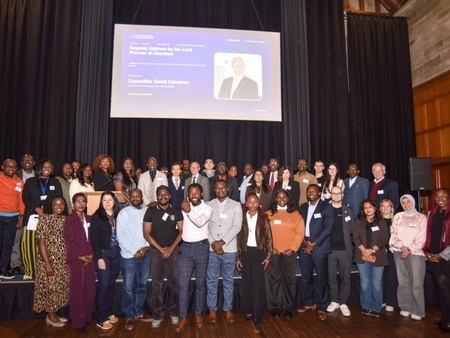
The summit, held at the University of Aberdeen on Monday 5 October, brought together representatives from industry, government, education and community organisations to explore how Scotland can ensure people from all backgrounds benefit from the opportunities created by the energy transition.
Under the theme ‘ESG, Energy and Diverse Talent: Navigating Disruption, All Scotland’s Talent at the Helm’, delegates took part in five roundtable discussions alongside keynote addresses and an exhibition.
The Lord Provost of Aberdeen, Councillor David Cameron, delivered the keynote address. He said the deeper issue in diversity is power: “Who frames a problem? Who holds a budget?” and “Whose evidence is believed?” He warned that access fails if it is “restricted to people who already know the right employer and can afford unpaid experience”, and called for a shared commitment across government, industry, education, trade unions, local authorities and communities to move structural barriers at every stage. He stressed the importance of ensuring a just transition does not inherit the closed networks and unequal outcomes of the past. Fash Fasoro, Chief Executive of The DataKirk, also addressed the summit.
Professor Wu, who chaired the event as Academic Convenor, challenged employers to identify where automated systems rather than people make the first decisions about candidates in recruitment and promotion, and to examine who progresses as a result.
He also urged policymakers to give greater attention to what he described as the “infrastructure of judgement”, the systems and criteria which determine who is given the opportunity to participate in the new economy.
His argument draws on recent research published in the Journal of Management Studies, in which he develops the concept of “algorithmic status inequality”.
The research explores how assumptions embedded in the design and use of AI, combined with unequal access to technical capabilities, can reinforce existing disparities in areas including recruitment, healthcare and legal assistance.
Professor Wu argues that neither technical solutions, such as using more diverse training data, nor market competition alone will necessarily address the problem.
The paper was published alongside responses from Professor David Teece of the University of California, Berkeley; Professor María del Carmen Triana of Vanderbilt University; and Professor Arun Upadhyay of Florida International University.