
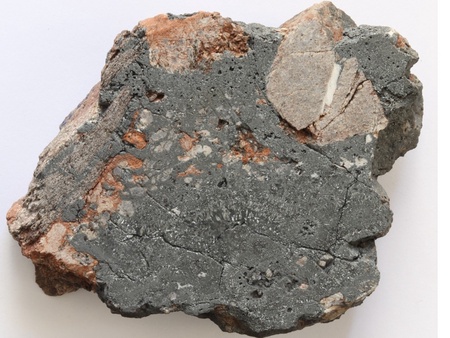

A hidden 'uranium hotspot' has been discovered beneath Aberdeen by University of Aberdeen researchers - shedding new light on the geological history of the region.
Crystals of a uranium-rich mineral called chernovite were identified by researchers in samples from old mine workings at Grandhome, on the northern edge of the city.
The site was once quarried for manganese and has been known to generations of geologists for more than 200 years, according to Professor John Parnell and Dr Joe Armstrong, who have published their findings in the journal Geochemistry: Exploration, Environment, Analysis’.
The study found that rocks from Grandhome contain uranium concentrations around 100 times higher than those typically found in Aberdeen granite.
By contrast, granite samples collected from elsewhere across the city, from Cults in the south-west to Dyce in the north, showed no similar enrichment.
Despite the popular associations with the chemical element, researchers stress that the discovery does not pose a safety concern.
"People sometimes hear the word uranium and immediately think of radioactivity or nuclear energy," said Professor Parnell. "But the amounts found at Grandhome are not dangerous, and the deposit is far too small and dispersed to have any economic value. What makes it exciting is the story it tells us about how rocks and minerals formed hundreds of millions of years ago."
The team believes the uranium became concentrated during a period when the ancient granite landscape was exposed at the Earth's surface. Groundwater moving through the rocks is thought to have carried dissolved elements, which were later trapped in newly formed minerals including chernovite, a rare mineral that also contains yttrium and other rare earth elements.
The discovery provides evidence for geological processes that took place around 400 million years ago during the Devonian period, when Scotland's landscape looked very different from today. At that time, weathering and circulating groundwater altered rocks at the boundary between Aberdeen's granite and younger sandstone deposits above it.
Professor Parnell suggested: "It's a bit like a tarte tatin, where something new happens at the boundary between the pastry and the fruit. Pies often make surprisingly good analogies for geology! At Grandhome, the really interesting chemistry happened at the interface between different rock layers."
The study also found unusually high levels of arsenic associated with the mineralisation, due to low-temperature chemical processes near the Earth's surface rather than deep underground.
For geologists, the Grandhome site offers a rare natural laboratory for understanding how elements move through the Earth's crust and become concentrated in specific locations.
Dr Armstrong said: "The rocks in and around Aberdeen are a remarkable record of the Earth's history. Discoveries like this help us understand the long and complex processes that have shaped the landscape beneath our feet.
“While there's no prospect of mining uranium in Aberdeen, the deposit provides valuable evidence of how minerals can form and evolve over geological time."