
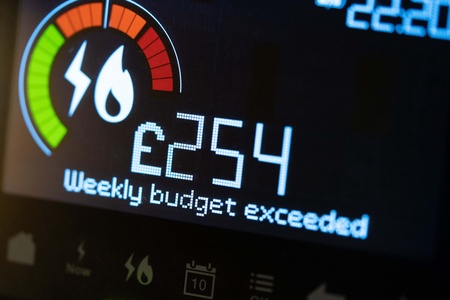

Research from the University of Aberdeen has revealed the public health implications of the ongoing cost-of-living crisis in Scotland.
Data gathered from more than 4,000 adults across Scotland showed that fuel, food and financial insecurities are widespread across the adult population and more than one in 10 experiences all three simultaneously.
Published in the European Journal of Public Health, the research by Sarah Champagne and Dr Aravinda Guntupalli from the Institute of Applied Health Sciences and Professor Euan Phimister from the Business School at the University of Aberdeen and the University of Stellenbosch, highlights how traditional income-based measures of poverty fail to capture the full extent of the hardship facing Scottish households.
Instead, the team examined ‘multidimensional poverty’ which recognises that people can experience hardship in several overlapping areas at the same time. Rather than focusing solely on income - 'multidimensional poverty' looks at whether people can meet basic needs such as fuel, food and finances.
By examining multidimensional poverty, the authors argue that the cost-of-living crisis should be considered a significant public health issue rather than solely an economic one.
Using Joseph Rowntree Foundation survey data collected by Savanta ComRes in 2023 from 4,203 adults in Scotland, the study found that fuel insecurity - the inability to heat homes adequately or falling behind on energy bills, is the most prevalent form of hardship, affecting 58 percent of people who responded.
Lower-income adults aged 35 to 74 were particularly at risk of fuel insecurity. Twenty eight percent of people reported experiencing food insecurity. This means that they skipped meals, reduced food portions or accessed a foodbank due to food costs or limited food availability.
Twenty two percent of people reported financial insecurity, meaning that they have been unable to pay bills, manage unexpected costs and avoid problem debt.
More than one in 10 adults experienced all three insecurities at once.
The researchers also identified a disconnect between perceived and actual insecurity. Older adults, despite being more likely to have incomes below minimum income thresholds, were less likely to report financial insecurity, a pattern, the authors say, may mask the true scale of need.
Dr Aravinda Guntupalli who led the research, explains the team’s findings: “The health implications of the cost-of-living crisis are profound.
“Scotland already faces the lowest life expectancy in the UK and the highest life expectancy inequality in Western Europe. Our data suggests that fuel insecurity is likely to carry substantial public health costs.
“Paradoxically, the negative health impacts of insecurities were more pronounced among younger and middle-aged adults than older adults, echoing older adults’ tendency to underreport financial strain.
“We estimate that around half a million older adults in Scotland may be experiencing fuel insecurity. This is especially concerning given older adults’ greater heating needs due to chronic conditions, reduced mobility and spending more time at home.
“Put plainly, our findings show that international conflicts and global shocks are having direct and serious consequences for Scottish households. Cold homes, reduced food intake and persistent money worries are not just economic issues – they are drivers of health inequality."
The researchers argue that Scotland’s anti-poverty strategy must recognise the intersectionality of multidimensional insecurities to ensure support reaches those most at risk and to reduce the burden on individuals and the health system.
Sarah Champagne who co-authored the paper added: "Multidimensional poverty is not an abstract concept, it is the lived reality for thousands of people in Scotland. Tackling one insecurity at a time simply isn’t enough. A strategy that understands how these pressures intersect is essential if we are to protect public health and reach those who need support most."
Second co-author, Professor Euan Phimister said: "Behind every statistic is a household trying to stay warm, eat well and keep up with bills. When fuel, food and financial insecurities collide, the impact on health is profound. Our research shows that Scotland must recognise the intersectionality of these insecurities if we are to reach those most at risk and reduce the growing pressure on individuals and the health system."
The full paper, Multidimensional poverty in Scotland and health across adulthood—the paradoxical associations with food, fuel, and financial insecurity in later life, is available via the European Journal of Public Health.
This research was partially funded by the Canadian Institutes of Health Research Foreign Doctoral Study Award.