
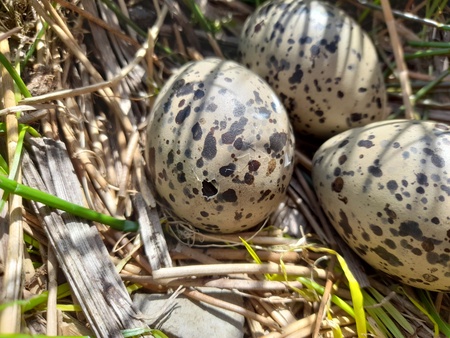

New research from the University of Aberdeen and Edinburgh Napier University has found that simple changes to the timing of conservation measures on farmland could significantly improve protection for some of the UK's most rapidly declining wading bird species.
The study has implications for species including lapwing, oystercatcher, and curlew - birds that were once a familiar sight and sound across the British countryside, but whose populations have fallen sharply in recent decades. Between 1995 and 2024, Scotland populations declined by 63% for lapwing, 41% for oystercatcher and 62% for curlew.
One cause of the decline is a widespread change in the way that agricultural grasslands are managed. With fields being mown earlier and more frequently, and high livestock densities in some areas, ground-nesting birds such as lapwing, oystercatcher, and curlew can find it increasingly difficult to breed successfully as their nests and chicks are vulnerable to livestock and farm machinery.
Agri-environment schemes in the UK include options that provide payments to farmers to protect wildlife by delaying activities such as mowing grass or introducing livestock until later in the breeding season. However, the dates used by these schemes are generally applied uniformly across each country.
The new study published in the Journal of Applied Ecology this week, found that this "one-size-fits-all" approach does not closely match when birds breed.
Using nesting data collected from across the UK, including datasets provided by the British Trust for Ornithology, Royal Society Protection of Birds, and the Game & Wildlife Conservation Trust, researchers showed that breeding seasons vary considerably between species and across different areas. As a result, conservation measures are often mistimed, putting nests and chicks at risk even where protection measures are in place.
The team developed new recommendations that tailor conservation timings according to both species and location. Their analysis showed that relatively minor adjustments to current exclusion dates, in some cases by as little as two to three weeks, could substantially improve outcomes.
The proposed changes could increase nest protection from livestock by 30% for lapwing and 57% for oystercatcher. Protection for chicks from mowing operations could increase by 35% for lapwing and 72% for oystercatcher.
Leah Gray, a postgraduate researcher at the University who led the study, said:
“The main driver of wader population declines is a widespread decrease in breeding success. In recent decades, waders have simply not been able to produce enough fledglings to sustain their populations.
"The drivers behind declines in breeding success are complex; waders face numerous challenges, from habitat degradation and predation to the destruction of nests and chicks by machinery and livestock.
"While many of these pressures need to be addressed, agricultural losses are comparatively simpler to mitigate compared to more complex issues such as predation and habitat loss.
"Changes to livestock management and mowing regimes therefore offer an ‘easy win’ for conservation and are among the most effective interventions for supporting breeding waders.
“The timing of nesting varies between wader species and across different parts of the country, so conservation measures need to align with local breeding patterns if they are to work effectively.
"Our research shows that current agricultural exclusion dates are often missing the periods when birds are actually nesting and raising chicks. This means nests and chicks can still be lost unnecessarily, despite schemes specifically designed to protect them.
"The encouraging finding is that relatively small changes to existing schemes could make a substantial difference. By using evidence on species-specific and regional breeding patterns, conservation measures can be targeted more effectively and deliver better outcomes for declining wader populations.”
The primary purpose of the research was to provide practical evidence to directly inform NatureScot, which advises the Scottish Government on Scotland’s Agri-environment scheme. The researchers hope their findings can be used to improve the current scheme by ensuring that conservation measures are better aligned with true breeding timing.
Long-term success of agri-environment schemes requires a balanced approach that protects wildlife while supporting farmers. From here, policymakers will need to engage closely with farmers and ecologists to ensure that changes to schemes are both evidence-based and practical for farmers. The aim should be to develop schemes that work for wildlife and work for farmers.
If implemented, these changes could significantly improve breeding success and help protect declining wader populations across Scotland, the wider UK and beyond.
Leah continued: “Many conservation interventions depend on getting timing right, and the same evidence-based approach could help improve the effectiveness of measures designed to protect other species in different regions.
“Better targeting of existing interventions, rather than introducing entirely new measures, offers a cost-effective opportunity to improve breeding success and support the recovery of some of the countryside's most iconic bird species.”