
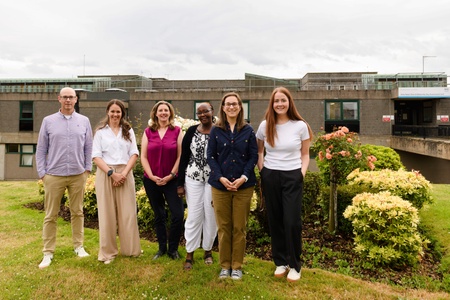

A team of experts led by the University of Aberdeen will, for the first time, establish the way that maternity care should be delivered to pregnant women with multiple long term health conditions.
Made possible by an award of £1.3 million from the National Institute for Health and Care Research (NIHR), the team say their results could benefit the almost one in five women who receive maternity care whilst also managing two or more long term health conditions.
Recent figures show that over 80 women die each year in the UK due to complications arising from their pregnancy and more than one in six pregnant women are also living with multiple long term health conditions.
Common health conditions that can affect health in pregnancy include diabetes, high blood pressure, heart disease and mental health disorders – all of which are on the increase.
The increasing occurrence of multiple long-term health conditions among pregnant women is considered an important contributor to poor maternal outcomes.
Pregnant women with multiple long term health conditions are at double the risk of pre-term birth and 9 times more likely to die during pregnancy than those without these health complications. Despite this, there is currently no defined care requirements for pregnant women with more than one long term health condition.
Living with multiple long term health conditions can make pregnancies more challenging due to a variety of factors.
These include changes to medication, disjointed care received from multiple teams, conflicting advice from different care teams, lack of knowledge of red flags amongst health professionals and a lack of appropriate follow-up of health conditions after birth.
Over three years, the team, led by Dr Mairead Black, Clinical Reader in Obstetrics, at the University of Aberdeen and Honorary Consultant Obstetrician at NHS Grampian will address the challenges these women face and create a package of care that will reduce the risks they encounter in pregnancy.
Known as a ‘care bundle’ it will be specifically designed to guide the safe maternity care for pregnant women with multiple long term health conditions.
The care bundle will include guidance on all aspects of maternity care from medication management and team communication, to midwifery care and postnatal handovers, pulling together expertise from across the health pathway. As well as input from maternity professionals, expertise from people with lived experience of maternity care will also be sought to shape and test the care bundle.
Dr Black will be supported by experts in implementation science including Dr Kristin Konnyu also from the University of Aberdeen and Dr Rosalind Adam, an academic GP also based at the University of Aberdeen. Partners in the research include co-lead Prof Judith Dyson from Birmingham City University, several University and NHS partners and a public panel with lived experience of multiple long term health conditions.
Dr Black explains why this project is so important: “The chance of pregnancy related deaths in the UK is rising and we need to address the reasons for this so we can find the best ways to prevent it.
“We know that people with multiple long term health conditions are at a greater risk of serious complications during their pregnancy and are also at a much greater risk of not surviving the pregnancy or postnatal period.
“This, we believe is preventable. With the correct care in place and appropriate measures taken – this health inequality can be addressed.
“We will gather all the evidence available to us, including from our previous research led by the University of Birmingham, from healthcare providers, midwives, and importantly from the people who have experience of receiving maternity care whilst also dealing with multiple health conditions.
“By the end of this project, we will be able to provide an evidence-led care bundle that is specific to this group of women and that will, for the first time, ensure that their complex needs are taken care of in the best way possible.”
Dr Rosalind Adam GP and Senior Clinical Lecturer at the University of Aberdeen added: "As a GP, I see how difficult it can be for people with multiple long-term health conditions to navigate a healthcare system that is often organised around individual diseases rather than the whole person. During pregnancy, those challenges can become even greater. By bringing together expertise from maternity and primary care, this research will help develop more joined-up, person-centred care, giving women with complex health needs the best possible support before, during and after pregnancy."
Professor Kathy Rowan, Director of NIHR’s Health and Social Care Delivery Research (HSDR) Programme, which is funding the study, said: “Increasing numbers of pregnant women are living with multiple long-term health conditions which can severely affect their health and that of their babies. This important NIHR-funded research aims to inform and improve health and care services for these women with such complex health needs as part of the government’s shift from sickness to prevention. “For the last two decades, NIHR has transformed health and care research. Every research study we fund aims to improve health outcomes that matter most to patients, families and all communities.”
The project will be led by the University of Aberdeen and Birmingham City University alongside partners including Professor Jane Sandall and Professor Krishnarajah Nirantharakumar of King’s College London and support from the University of Birmingham, Manchester University, Barts Health NHS Trust, Newcastle-upon-Tyne NHS Foundation Trust, and Guy’s and St Thomas’ NHS Foundation Trust.
Case study
Mary Hunter, 43, from West Lothian, has lived with multiple long‑term health conditions including kidney failure, gastrointestinal disease and gynaecological complications since she was a teenager. These conditions made both of her pregnancies high‑risk, medically complex, and emotionally overwhelming.
Mary describes being pregnant whilst managing her health conditions as “incredibly daunting”. She said: “I had always dreamed of being a mother, but my medical history meant that pregnancy for me would not be plain sailing.”
Both pregnancies were complicated by placenta praevia and Mary’s declining kidney function, leading to early delivery and neonatal intensive care admissions for both babies.
Mary’s second pregnancy was particularly challenging. At 22 weeks, her one remaining kidney began to fail, triggering repeated hospital admissions, invasive procedures, and difficult decisions about her care. She recalls being presented with two major interventions, a nephrostomy or ureteric stent, and received little specialist advice: “Renal were in a different hospital and no‑one even came to see me… I was given these two options via a phone call with limited information and left to make the decision.”
In the end, Mary had to weigh the medical risks against her mental health often without adequate support. “I felt let down that I had been left to make the decision… I didn’t feel my mental health was considered at all but I find that is common when the emphasis is placed on physical interventions.”
Even her consultant obstetricians acknowledged they had never managed a case as complex as hers. The emotional impact was profound: “Pregnancy alongside multi‑morbidity is a frightening, lonely experience. Not only are you advocating for yourself, you are now finding the strength and knowledge to advocate for your precious bundle too.”
Logistical pressures added further strain. Mary travelled frequently between hospitals 20 miles away, often while unwell, and spent long periods as an inpatient, sometimes in bays with new mothers and babies while she anxiously awaited news about her own pregnancy. She missed her older daughter’s birthday while receiving intravenous antibiotics for a rare infection and struggled with the guilt and exhaustion of trying to maintain work and family life while managing a nephrostomy, infections, and the emotional toll of uncertainty.
Reflecting on her experience, Mary strongly supports this project to develop a new maternity care package: “No woman should have to co‑ordinate her own care or make complex medical decisions alone. A joined‑up maternity care package would have made an enormous difference to me and my family. It will help women feel safe, heard, and supported which will ultimately improve outcomes for mothers and babies.”