
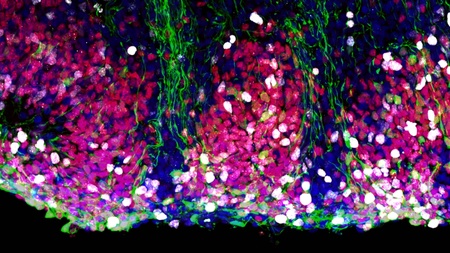

A new 3D model of the developing human brain has been used by researchers at the University of Aberdeen to gain fresh insight into how inflammation during pregnancy may influence early brain development.
The study, published in Nature Neuroscience and funded by UKRI (BBSRC)was co-led by Dr Eunchai Kang and Dr Daniel Berg from the University of Aberdeen’s Institute of Medical Sciences.
Inflammation and infection during pregnancy have previously been associated with an increased risk of neurodevelopmental conditions. However, understanding exactly how inflammatory signals affect the developing human brain has remained a major challenge because many aspects of human brain development cannot easily be studied in the laboratory.
To address this, the Aberdeen-led team developed a new 3D human brain tissue model known as a ‘cerebroid’. Unlike simpler cell culture systems, cerebroids preserve much of the cellular organisation and structure seen in the developing brain, providing researchers with a powerful new tool for investigating early brain development.
Using the new model, the researchers examined the effects of an inflammatory signal linked to immune responses during pregnancy.
They found that this signal can act directly on neural stem cells, changing how neurons are produced and mature during the development of the cerebral cortex, the part of the brain responsible for many higher cognitive functions.
The signal altered the structure of developing brain tissue and changed the timing of neuron production and maturation. The team also identified an important biological process behind these effects and showed that blocking it could reverse many of the changes they observed.
The findings provide new insight into the biological mechanisms through which inflammation may directly influence the developing human brain.
Dr Kang said: “Our findings show that an inflammatory signal associated with maternal immune activation can directly affect neural stem cells during very early stages of human brain development.
“Using our new cerebroid model, we were able to observe changes in the developing cerebral cortex and uncover some of the biological mechanisms that may be involved.”
Dr Berg said: “While there is still much to learn, this work provides a valuable new way to study how environmental influences affect the developing brain and could help inform future research in this area.”
As well as uncovering a potential mechanism through which inflammation can influence brain development, the researchers say the new cerebroid model could be used to study a wide range of other environmental influences on the developing human brain.
The team now plans to build on these findings through further investigations of the biological processes involved and to explore additional applications of the model.
The study was only possible due to the generous donation of human tissue for research and the research team would like to express their gratitude for the donors and the NHS staff involved with the tissue collection.
The study was funded and supported by UK Research and Innovation (UKRI) Biotechnology and Biological Sciences Research Council (BBSRC), including an EASTBIO PhD studentship supporting Dr Muhammad Z. K. Assir; The Academy of Medical Sciences; The Medical Research Council (MRC); The Royal Society; The Humane Research Trust; European Union research programmes, including the Marie Skłodowska-Curie PROTECTED, FREIA and INITIALISE projects.