
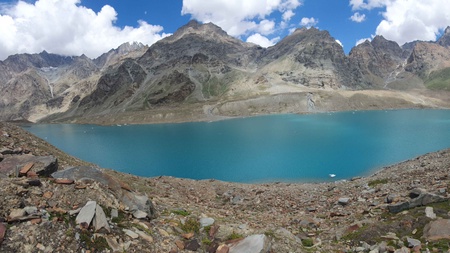

Researchers call for urgent rethink of global hazard monitoring as "Small Alpine Lake Outbursts" emerge in a warming world
A new international study involving scientists from the University of Aberdeen has revealed a critical blind spot in global climate risk assessments - the growing danger posed by small alpine lakes formed by glacier retreat and permafrost thaw.
Published in Nature Sustainability, the research highlights how these lakes, which are often too small to appear in conventional hazard databases, can still unleash sudden and destructive floods with little warning.
The findings challenge long-held assumptions that only large glacial lakes pose significant threats and call for a fundamental shift in how mountain hazards are monitored and managed.
The study introduces the concept of Small Alpine Lake Outbursts (SALOs), a newly defined hazard category that includes both small glacial and thaw lakes.
These floods are often triggered when rocks, ice, or landslides suddenly crash into fragile mountain lakes, or when the loose natural dams holding them in place give way. Earthquakes and extreme rainfall events can also be the primary triggers.
The researchers argue that this emerging risk is intensifying as climate change accelerates glacier melt and destabilises mountain environments worldwide.
Despite their size, these lakes can produce devastating impacts, particularly in steep and unstable terrain. The study shows that risk is not determined by lake size alone, but by a combination of environmental triggers, landscape instability, and downstream vulnerability.
Crucially, the research finds that current global monitoring and policy frameworks are heavily skewed toward larger lakes, meaning many smaller but dangerous lakes are systematically ignored. This leaves remote and marginalised mountain communities - often with limited early warning systems and institutional support - especially exposed.
Real-world case studies from 2025 illustrate the scale and inequality of the problem. In Nepal’s remote Limi Valley, a previously undocumented small lake triggered a flood that destroyed bridges, irrigation systems and hydropower infrastructure, yet received little international attention. In contrast, a similar event in Peru near the Vallunaraju Glacier caused fatalities and major damage but prompted a rapid response, highlighting disparities in visibility, governance, and disaster preparedness.
The study also points to a technological turning point in addressing these risks. Advanced Earth observation tools such as high-resolution PlanetScope imagery, SAR and InSAR sensors, UAVs, AI-driven mapping, and the upcoming NASA–ISRO NISAR mission, might make it possible to identify and monitor these small, fast-changing lakes in ways that were not previously feasible.
Researchers say harnessing these technologies will be essential to improving early warning systems, strengthening climate resilience, and ensuring more equitable disaster risk governance in mountain regions globally.
“No lake is too small to be dangerous,” said Dr Lydia Sam a glaciologist and Lecturer at the University of Aberdeen and co-lead of the study. “Focus has been the biggest lakes because, naturally, they’re easier to see in satellite images. But several recent outbursts globally show that even tiny, hidden lakes can trigger serious floods. To overcome these observational limitations, in this study, we have also provided a novel and comprehensive catalogue of remote sensing options and risk-informed recommendations for mapping and monitoring small alpine lakes, including sensor thresholds and mission combinations. This will be a valuable resource for the SALO hazard research community.”
“If we don’t start recognising these risks now, we’re leaving some of the world’s most vulnerable communities exposed to disasters that go unseen and unprepared for. We now have the technology to monitor these smaller lakes more easily and we should use it”, says Dr Rayees Ahmed, the lead author of this work.
“Under a Natural Environment Research Council (NERC) funded project led by Dr Lydia Sam, the team is now heading to the Nepal Himalaya with several geophysical instruments to better understand the triggers for one of such SALO events”, adds Dr Anshuman Bhardwaj, co-author and Head of Department (Planetary Sciences).
The study represents a collaborative effort between the University of Aberdeen, the Indian Institute of Science and Kyoto University, combining expertise in cryosphere science, remote sensing, geomorphology, and disaster risk management across multiple mountain regions.
Researchers are calling for urgent updates to global hazard inventories and climate adaptation strategies, moving beyond simple size-based thresholds toward more comprehensive, risk-informed approaches.
ENDS