
Researchers from the University of Aberdeen played a key role in international discussions on climate action and a just transition during London Climate Week, which this year saw over 60,000 attendees gather amid a record-breaking heatwave exceeding 36°C.
Professor Tavis Potts of the School of Geosciences and the University’s Just Transition Lab attended the event, where the extreme temperatures served as a stark reminder of the urgency underpinning conversations on climate science, policy and societal change.
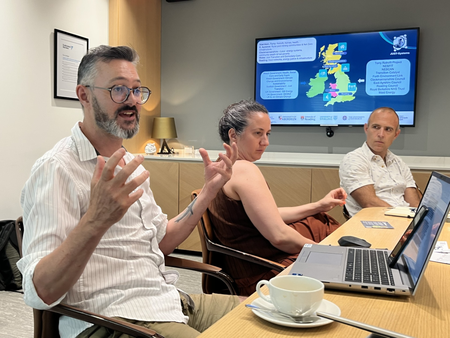
Alongside Dr Rebecca Macklin, Interdisciplinary Fellow in Social Inclusion and Cultural Diversity, Professor Potts co-hosted and participated in a high-level session in collaboration with the Northeast Scotland Climate Action Network (NESCAN Hub) and Action for a Fairer World. The discussion was moderated by Saker Nusseibeh CBE, CEO of Federated Hermes and a global leader in responsible investment, and featured insights from Satya Tripathi, former United Nations Assistant Secretary-General and Director of the Global Alliance for a Sustainable Planet (GASP).
The event, titled Powering Change: A Systems Approach to Achieving a Just Transition in Scotland, examined emerging findings from the UK Research and Innovation (UKRI) JUST-Systems project and the Scottish Government-funded Just Transition Communities initiative. Discussions centred on the challenges of scaling up climate action, improving delivery mechanisms and achieving meaningful transformation.
Participants explored how adopting a systems-based approach could support Scotland in delivering a genuine just transition that balances economic change with environmental protection and social equity. The session emphasised the importance of moving beyond isolated projects to consider the broader interaction between finance, policy, ecosystems and communities.
Professor Potts highlighted that by understanding these interconnected systems, policymakers and practitioners can better support long-term, community-led action. “A systems approach provides a foundation for delivering not only climate resilience, but also biodiversity restoration and community empowerment,” he said.