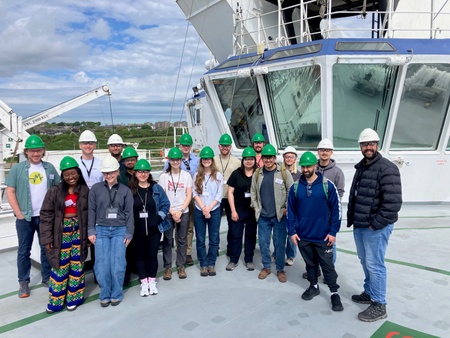

A group of University of Aberdeen geophysics and integrated petroleum geoscience students and staff were given a rare opportunity to step aboard one of the world's most advanced seismic vessels during a visit to Shearwater SW Tasman in Aberdeen.
The visit, which took place on Tuesday 26 May 2026, brought together 18 students and staff from the University’s MSc and PhD programmes for a guided tour of the vessel, hosted by Party Chief Duncan Ansell-Vaughan and organised with support from Will Burgin at Shearwater.
The SW Tasman is a specialist geophysical vessel owned, operated and fully managed by Shearwater. Shearwater describes it as the world's first commercial multi-technology geophysical vessel, combining dual ROV capability, Pearl ocean bottom node operations and seismic source capability in a single platform. Following a significant upgrade for the ocean bottom node (OBN) market, the vessel returned to service in September 2023. Its single-vessel OBN capability reduces the risk and schedule uncertainty traditionally associated with multi-vessel node operations.
During the visit, students were introduced to the operational environment of a modern seismic vessel, including onboard working practices, ocean bottom nodes (OBNs), remote operation vehicle (ROV) node deployment, seismic data quality control, survey logistics, safety culture, and the range of technical and professional skills required offshore. The visit complemented formal teaching in seismic acquisition, processing and interpretation, giving students a direct insight into how the theory, workflows and datasets discussed in class are applied in industry.
The visit also builds on Shearwater’s wider support for geophysics teaching at the University of Aberdeen. The University benefits from Shearwater’s support through access to Reveal, Shearwater’s seismic processing and imaging software, which is used in MSc Geophysics teaching. Reveal provides tools for seismic data processing and imaging, from onboard quality control through to processing, model building and depth imaging, and gives students experience with industry-relevant software workflows.
Dr David Cornwell, Senior Lecturer in Geophysics at the University of Aberdeen, said: “We are extremely grateful to Shearwater, Duncan Ansell-Vaughan and the crew of the SW Tasman for giving our students such a valuable insight into the realities of modern marine geophysics. Seeing the vessel, meeting the people who run these operations, and understanding how seismic acquisition and processing fit together offshore makes a huge difference to student learning. It brings the subject to life in a way that cannot be fully replicated in the classroom.
“Shearwater’s support through access to Reveal is also very important for our MSc Geophysics teaching. It allows students to develop practical skills in seismic processing using software and workflows that are directly relevant to industry and research careers.”
William Burgin, Sales Manager at Shearwater, said: "We were delighted to host the University of Aberdeen aboard the SW Tasman. Supporting the geoscience community here in Aberdeen and the next generation of geoscientists coming through it, is something we believe matters for the whole industry — whether that's through access to Reveal in the classroom or opening up our vessels so students can see the technology and teamwork behind modern seismic acquisition. These are the people who'll shape the future of our industry, and we hope experiences like this give them a real sense of where a career in marine geophysics could take them."
MSc Geophysics student, Karan Sharma said: "Touring the SW Tasman was an incredible experience. It really highlighted the multi-disciplinary approach needed for Seismic acquisition and processing - from the node team in charge of keeping the receivers in top shape, the skill required by the ROV operators in placing and extracting these nodes, the constant monitoring on board the ship office to the eventual processing required while the ship was kept in place by the deft bridge crew. It's hard not to be taken aback with the skill of the crew and the professionalism they display daily, and exciting to see how learning the basics of Reveal in the MSc allows for greater appreciation of how the raw data is collected in the first place. I would honestly love to work in an environment such as this one!"
MSc Geophysics student, Mauro Garcia Enriquez said: “It was a huge opportunity to be part of the team that experienced the uniqueness to be aboard on a seismic acquisition vessel. Being on the different areas that complete the whole process was very illustrative. From the navigation system, the display and collection, the positioning and the data treatment team until the recreational areas were essential in the seismic acquisition synergy. To chat with the tribulation on board and have a little glance on how their life is in that floating station was in readings to experience. On the other hand, be able to see the machinery that the crew use, making emphasis on the sensors they used and how they have to deal with setbacks was extraordinary and inspiring.”
The University of Aberdeen’s MSc Geophysics programme trains students from backgrounds including geology, geosciences, physics, mathematics and engineering in the theory and application of geophysical methods. Teaching spans seismic acquisition and processing, environmental and near-surface geophysics, GIS, geophysical interpretation, and emerging digital and machine-learning approaches. The programme prepares students for careers across the energy, marine geoscience, environmental, engineering and research sectors.
The visit highlights the value of collaboration between universities and industry in developing the next generation of geoscientists. By combining classroom teaching, practical software training and direct exposure to working offshore environments, students gain a clearer understanding of the skills, technologies and teamwork required in modern geophysics.