
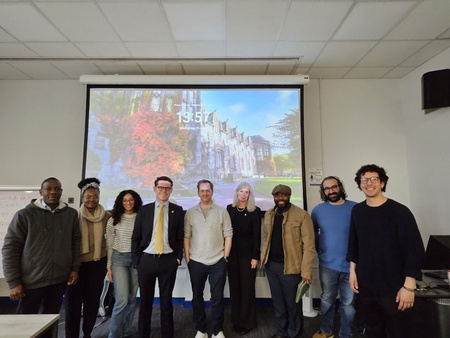

On Wednesday, 15 April 2026, the Aberdeen University Centre for Energy Law (AUCEL), had the pleasure of hosting an alumnus of the University of Aberdeen; Mr. James Hewitt, Senior Planner at the Aberdeenshire Council.
James delivered delivered a talk titled: ‘The Scottish Energy Consenting System in Practice: A Planner’s Perspective’ where he explained the consenting process through the relationships and interdependencies between government ministries and departments from planning, assessments, approval (or otherwise) up to environmental appeals. With particular reference to his work at the Aberdeenshire Council, he exemplified their team’s differing roles in National Planning Applications, Electricity Act Consenting/Consultations and Marine Licensing through the different phases of Pre-application; Screening/Scoping; Application Assessment; Decisions/Inquiry and Conditions/Discharge.
He discussed a brief history of the development of Planning Laws and Consenting in Scotland and traced the evolution of legislation [including, for example, the Electricity Act, 1989; Town & Country Planning (Scotland) Act, 1997 (As amended); Electricity Works (Environmental Impact Assessment) (Scotland) Regulation, 2017] from a planning point of view and noted the progression from the goal of ‘directing the right development to the right place’ to the current holistic charter of the National Planning Framework 4 (NPF4), which supports evidence-based, sustainable development through focus on promoting nature-based solutions to climate change and nature recovery; enhancing connectivity through nature networks, continuing role for developer contributions, were statutory tests are satisfied among others, as primary guiding principles for all plans and permissions. Thus, he highlighted the import of Environmental Impact Assessments (EIAs) as the comprehensive document that generates evidence while the planning laws and policies help to test this evidence against set parameters to navigate the peculiarities of each project, in a bid to determine project viability. In buttressing his submissions, James shared interesting case studies of the law in action in planning Energy Projects such as the Hurlie Substation Project and the Wull Muir/Raeshaw Wind Farm Project, respectively.
James opined that while a planning permission generally authorises the development of an area, it does not automatically remove the other legal obligations to other protected parts of the environment such as biodiversity and protected species, land, water bodies and so on. Therefore, this demand for balance underscores the planner’s duty to work in collaboration with many relevant professionals to ensure that planning provides the methods to ascertain that projects are indeed, evidence-led acceptable development.
After fielding copious questions from students and legal practitioners in the audience, attendees agreed that the seminar was intellectually stimulating for participants as it created the avenue to hear beyond the letters of the relevant laws; but more about an practitioner’s perspectives on the implementation of the laws for environmental protection, in balance with the goals of the energy transition and sustainable development in Scotland.
AUCEL and the Law School are very grateful to James joining us!