
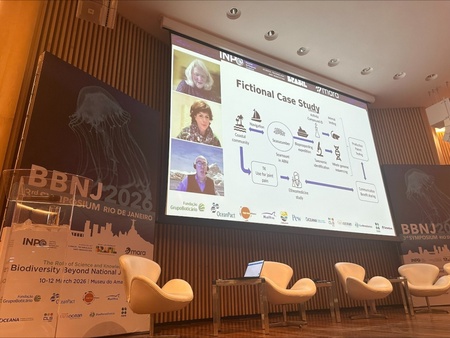

Professor Abbe Brown (Law) and Professor Marcel Jaspars (NCS) together with philosopher of science Professor Michela Massimi of the University of Edinburgh launched their edited collection Ways of World Knowing: Local Knowledge, Coastal Communities and Equitable Ocean Governance (Oxford University Press) in Rio de Janeiro on 10 March 2026.
Ways of World Knowing an output of their interdisciplinary international research Scientific Knowledge Across Jurisdictions (SKAJE) and Ocean and Us projects funded by the Royal Society of Edinburgh . These projects explored challenges confronting scientific knowledge production working with Marine Genetic Resources and Digital Sequence Information which might come from areas beyond a state’s control, questions of public good and private commodity, fair epistemological narratives about who owns the ocean, and paths towards fairer and more inclusive approach to stewarding scientific knowledge production and more equitable ocean policy. Ways of World Knowing has contributors from all over the world, from a wide range of disciplines (philosophy, law, chemistry, arts) and includes authors with First Nations and Indigenous heritage. The hybrid launch event was held at “BBNJ 2026 3rd Symposium”.
BBNJ (in full, Agreement under the United Nations Convention on the Law of the Sea on the Conservation and Sustainable Use of Marine Biological Diversity of Areas beyond National Jurisdiction) came into force in January 2026. The Rio meeting was an important opportunity to explore paths to implementation of the Agreement in advance of the third meeting of the Preparatory Commission in New York in March/Apil 2026. The BBNJ Agreement is transformative for governance of around two thirds of the ocean. Access and benefit sharing, capacity building, traditional knowledge, and a coherent and non undermining approach across different legal regimes are key parts of the BBNJ Agreement.
The BBNJ Agreement also provided the base for Massimi, Brown and Jaspars’ contribution to the collection. Their contribution explores new forms of thinking and practical suggestions regarding the importance of the term” local knowledge” (an established term in geographical, cultural and philosophical work, but less familiar to law which works more with “traditional knowledge”); the importance of place-bound, place-based and placed-indexed knowledge; the intersections with intellectual property rights; and paths to braided, non-exploitative and equitable approaches to scientific practice working with resources linked with coastal communities, which was explored using a hypothetical case study.
In 2026, Professors Jaspars and Brown have continued their policy engagement to inform a law-science-policy nexus approach to implementation of the BBNJ Agreement in advance of the third meeting of the Preparatory Commission. Professors Jaspars and Brown have co-produced, together with colleagues at ANCORS, a 4 part podcast series building on an edited book to which they contributed Decoding Marine Genetic Resource Governance under the BBNJ Agreement (Springer), edited by Dr Fran Humphries. This book is published open access through the support of the BlueRemediomics project of which Professors Jaspars and Brown are part. Professors Jaspars and Brown also contributed to Episode 3: Anchoring the Framework: Interaction between Treaty Systems and Episode 4: Navigating the Voyage Ahead: Treaty Implementation.