
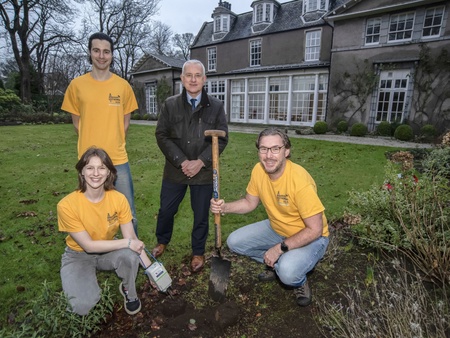

Researchers exploring Aberdeen's potential for geothermal heating have begun deploying a city-wide network of seismic nodes that will be used to create a 3D subsurface map.
Installed across a mix of public and private green spaces, including domestic and commercial properties, as well as local authority municipal areas, each of the 100 nodes will be buried in the ground to record natural and man-made vibrations from waves, wind and traffic over the next 1-2 months.
Approximately 10 cm x 10 cm x 30 cm in size and covered by a thin layer of soil, the ‘seismic noise’ each node records will help create a map of the granite and other subsurface structures to a depth of 5 km beneath the entire city.
Installed by a team of volunteers over three days across an area ranging from the Bridge of Don to Nigg, and inland as far as Hazlehead, the resulting data will show where geothermal heating will work best in Aberdeen.
Dr Amy Gilligan, researcher with the Aberdeen Geothermal Feasibility Pilot (AGFP), said: “This marks the beginning of an exciting stage of the project. By placing these small sensors in the ground, we can safely and quietly listen to natural vibrations and build a picture of the rocks deep below Aberdeen.
“Most people won’t notice the sensors once they are in place but what we learn will help us understand whether geothermal heat could one day provide a clean, local source of heating for homes and public buildings, reducing carbon emissions and support a more sustainable energy future for Aberdeen.”
The AGFP is an ambitious city-wide collaboration exploring Aberdeen’s geological potential and paving the way for low-carbon heating solutions.
Funded through a £1 million public grant from UK Research and Innovation (UKRI) and led by the University of Aberdeen, subject to planning consent the project will see an instrumented borehole drilled to a depth of over 500 metres on King’s College campus in Old Aberdeen.
The borehole will provide direct subsurface temperature, geology and hydrology data and provide the startling point to test the potential for heat generated by granite at depth to be used to heat homes, the University and other buildings across the city.
With all the data collected being made openly available by the team, the project will be the first to provide the in-field geological data needed to help bring the University’s ambitions and other initiatives being considered across the city and across the UK to reality.
The pilot draws on expertise from the University of Aberdeen’s Estates & Facilities, Geosciences and Engineering Schools, the Centre for Energy Transition and the Just Transition Lab, supported by a broad consortium of collaborator and partner organisations including NHS Grampian, Aberdeen City Council, Aberdeen Heat and Power, Robert Gordon University, Geosolutions Leeds at the University of Leeds, the British Geological Survey, TU Delft Netherlands, the National Geothermal Centre, the Net Zero Technology Centre and Aberdeen Renewable Energy Group, alongside several experienced and skilled geothermal industry partners and individuals.