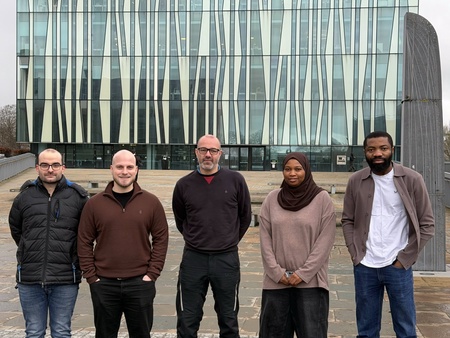

A team of PhD students from the University has succeeded against competition from around the world to finish second in the UN sponsored AI Environmental Footprint Measurement Hackathon.
The competition, organised through the AI for Good initiative, brought together innovators from across the globe to tackle one of the most urgent challenges in modern technology: how to measure and reduce the environmental impact of artificial intelligence systems.
Representing the University were Luis Carvalho, Abu Abu, Aisha Olomowewe, and Aldo Moreno, all PhD researchers from the Artificial Intelligence, Robotics and Mechatronics Systems Group (ARMS). Their project, titled “Standardizing Energy Models for Large-Scale AI Training with Long-Term Sustainability Projections,” proposed a novel framework for assessing the efficiency and environmental footprint of AI infrastructure.
The team progressed through multiple competitive stages, ultimately presenting their solution to an expert panel of judges. Their innovative approach earned them second place worldwide.
The students’ model addresses a growing global concern. As AI systems - including large language models - expand in scale, so too do their demands on energy and water resources. The hackathon challenged participants to create transparent, reliable methods for measuring the carbon and water footprint of AI technologies. The team’s proposal not only met this challenge but also offered a pathway toward future industry standards for evaluating and comparing the environmental cost of AI across platforms.
The team’s submission will be showcased at COP30, placing their research in front of global policymakers, scientists, and industry leaders.
Dr Andrew Starkey, Reader from the School of Engineering, said:“I’m incredibly proud of our PhD students for achieving such an exceptional result in a highly competitive global UN challenge. Their success highlights both their technical expertise and their commitment to advancing Green AI.
“This project demonstrates how engineering principles can drive meaningful innovation in AI sustainability, and the team’s achievement will undoubtedly inspire further development of their model and contribute to shaping future industry standards.”