
A collaboration between the University of Aberdeen and a Canada-based resource company dedicated to the discovery and development of primary helium projects has already made a potential breakthrough in helium exploration.
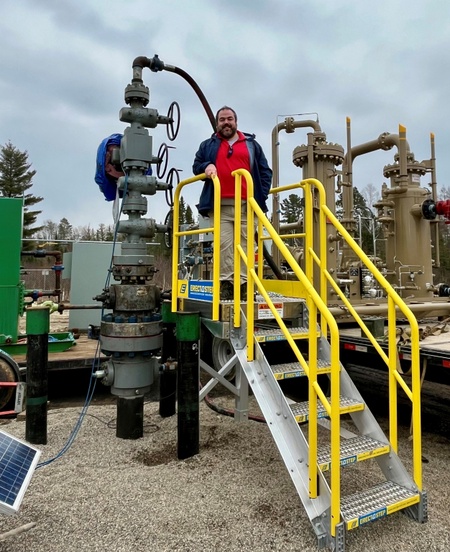
Professor of Igneous & Petroleum Geology at the University, Nick Schofield, started a secondment with Pulsar Helium last year to work on its Topaz Project in Minnesota. The team are currently drilling a series of wells and already seeing results, having made five key discoveries. In his role, Professor Schofield acts as Chief Geologist and oversees the geological programs, including subsurface data interpretation, well and corehole planning, and seismic acquisition.
In 2011, a mineral exploration company in Minnesota (not Pulsar Helium) was undertaking exploration drilling for nickel. At about 530 metres below the surface, the borehole encountered high-pressure gas, which then began to escape the borehole unconstrained. Rudimentary analysis at the time confirmed that the gas contained high levels of helium.
Professor Schofield said: “Helium is much more than just a filling for balloons, it’s used in a whole range of items, from MRI scanners, through to microchip production, as a mix for deep sea divers (Heliox), and more. It is an essential gas for the green energy transition and new technologies, but supply is constrained as it is currently a byproduct of natural gas production. Pulsar aims to change that by developing Topaz which is a primary helium occurrence with negligible hydrocarbons.
“Pulsar Helium is focused on unlocking new helium resources. In 2024, the company drilled Jetstream-1 in Minnesota, confirming the remarkable discovery first hinted at in 2011. Gas samples revealed an average helium concentration of 8%—a figure that far exceeds the 0.3% threshold typically required for economic viability. The resource is hosted within the Duluth Complex, one of the world’s largest igneous formations.
“Currently, following up on the Jetstream-1 well, we’re in the middle of an exploration and appraisal campaign, involving drilling a series of wells between 3000 and 5000 ft. Three have been drilled so far at locations where my work has been key in the selection, so it’s an exciting time. All three are showing evidence of high-pressure gas, which we will be testing in the coming months.”
With Minnesota having no prior history of producing gas from under the surface, Professor Schofield, along with colleagues at Pulsar, have been working closely with state entities to help establish new frameworks for helium development.
Professor Scholfield said: “On a personal front, the secondment has opened up a whole new geological frontier for me and allowed me to integrate the cutting-edge research into real-world resource development. Scientifically, the new work and data reveal many previously unknown aspects of the Duluth Complex, and I’m looking forward to publishing some of it in the future with colleagues from Pulsar.”
Thomas Abraham-James, CEO of Pulsar Helium commented: “Nick’s secondment has been hugely positive for Pulsar Helium, bringing both world-class expertise and an infectious enthusiasm that have driven exceptional progress in our exploration program. Under his guidance, our work has flourished, we've achieved significant breakthroughs and hit milestones that exceeded our expectations. We’re proud to have Nick as part of the Pulsar team and look forward to a long and successful association with him and the University of Aberdeen.”
Professor Schofield will work with Pulsar Helium until at least 2027. Together, they aim to achieve two major milestones: accurately determining Topaz resource size and starting helium production at the Topaz Project
In addition, as a result of the collaboration, new teaching modules on helium exploration fundamentals have been introduced in the University's flagship geoscience MSc programs in Integrated Petroleum Geoscience, Sustainable Geoscience, and Geophysics.
Professor Schofield added: “This kind of joint-industry collaboration shows the real-world positive impact that academic work can have.”