
A University of Aberdeen engineer turned artist will showcase work drawing on life in north-east Scotland - and combining her passion for both disciplines - at the Aberdeen Art Fair.
Kate Steenhauer, who gained a PhD in Coastal Engineering in 2010 and worked as a research fellow in the School of Engineering, will share her inspiration and creations at Aberdeen Music Hall from Friday August 29 to Sunday August 31.
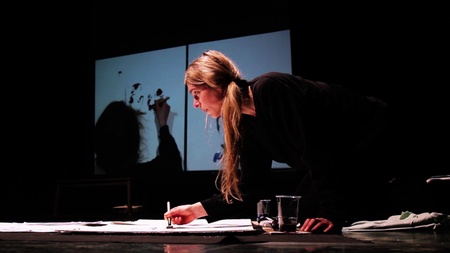
In recent years Kate has worked with robotics and AI expert Dr Andrew Starkey from the University’s School of Engineering to develop Painting Music – a unique tool which uses explainable and green AI to create musical compositions from live drawing.
Kate, who is originally from the Netherlands, had always had an interest in art but it wasn’t until she completed her PhD that she decided to undertake art lessons. Since then, her career has flourished and she has gained an international reputation as a visual artist and filmmaker.
In addition to the people and places of north-east Scotland, her work is also inspired by and pays tribute to a female mathematician and writer hailed as one of the earliest pioneers of computer science, who also had connections to Aberdeen.
Ada Lovelace, the daughter of Aberdeen-born Romantic poet Lord Byron, is remembered for her groundbreaking work on Charles Babbage’s proposed mechanical general purpose computer, first described in 1837.
Kate says her own connections to both engineering and art drew her to Lovelace who described a machine making music 200 years prior to the creation of Artificial Intelligence.
She said: “After completing my PhD, I decided I wanted to get art lessons. It was always something I had wanted to do and while working as a research fellow at the University I was taken on by an artist in Aberdeen and had two years of tuition.
“After that my passion really developed. I took a part-time job and art became more serious.”
Kate found she did not have to look far for inspiration for her drawings.
“I was immediately inspired by Aberdeen’s stories,” she adds. “I had a studio down by the harbour and found so much of interest in people going about their daily lives.
“I’m fascinated by real people not celebrities or sitting portraits, I prefer people in their natural habitats engrossed in what they are doing.
“Here in Aberdeen you have so much of interest from the cranes crossing the sky, trucks coming and going into the harbour and seagulls to people doing boat maintenance or getting ready to launch vessels. There’s so much activity to draw or to capture.
“I started drawing those scenes and then from there I got into Aberdeen heliport via my engineering connections. That led me into the whisky industry at Speyside Cooperage and to Thainstone Mart for the livestock auctions. Every aspect of my work is tied into north-east Scotland.”
Kate says that while many consider art and engineering as opposite ends of the spectrum, for her the two marry well together.
“I have an analytical mind and everything starts with ‘why’? Why does that work in the way it does, or why does that not work, and that helps with compositions or creating depth.
“I was then invited into the theatre which was initially well out of my comfort zone but my work began to evolve into more visual art. I realised drawing was very fluid and has a performative application and this in turn led me back to engineering and back to the University of Aberdeen.”
Kate discussed her ideas on bringing the two disciplines together with Dr Andrew Starkey, who specialises in AI and robotics, and from this the Painting Music project emerged.
Software developer Jack Caven joined the team and together they produced technology which translates tangible painted marks into audible sounds in real time and unique for each performance.
Kate added: “Painting Music is exactly what Ada Lovelace envisaged all those years ago. Ada was the first software engineer in the world and saw that data could represent anything – symbols, letters or musical notes.
“We have taken her vision and applied it to modern technology but with that comes AI and ethical questions about how robots learn, how they make ethical decisions and how they become creative.
“My artwork draws on all of this but sets it within the context of Aberdeen’s stories, people, history and landscapes.”
Kate’s work will preview on Friday August 29 and will then be on public display on Saturday and Sunday (August 30-31) from 10am to 5pm. For more information visit http://www.aberdeenartfair.co.uk/