
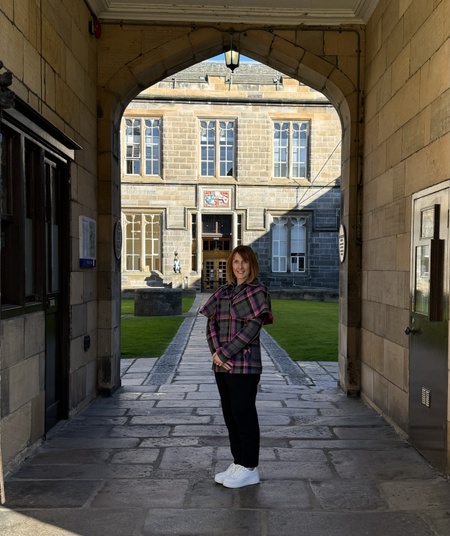

The University of Aberdeen's Board Apprenticeship offers a rare insight into institutional governance and the opportunity to engage with senior leaders and decision-makers across the University.
Keen to explore the world of governance but unsure where to start, alumna Shona Russell applied for the role last year in the hope it would develop her experience in a board environment and improve her understanding of the Higher Education sector, all while supporting her alma mater.
Shona graduated from the University of Aberdeen in 2000 with a MA (Hons) in English and Management Studies and has worked in HR for the last 15 years. Here she tells us why she decided to apply for the role, what she learned during her year on Court and why she’d recommend the experience to those looking for insight into the world of governance.
Why did you apply for the Board Apprentice role?
I saw the advert for this role when it was shared with the Alumni community. It stood out for me as I’d never come across the concept of a ‘Board Apprentice’ and I was curious to find out more.
I had reached a point in my career where I was considering the possibility of exploring Trustee and Non-Executive Director roles but wasn’t entirely sure if my skillset or experience would be of value. The Board Apprentice role felt like an excellent opportunity to test this. I’ve also spent my entire working life to date in the retail industry, so the opportunity to gain deeper insight into another sector was appealing. Similarly, as a proud Aberdonian whose work has seen them living in London since graduation, it was a great opportunity to reconnect with home - and hopefully an opportunity to give something back to the University too.
What does the apprenticeship involve?
It’s such a privileged position. As Board Apprentice I was given full access to the University Court and attended its five in-person meetings across the academic year. Ahead of each, I had access to all supporting meeting documentation so that I could be fully briefed on the agenda topics. Unlike formal Court members, the Board Apprentice has no voting rights, but I was always included in all communications and given the opportunity to check understanding or detail ahead of time. Members of the Senior Management Team were also generous with their time in supporting my navigation of governance in the Higher Education sector.
Additionally, I was given the opportunity to attend each of the five supporting Court Committees. Seeing these in action was invaluable too, particularly as it enabled me to experience how discussions and ‘heavy lifting’ at committee level developed into formal proposals presented at Court for approval.
I completed the Apprentice role alongside a demanding full-time day job. The formal Court meetings required me to be in Scotland for two days every other month. Any additional Court meetings were virtual. Committee meetings were typically hybrid.
What do you think you’ve learned from the apprenticeship?
Above all, I'd like to explore securing a formal governance role in the future. I’d heard it said before and now definitely agree that it’s never too early or too late in your career to consider a Board role. It’s been great to ‘look behind the curtain’ and see a Board in action without being on the hook for decisions or being held to account in debates. I’m also leaving with a much deeper understanding of the Higher Education sector and its challenges and opportunities.
It’s been a hugely rewarding experience - for confirming that I can add value to a Board but also for highlighting some gaps that I’d like to address to make me more efficient when I progress this. I’m keen to find the right opportunity and with an organisation that I have an affiliation with. I’ve loved the opportunity to reconnect with Aberdeen University for this very reason.
What was the highlight of your time in the position?
I was made incredibly welcome by Court members - academics, trade union representatives, professional services, student ambassadors, senior management and independents - all of whom broadened my perspective from their wide and varied backgrounds. I learned so much from each of them and am leaving with a significantly enhanced professional network.
Were there any challenges you faced?
It is definitely a time commitment so I am hugely grateful to my manager and colleagues who were so supportive of my focusing on my personal development in this way. With some discussions, particularly in relation to HR matters which is my professional specialism, it was also quite difficult not to express a view. I was always comfortable that I was an observer - but did use this as a means of getting to know my fellow Court members ‘offline’ where I could explore rationale for discussions in more detail, in support of my learning.
What would you say to anyone considering applying for the role?
Go for it! It’s such a versatile role, so whatever your motivation for doing it, you can be guaranteed to learn and gain supporting experience. Plus, Higher Education is such an evolving sector. In the single academic year I was attached to Court there was such change and development (positive and challenging) that I learned much more than governance - tenacity, resilience, compromise, re-prioritisation and the value of diversity of thought.