
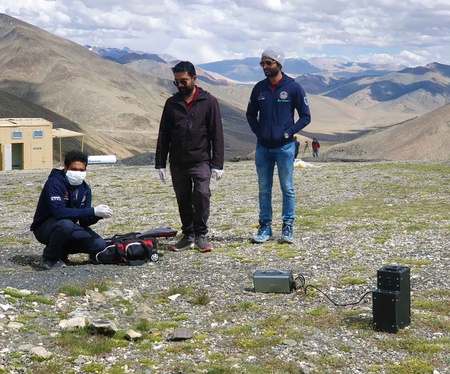

Space scientists at the University of Aberdeen have taken their pioneering research to new heights - but this time, right here on Earth.
Researchers from the University’s Department of Planetary Sciences travelled to the Indian Himalayas to demonstrate how specialist equipment developed for future planetary missions can also help societies in some of the harshest climates on Earth.
The high-altitude cold desert of Ladakh in India, with its thin atmosphere, harsh environment, and unique geomorphology shares similarities with the environment on Mars.
For communities living in such extreme conditions, issues such as water scarcity, pollution, energy insecurity, and climate change are urgent and growing.
The University of Aberdeen team, formed by Dr. Anshuman Bhardwaj (Senior Lecturer), Prof. Javier Martin-Torres (Head of Department), Dr. Lydia Sam (Lecturer), and Research Fellows Dr. Thasshwin Mathanlal and Dr. Miracle Israel Nazarious, were invited to participate in Spaceward Bound India 2025 (SBI), a prestigious initiative led by the space startup Protoplanet, in collaboration with the Indian Space Research Organisation (ISRO) and inspired by NASA’s outreach programme.
The project brought together over 20 international organisations, ranging from space agencies and academic institutions to NGOs and private-sector innovators, with the shared goal of testing space technology in high-mountains of Ladakh. The Aberdeen team was specifically focussed on identifying the possibilities of harnessing space science to address environmental challenges in vulnerable regions.
The Aberdeen team were keen to investigate how space technologies, such as AI-powered monitoring and miniaturised sensors can be adapted to serve communities in remote and environmentally fragile regions.
Dr Anshuman Bhardwaj from the University of Aberdeen said: “While space exploration has long captured our imagination, this important initiative helps show how tools developed for understanding landforms, habitability, and atmospheres on distant planets can also benefit us here at home. This project is about reimagining space technology - not as distant science fiction but as a tool for tangible help for communities around the world.”
The University’s Department of Planetary Science is internationally recognised for its role in developing HABIT, Europe’s first In-Situ Resource Utilization (ISRU) payload designed to extract water from the Martian atmosphere. Prof. Javier Martin-Torres, the Principal Investigator of the HABIT instrument said: “The same technology, when adapted for Earth, could help address critical water security issues in mountain regions like Ladakh.”
Past research from the department also includes environmental monitoring using satellite data and AI to assess glacier retreat, land use changes, renewable energy potential, and pollution trends.
As part of the visit to Ladakh, with the support of Ladakh University and in their campus, the Aberdeen team deployed an in-house low-cost monitoring station to collect open-access data on space weather events.
In May 2024, aurora borealis was spotted in Ladakh, an unusual phenomenon at such lower latitudes. The newly installed instrument will help study such events in future.
The Aberdeen team also made inroads to planning workshops, school visits, and stargazing nights to promote STEM engagement and citizen science.
The Aberdeen team also used the opportunity to gather evidence for a forthcoming Impact Case Study, positioning the University of Aberdeen as a global leader in applied space science for sustainable development.