
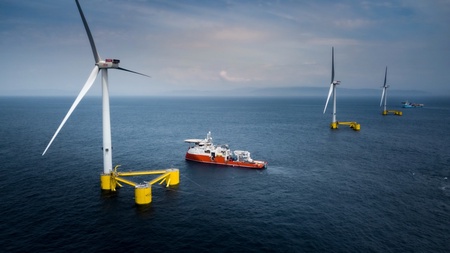

A recently published study from the University of Aberdeen has revealed a new approach to evaluating the ecological impacts of offshore activities.
By integrating a dynamic ecosystem model with a comprehensive ecosystem services database the team, which includes researchers from the Plymouth Marine Laboratory, aim to accurately forecast the environmental consequences of fisheries displacement and broader ecosystem-level changes resulting from offshore wind farm development.
The scientists says that this new methodology will have the ability to support marine spatial planners to balance and minimise conflicts and tensions amongst existing and future planned marine uses of natural resources.
The proposed methodology also provides an approach to integrating the relative value of Marine Net Gain (i.e a conservation approach that ensures human activities in marine environments result in a measurable net positive impact on biodiversity) interventions in terms of wider Natural Capital Accounting. This will further progress understanding of ecosystem services and market-based approaches which will enable stakeholders to access and compare global studies on the environmental and socio-economic outcomes of offshore wind farm developments.
Dr Neda Trifonova from the University of Aberdeen and lead author of the study said: “The rapid expansion of offshore wind farms is a key component of global decarbonisation efforts. However, in the race to achieve Net Zero, it is essential to ensure that we do not inadvertently create new environmental challenges. Our study presents a methodological roadmap designed to support sustainable and evidence-based marine management and offshore renewable energy policies.
“Given the dual pressures of climate change and spatial conflicts with existing industries such as fishing, our approach aims to enhance decision-making by balancing environmental and socio-economic trade-offs. We propose the use of dynamic ecosystem modelling to inform a risk assessment framework, supported by a comprehensive ecosystem services database.
“At the heart of our methodology is supporting a nature-positive approach—a conservation principle that ensures human activities in marine environments result in a measurable net gain for biodiversity and ecosystem services.”
This project was funded by the Natural Environment Research Council (NERC) and The Crown Estate (TCE), part of the ECOWind Programme, as well as the UK Energy Research Centre. The study is published in BES Ecological Solutions and Evidence.