
Williams College/Clark Art Institute graduate student Nora Høegh has made some fascinating discoveries undertaking archival work to assist DHPA's Interdisciplinary Research Fellow Dr Isabelle Gapp.
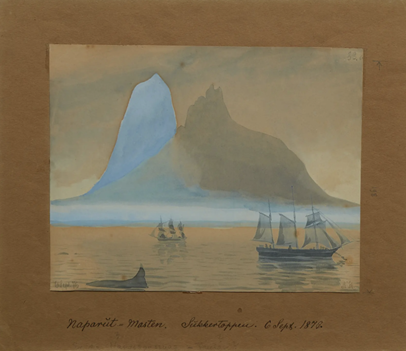
For the past year, our Interdisciplinary Research Fellow Isabelle Gapp (Art History) and glaciologist Lauren Rawlins (University of Leeds) have been working on a paper that looks at the drawings made by the Danish geologist Andreas Nicolaus Kornerup of Greenland’s glaciers during the 1870s. Taking a collaborative and interdisciplinary approach to these field sketches, their aim is to present them within the context of a glaciological art history. However, access to archives has remained one of the major limitations in conducting this research. Following a fantastic contribution that Nora Høegh wrote for the academic blog Network in Canadian History and Environment (NiCHE) on the Norwegian polar explorer Fridtjof Nansen, which Issy had the great fortune to edit, they were extremely lucky that Nora wanted to assist further with their research and dig even deeper into her own interests in Arctic art history.
As part of her MA programme at Williams College in Massachusetts, which provides support for students to gain research, curatorial, or other relevant experience over the summer months, Nora came to Aberdeen for a week in June (huge thanks to our Art History PhD student Emily for showing Nora around!), before travelling onto the archives in Copenhagen. We are extremely grateful to the Arctic Institute, in particular, for providing a space for Nora to work and being such generous hosts. The archival research, discoveries, and translations that Nora has made have been instrumental in reshaping and directing Issy and Lauren’s paper as they enter the final stages of the writing process. And they can also now count Nora as a co-author!
The following is a summary of Nora’s archival research:

This project, in collaboration with glaciologist Dr Lauren Rawlins at the University of Leeds, takes an interdisciplinary approach to the many sketches and paintings Kornerup made during and after his travels to Kalaallit Nunaat. The true meaning of the interdisciplinary nature of this project is perhaps most clearly illustrated in the varied list of things I was on the lookout for as I read pages and pages of spindly Danish handwriting. I searched for descriptions of watercolour pigments alongside mentions of glacier melt water and crevasses. I paid close attention to descriptions of the harsh conditions on the ice sheet, whilst looking for evidence of Kornerup’s ambitions as an artist. I would often find answers to these starkly different research questions in the same letter, or even in the same sentence, so entangled were Kornerup’s artistic and scientific pursuits.

Before setting off to Copenhagen, I had hoped to find some useful archival material to support Dr Gapp’s research. I was lucky enough to be able to do this and bring to light evidence that will be useful in making the case for Kornerup as an artist and documentarian of the rapidly changing ice sheet. I also found myself leaving Copenhagen with an unexpectedly intimate connection to a long-dead Danish geologist, a few years younger than myself when he first left for Kalaallit Nunaat, who was missing home."
