
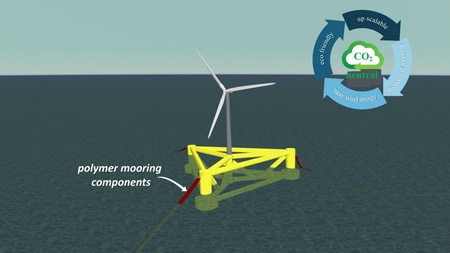

A project led by researchers at the University of Aberdeen has been shortlisted as a finalist in the 2023 Ventus Awards, the offshore wind industry's highest level of professional recognition for individuals and organisations whose research is making a valuable contribution to the sector.
The research, which has designed a cost-effective mooring system for deployment on the UK continental shelf, has been nominated in the ‘Innovation of the Year’ category of the Ventus Awards, where it is described as having the potential to ‘unlock consistent and robust wind potential in deeper water regions of harsh offshore environments and contribute to the challenging and emerging needs of the upstream renewable energy industry, driving innovation-led socio-economic benefits to wider society’.Dr Antonios Karadimos and MSc student Raghu Mahadevappa from the University’s School of Engineering worked on the project, which has also resulted in Raghu receiving a nomination in the Student Sustainability Champion category of the upcoming Green Gown Awards 2023.Commenting on their work together, Dr Karadimos said: “Raghu’s extensive industrial experience in offshore structural design and dedicated hard work has led him to make a significant design contribution to the upscaling of the floating wind turbine system for higher energy output meeting the anticipated industry needs of upcoming systems. The research has been supported by the National Decommissioning Centre (NDC) and Offshore Renewable Energy (ORE) Catapult, in a research partnership aimed at developing new offshore wind technologies.
“It's a rare feat for a UK higher education institution to be recognised and shortlisted to compete with the leading companies in offshore wind industry, and it is a testament to Raghu’s hard work that the project has been shortlisted as a finalist.”Raghu Mahadevappa said: “My vision for this project was to improve the floating wind systems capacity output and this led me to the hydrodynamic design of a scalable floater that can accommodate higher output wind turbines as anticipated by the floating industry at this stage. I want to acknowledge the support and industrial expertise of my supervisor Dr Karadimos, in building the model and performing the hydrodynamic analysis for this novel system.”