A
Asleid 1
Asleid 2

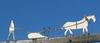
A cut sheet metal sign by the same artist as Asleid 1, on another entrance to the farm this time illustrating a horseman with a box cart.
Asleid 3
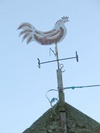
A sheet metal painted weather vane created by the brother of G Christie who made the related farm signs.
B
Barthol Chapel war memorial
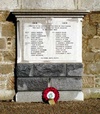
A simple small stone tablet on a pediment of darker granite ashlar. Like many rural Scottish WW1 memorials the length of the list of names in relation to the tiny size of the settlement is very striking. It commemorates the dead of World War I. It has a classic cornice below which are carved, in the centre of the memorial, the entwined letters B & C. It was unveiled 23 November 1919.
C
Culsh Monument

The 80ft (24m) Culsh Monument, erected 1876 in memory of William Fordyce MP of Brucklay , Aberdeenshire's first MP.
Viewing platforms are provided at the base, and at the top of the spiral staircase within the tower. On a clear day the distant Caithness Hills can be seen to the north, Ben Rinnes at Dufftown in the west, the Grampian Mountains to the south and Peterhead to the east.
Culsh Monument Viewpoint
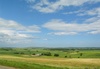
A sculptural granite, viewing and orientation point, located next to a steepled tower built as a memorial.
D
Delgatie Castle

Delgatie Castle dates from about 1030. The main tower dates from the 1100s while its final extension with the battlement walk above the string course was completed in 1579. Both wings were added in 1743. From 1314 until the recent death of Captain Hay of Delgatie the castle has belonged to the Hay family. It is now managed by a charitable trust. The painted ceilings from 1592 and 1597 are amongst the finest surviving in Scotland. Their iconography has interesting comparisons to the much earlier Aberdeen Bestiary and even earlier Pictish sculpture. See The Pictish Arts Society The castle boasts an eclectic range of architectural decorations and sculpture. Delgatie is open daily from 10a.m. to 5p.m. every day throughout the year and is only closed Christmas and New Year weeks. There is also a tearoom serving home baking and snacks. Accommodation is available see Delgatie's own site for details www.delgatiecastle.com or e.mail Delgatie Castle
Delgatie Doocot

An unusual pink harled circular structure with three tiers of decreasing diameter. A circular dovecot in good repair: three sharply diminishing stages with batten, rubble-built. Entrance with chamfer and relieving arch, widened at lower courses. 708 stone nesting boxes. Similar to those at Auchry and Huntly but appears to be considerably older.
Delgatie, Maries Bower

A text work painted on the ceiling beams in a room reputed to have provided lodging for Mary Queen of Scots, this painting confuses me as the text is the same as 2 stanzas in the poem "Kilmeny" by James Hogg 1770–1835 (it is a part of her prophetic vision during her stay among the fairies) . I admit my ignorance, I do not know if the ceiling painting is in fact a modern work or if this part of the poem was copied by Hogg from an earlier source.
Dog statue, Delgatie

Gatepost ornament, Red sandstone carving of a dog? holding a shield. The late Captain Hay of Delgatie was an inveterate collector and the castle has many decorative elements that are now difficult to attribute to exact dates and provenances.
E
Egg sign free range neeps
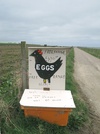
A painted and collaged eggs and neeps for sale sign, with an honesty box that has sadly been re-classified as a dis-honesty box as far as eggs are concerned.
The concept of a "free range neep" (turnip) is a little disturbing, but the hen has a definite charm.
F
Faddonhill Farms Sign
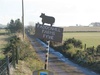
A silhouette farm sign in the shape of a fat ox. These cut out signs were once ubiquitous in the area in the forms of pigs, cattle, horses and etc. they are now becoming rare. The original 20th century sign (illustrated here for reference) was replaced in 2004 after storm damage. The new sign retains the ox of the original but the painted lettering has been replaced with gilded cut out metal lettering and 2 decorative gilded fleur de lys.
Fintry, school shelter murals
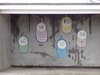
Murals to act as ball game targets the pupils of this small village school. The paintings were done by the
pupils and head teacher with support from the art specialist.
Forglen War Memorial
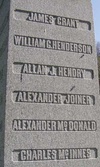
Of a more original design than most war memorials. It is a tall rectangular block of granite which is capped with a pyramidal shape with small projecting points at each corner. The names are carved in wide bands around all sides of the obelisk on two sides they are extremely clear while the other two are rather weathered. On the front face near the base is a carved wreath with 1914 , 1918 within it. It sits on a cross-shaped two-step plinth with a step up on either side. It commemorates the dead of both World War I & II.
Fyvie 1

Fyvie Parish Church is at the east end of Fyvie, on the south side of the B9005. Set in the east wall of the church are three worn Pictish class I symbol stones, all have been trimmed.
Fyvie 1 was once built into the wall of the schoolhouse. On it is the 'elephant' or 'Pictish Beast' symbol, the bottom part of a 'crescent and V rod' and most of a 'mirror' symbol.
Fyvie Church also contains important stained glass by L. C. Tiffany. South-east of the church in a railed enclosure, marked by an obelisk is the old tombstone of "Mill of Tifty's Annie" (1673), subject of the eponymous ballad.
Fyvie 2

Fyvie Parish Church is at the east end of Fyvie, on the south side of the B9005. Set in the east wall of the church are three worn Pictish class I symbol stones, all have been trimmed.
Fyvie 2 was found built into the wall of the church. On it is the right hand part of a 'double disc symbol' and the centre part of an 'eagle symbol' facing left to right.
Fyvie Church also contains important stained glass by L. C. Tiffany. South-east of the church in a railed enclosure, marked by an obelisk is the old tombstone of "Mill of Tifty's Annie" (1673), subject of the eponymous ballad.
Fyvie church fountain
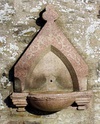
A polished pink granite fountain in a neo-gothic style. Inscribed ‘ Presented by captain A.H. Gordon 1875 John 13 – 14’
Fyvie Cross
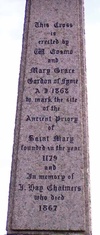
Corrennie granite Cross (erected 1868) and cairn – all
that remains on the site of the former St Mary’s priory Fyvie a cell of Arbroath Abbey. Founded in
1285 by Reginald de Cheyne. (the last traces, of the buildings, vanished in 18th century).
Fyvie stone carved relief figure holding head

Stone carved figure covering face with hand, the other hand appears to be cradling the head of an infant at waist height. Interpretation is slightly speculative as the stone is quite badly eroded.
G
Geordies Kist planter

Planting feature, as part of a village wide planting project. Description an installation of bedding plants in a 'horseman's kist', the lid interior featuring a painting in the local folk style of two Clydesdale horses in agricultural show harness.
George and Ann Thomson Memorial Fountain
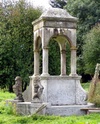
An Italianate fountain with a sophisticated urban look that does not really suit its current location where it looks a bit lost.
L
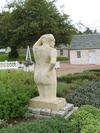
Large Nude Statue, Fyvie Castle Garden
Leopard
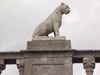
3d stone carving of a leopard decorating a balustrade. The late Captain Hay of Delgatie was an inveterate collector and the castle has many decorative elements that are now difficult to attribute to exact dates and provenances.
Light buoy installation
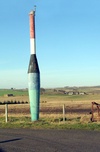
An installation in a field of a light buoy, an object one normally only sees the very top of emerging from the sea. The same track end also has surreall traffic lights which surprise the viewer as they are unexpected on a farm track.
Little Ardo sign
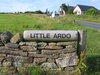
A reused old fashioned granite roller with deeply cut plain lettering "LITTLE ARDO" blacked in with paint or similar.
M
Mannie

Stone carving, used as a gate post decoration, of a caricatured human figure. The late Captain Hay of Delgatie was an inveterate collector and the castle has many decorative elements that are now difficult to attribute to exact dates and provenances.
N
New Byth war memorial

New Deer War Memorial
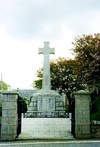
A war memorial of the Celtic Cross type decorated with knotwork on the head only. It has a large angled base of rough-dressed granite into which are set plaques with the names of the dead of both World War I & II.
Newstead, farm sign Cuminestown

An elegant sheet metal cut out sign. The image while at first appearing to be simply an icon of the farm's livestock has an element of dark comic narrative, the tiny chick is threatened by an omnivorous and greedy sow, it is unaware of its possible impending doom while the mother hen leads it to shelter beneath the indifferent cow maybe escaping one gruesome end to suffer another.
R
Rothiebrisbane Symbol Stone

Fyvie Parish Church is at the east end of Fyvie, on the south side of the B9005. Set in the east wall of the church are three worn Pictish class I symbol stones, all have been trimmed.
The Rothiebrisbane stone was found in use as a drain cover on the road (now the B992) running south from Kirkton of Auchterless. The nearest to complete of the 3 stones at Fyvie. On it is a 'horseshoe symbol' over a 'disc symbol'.
Fyvie Church also contains important stained glass by L. C. Tiffany. South-east of the church in a railed enclosure, marked by an obelisk is the old tombstone of "Mill of Tifty's Annie" (1673), subject of the eponymous ballad.
S
Sandstone carving Municipal Building Turriff

A small sandstone carved figure holding a scroll. The seated pose with scroll in both hands and the outfit, naked except for a kilt/sarong type garment is similiar to a carving at Delgatie Castle (see related artefacts link 'Mannie' below)
T
The 1592 Ceiling, Delgatie

This ceiling is decorated on the beams only, mostly with a long inscription on the sides, with decorative work on the underside.
The 1597 Ceiling, Delgatie
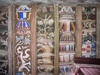
One of the most important surviving 16th century painted ceilings in Scotland The iconography has interesting comparisons to the much earlier Aberdeen Bestiary and even earlier Pictish sculpture.
The 1800 Laundry, Delgatie

A curiously and ornately decorated small cottage. With ogee window arches, gothic finials at the ends of the gables and a motif of ox yokes.
The False Doocote, Delgatie detail
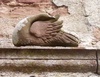
The Faux Doocote, Delgatie
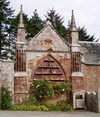
Turra Coo
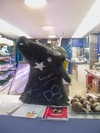
A life size bronze cow decorated with cast garlands and a rope halter, behind the cow is a series of cast cow footprints. On the right flank in slightly raised and differently coloured metal representing the painted lettering on the historical "Turra Coo" at her return, are the words "FREE !! DIVN'T YE WISH THAT YE WERE ME". The sculpture was created by a casting process from an actual cow's body. The historical coo was an Ayrshire cross Shorthorn, no suitable cow of that variety could be obtained so the animal used, a Jersey-Blonde cross, was picked as similar looking to photographs of the original beast. Also illustrated are examples of the "Coo Heads" created by Turriff Academy pupils during the education package associated with the sculpture project and exhibited in the town shops during the month of the unveiling.
Turriff Mercat Cross

The present 20 foot high cross was erected in 1865 and is made from red sandstone like most of the town. Octagonal pillar rises from a Gothic style base by James Duncan with sculptures by Thomas Goodwillie
U
Unicorn, Delgatie

A pair of stone unicorns gaurding the main entrance of the castle. The late Captain Hay of Delgatie was an inveterate collector and the castle has many decorative elements that are now difficult to attribute to exact dates and provenances.
This content was submitted by external contributors and does not necessarily reflect the views of the University of Aberdeen.