
A
Agnews office railing
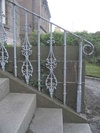
A surviving example of highly decorative Victorian or Edwardian decorated cast iron work
Ardlui gate
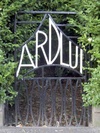
Possibly made by Emil Rzechorzek, a steel gate and house sign combined that although of a later period perfectly attunes with the 'art deco' style of which the town has such fine surviving examples.
Art-deco Shops
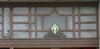
Possibly Colonel Tawse and Messrs Hall, 1936. Single storey and 2-storey with attic, 6-bay, terraced, Art Deco style former Co-operative building adjoining separately listed Carron Restaurant, Cameron Street. Fine decoratively-astragalled top-lights, coloured glass medallions and original shop doors with brass door furniture. Granite ashlar shop fronts, with crenellated, crowstepped darker ashlar 1st floor bays; harl and coursed rubble to side. Oversized stylised keystone and capitals.
N (PRINCIPAL) ELEVATION: 3 single storey bays to right of centre incorporating stepped moulded shop front at outer right with large centre keystone, deep-set centre door with margined glazing and original handle, flanking fixed display windows and 3-part decorative top light with coloured glass medallion depicting grocery basket over entrance. Paired smaller shops to left with deep-set outer doors (that to right as above), inner display windows and dividing pillar, shop to right with coloured glass medallion depicting cow's head and that to left with wheatsheaf (see Notes). Further pillar to outer left adjoining 2-storey building with 2 similar (but altered) shops, that to centre with decorative top light with pestle and mortar medallion. Broader shop at outer left comprising 2-part fixed display window, boarded top light and doorway to outer angle with metal roller giving way to deeply in-canted door, mosaic-tiled floor with monogrammed 'NCSL' and flanking display windows. 1st floor with 3 wide-centre tripartite windows and 4-light window to outer left angle, later out-of-character flat-roofed dormer to left.
E (ANN STREET) ELEVATION: shop front with 2-part fixed display window and huge centre keystone to right, 2 doors to left and asymmetrical fenestration at 1st floor; small roundheaded window in gablehead.
Original Art Deco glazing combining horizontal patterning with Deco symbols in metal windows to all shop fronts (some obscured by modern fascias); modern glazing above ground. Grey slates, single storey bays with piended roof and large horizontal rooflight to W. Coped ashlar gablehead stacks with cans.
INTERIORS: modern.
B
Barrie Fountain, Stonehaven

Polished granite. Small free standing Gothic drinking fountain. Baptismal font style circular bowl on octagonal pier with scroll supports at splayed faces; corniced, open square columned canopy above, each face with round-arch and decoratively-tooled spandrels supported by central column and 4 corner colonettes with stiff-leaf capitals; this surmounted by ornamental pyramidal spirelet rising from decoratively-tooled gablets, inscribed E gablet reading '1897 Presented to the Town of Stonehaven by George Barrie, Law Agent and Notary Public, Edinburgh', tooled band course and square-plan stiff-leaf capital capped by metal colonette (probably for gas lamp, lamp now missing). Associated horse trough, probably later, adjacent (see below).
HORSE TROUGH: plain, rectangular granite horse trough on stand, with rectangular bowl beneath; 2 pink granite supports; 2 freestanding bollards.
Beachgate House Sign

Painted Wooden Bed and Breakfast sign incorporating the Scottish Tourist Board ranking sign, sign is topped with a silhouette of a trawler called Helene.
Bervie old Parish Kirk yard, various
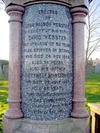
One of the photographs show 2 of the notable memorial slabs, one decorated with relief carved memento mori and two unusual figures, the other photographs show a grand Victorian/Edwardian monument in polished pink and grey granites to a "David Webster flax spinner in Bervie".
Burns garden, second Burns bust and Laura Anne memorial stone
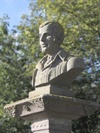
A small civic garden near the Cowie River crossing on the north side of the town centre.
The steel fabricated railings were created by 'The Stonehaven Horizon' a team volunteers when the garden was revamped in 2006. Various themes from Burns's poems are used in this garden, as well as the 'moosie' and the Thistle, along with the 'sun' logo of the Horizon Project Group. The plants in the garden are also those with Burns associations. The 'sun' logo is used throughout the town on various improvements that the group have been involved with.
The Laura Anne memorial a small sandstone memorial relief carved with a rose, inset with a granite plaque bearing the dedication (artist unknown) late 1990s.
The pre eminent raison d'être of the garden is the sandstone Bust of Scotland's most famous poet Robert Burns (b. 25 Jan 1759 Alloway d. 21st July 1796 Dumfries, at the age of 37). The entire piece is covered with references to Burns's poems - each of the four sides of the pedestal has a grotesque mask of one of his many characters along with an associated text. It was carved by Robert Taylor 'Ghosty Bob' - a local monumental mason and sculptor (his nickname a result of his work carving many gravestones).
This is the mark 2 version. Both works ultimately derive from the 1787 portrait by Alexander Nasmyth (1758-1840). This seems to be regarded as the definitive image of Burns and has been used as a source for most of the huge number of later representations, it is certainly more flattering than the portrait painted by Peter Taylor in 1786.
C
Carron River Falls
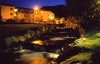
Predominately a civil engineering project but its aesthetic pretensions may just make it eligible for inclusion. A system of weirs create a man made series of waterfalls with boulder built embankments.
Carron Terrace Houses
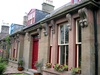
Single storey and attic, 5-bay terraced pair of boldly detailed, late classical houses; No 8 with late 19th to early 20th century single storey, single bay wing. Ashlar. Base and eaves courses. Consoled cornices to doors and to 3 advanced tripartite windows, latter with coupled outer consoles and block pediments rising above eaves.
SE (PRINCIPAL) ELEVATION: 5 symmetrical bays, those to right with broad panelled timber door and 2-pane etched glass fanlight flanked by tripartite windows in flanking bays (No 7), further door with 2-pane fanlight in bay to left with tripartite beyond at outer left (No 8). 3 pedimented tripartite dormers above, those to No 7 flanking small rooflight. Further later flat-roofed bay projecting at outer left, incorporating panelled timber door to left, window to right and further window on return to right.
4-pane glazing pattern in timber sash and case windows. Grey slates. Coped ashlar stacks with polygonal cans; ashlar-coped skews with block skewputts.
BOUNDARY WALLS AND GATEPIERS: low coped ashlar boundary walls with corniced, square-section gate piers and terminal piers to SE. High rubble boundary walls elsewhere.
References:
1st Edition ORDNANCE SURVEY MAP (1867). Information courtesy of owner No 8.
Catterline Primary School Playground Shelter
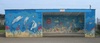
A cement shelter shed with corrugated roof, painted with murals on submarine fantasy theme depicting dolphins, seals, a mermaid, octopus, fish and etc.. A mixture of local marine wildlife with exotic and imagined species.
Christians house Doorway Arch
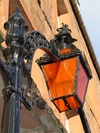
An ornate decorative cast iron arch supporting a large lantern of orange-red glass, which presumably was once illuminated by an oil or gas lamp.
Installed over doorway to a house built in 1712. Used around 1746 by Rev Alexander Grieg for Episcopalian services, when because of support for the Jacobite cause legislation by the (Hanoverian) government prohibited congregations of more than five. In the 1850s the house was home to Peter Christian, solicitor and Sheriff's clerk for Kincardineshire. The Doorway probably originally led through into courtyard area
Church of the Immaculate Conception , various architectural decoration, windows and, soup kitchen
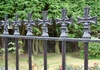
The Church of the Immaculate Conception is the last remaining place of worship in Stonehaven's Old Town. It boasts details recognised as deriving from Notre-Dame-le-Grand, Poitiers and Chartres and despite the loss of some original glazing is nevertheless an important quiet place on its island site surrounded by roads and behind the High Street. The building date varies from 1875 to 1879 depending upon the source, but it is a certainty that funds for this fine church and the nearby Rickarton Cottages were provided by Mrs Eliza Maria Hepburn of Rickarton, as a memorial to her daughter. A sketch in Christie's 'Haven Under The Hill', entitled 'Church of St Mary' shows decorative ridge detail and a ship weathervane, neither of which are evident today (2004). He also mentions an American organ which was installed in April 1880. The priest´s house is located at the nearby (separately listed) Rickarton Cottages and is accessible from the church grounds. The nearby soup kitchen was presented to the church by George Blackie in 1905.
GENERAL: Architect J. Russell Mackenzie, 1877. Small, elaborately-detailed gothic church with 3-bay aisles nave, traceried and arcaded front, shallow gabled transepts, semicircular apse, polygonal baptistery and 4-stage buttressed tower with belfry and octagonal pinnacled spire. Coursed, squared and snecked rubble with ashlar dressings. Deep base and eaves courses. Traceried circular openings, cusped lancets. 2-stage, sawtooth-coped and pinnacled buttresses. Voussoirs; chamfered reveals and raked cills. Timber doors with decorative ironwork.
GLASS: Coloured glass to NE traceried window depicting St Margarita (St Margaret Queen of Scotland, Saint Margaret (c. 1045 – 16 November 1093, canonised in 1251 by Pope Innocent IV); leaded diamond pattern glazing to apse and baptistry; some openings reglazed; figurative coloured glass lancet to SE transept (see Interior). Grey slates. Ashlar-coped skews. Cast-iron downpipes with polygonal rainwater hoppers.
INTERIOR: fine plain interior with moulded cornice, hammerbeam roof and decorative timber braces, timber pews and boarded dadoes; transept with double arch springing from low column with moulded capital. Apsidal chancel with elegant braced timber roof on stone corbels. Lancet to SE transept 'Come Holy Spirit' by Edinburgh Stained Glass House, 2003.
SOUP KITCHEN: Single storey, slated, rubble cottage known as 'soup kitchen'.The Soup Kitchen is now used as a meeting room. Work began on the Kitchen on 24th December 1904 on three days weekly, and closed on 18th March 1905.
The Kitchen was used in the 1940s but is thought to have ceased work in 1946. The building was then used for various purposes, and the Mearns Leader reported a visit by an interested townsperson in 1983 to the wood store.
Cowie Chapel Childs Memorial Book
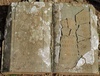
Example of a memorial in the popular book form, this one dated 1894 is in a permeable stone and has suffered badly from shell erosion over the years, it is in memory of a 4 years and 6 month old John Leiper. Who died on the 7th July 1894
Cowie Chapel farmerss tombs
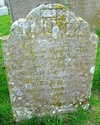
Three examples of late 18th century headstones to tenant farmers and their families marked with the ploughshare and coulter symbol. The inscriptions also give the farm names.
Cowie Chapel Gardner tomb
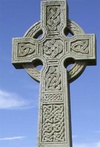
Another early 20th century Celtic revival cross. This one is in grey granite and has some very nicely carved interlace panels, it commemorates burials various members of the Gardner family from 1908 -1965
Cowie Chapel Headstone with Finger Pointing Up
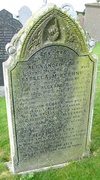
Lees family headstone of Gothic arch shape decorated with a hand pointing to heaven and flower scroll and cordage motifs.
Cowie Chapel lifeboat memorial
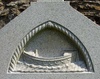
Grey granite memorial surmounted by a simple latin cross and carved in relief with a lifeboat, the inscription reads: Erected by public subscription to the memories of four of the crew of the Stonehaven life-boat "St George" Viz:- James Leiper, coxswain, John Brown, assistant coxswain, Alexander Main and James Lees, who were drowned while endeavouring to enter Aberdeen Harbour, after an attempt to render assistance to the "Grace Darling" of Blyth on 27th February 1874 --- James Leiper, is interred in Belhelvie Churchyard, Alexander Main in Nigg Churchyard, John Brown and James Lees are buried here.
Cowie Chapel Masonic headstone
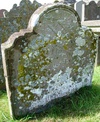
This stone, dated 1793, shows the Masonic symbols of sun, moon, star, set square and compasses, trowel, chisel on ashlar, level, plumb rule, mell, set square and gavel.
Cowie Chapel seamens tombs
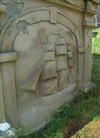
A variety of 18th and 19th century tombstones, adorned with ships and anchors, in memory of seamen and fishermen many of whom lost their lives at sea and often their wives and children. Some also bear memento mori symbols such as the hourglass. Most of the boats illustrated are open fishing boats but the fourth photograph shows a sarcophagus style tomb with a relief carving of a 3 masted ship in full sail. The top photograph showing a stone to David Adams also commemorates his seven children but has a blank where the inscription to his spouse was intended as does the related 'blacksmith's stone'. It is sad to think of that the likeliest explanation is that outliving their husbands and children these women had no survivors to order or pay for the inscriptions.
Cowie Chapel winged hourglass headstone
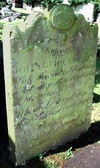
This unusual memento mori symbol of a winged hourglass may be seen on this badly eroded 18th century stone within the ruined chapel.
Cowie Chapel, 18th century blacksmiths headstone
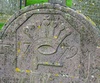
Stone with the blacksmiths' crown and hammer symbol, the stone is inscribed: "in memory of James Forrest late blacksmith in Stonehaven who died January 14 1779 aged 71 years" then there is a gap presumably intended for an inscription to his wife that has not been done, followed by: "and also of their children Margaret and Jean who died in infancy. As with the similar blank on the stone of the seaman David Adams it is sad to think of that the likeliest explanation is that outliving their husbands and children these women had no survivors to order or pay for the inscriptions.
Cowie Chapel, 18th century shoemakers headstone
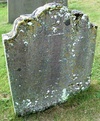
18th century stone dedicated to John Davidson shoemaker with the crown and last trade symbol of the shoemaker,
Cowie Chapel, Hassell tomb
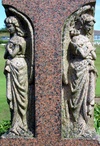
A grandiose Celtic revival cross with angelic figures in pink granite inscribed: In memory of Susan Constance Hassell widow of William Hassell of Bristol died August 4th 1906. "There shall be no night there".
Cowie Chapel, St. Marys of the Storms, Cowie Kirkyard
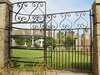
The old kirk now stands as a consolidated ruin, originally dedicated to St. Nechtan, or St. Nathlan, though it was rededicated to St. Mary in 1276. It was never a parish kirk and was suppressed by the kirk session in the 1560s.
The kirk was lengthened at the W. end during renovations in the 15th - century, though the remainder of the kirk is said to be 13th – century in date. Restoration work was carried out in 1870 and it is probable that the lintel to the arched opening in the S. elevation dates from that time.
The E. and W. gables remain, the former composed of three lancet windows, very thin in proportion, broadly spaced and having carved sandstone head terminals. The gable wall is extremely deep with the windows having a remarkably broad internal splay. The W. gable features a large square window opening.The mort-house or arched vault was built in 1842 though the W. end of the kirk extends over this arch making it impossible to see how the vault was entered. The granite side and grassed roof of the vault appear to be in good order.
Tombstones : There are approximately 20 recumbent tombstones of which 4 are significantly well-decorated. There are many hundreds of upright tombstones contained within the kirkyard that is itself located on two levels. The kirkyard is approximately oval in shape and is situated on the cliffs with commanding views over the North Sea.
The bottom photograph shows the wrought iron 'kissing gate'.
Cowie Mill, decorations

Original Mill; was 18th-19thC; remodelled 1920 a 2-storey and attic 11 bay main block, with a 3-storey block and a large pyramidal-roofed kiln at rear. The kiln vent is hexagonal, with revolving cap. The central low breast wheel has been removed and the lade destroyed; was recently derelict, though workings part remained. Then was converted in the late 1990's into flats. Various old wheels and gears have been used to 'decorate' the grounds as well as the pig on the kiln vent.
D
Dolphin sculpture, Stonehaven
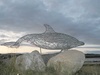
A Dolphin created from a network of steel rods in the characteristic style of many of this artist's public projects in Scotland, Australia etc.
Dunnottar Cemetery Stonehaven, general info
There have been a number of churches on the present site. The original church, dedicated to St. Bridget in 1394, was replaced in 1593 by the 5th Earl Marischal (George Keith), which in turn was replaced in 1782 by a much larger church. The church was completely reconstructed in 1903 and remodelled into a cruciform plan by G.P.K. Young of Perth, with parts of the 1782 church incorporated into the present building. The kirk is of a rectangular plan built of granite rubble with Gothic details. There is a plain ball-capped bellcote on the E. gable.
The Marischal Aisle is a small stone building in the churchyard, built by George Keith in 1582, as a burial place for his family.The Marischal Aisle is the oldest complete surviving section within the church confines. It was erected in 1582 by the 5th Earl as a family burial place. It was restored in 1913 by Aberdeen University, as a tribute to George Keith who had founded Marischal College.
Numerous tombstones of interest are found in the vicinity of the Marischal Aisle. Some date from the 17th & 18th centuries and are elaborately carved with winged souls, skulls, crossbones, hourglasses and sexton’s spades. Some display tools of trade. On the stone of James Kemlo, town’s officer and bellman, is carved a bell.
There are approximately 36 recumbent stones of which 13 are particularly well-decorated. There are a pair of oval recumbent tombstones a little to the E. of the Marischal Aisle, which are possibly the only two of their kind in Aberdeenshire. There are many hundreds of upright tombstones, many of special note. There is a stone commemorating those who died in the dungeons of Dunnottar for their adherence to the Covenant. There is an extremely well-carved skull in the boundary wall above an upright tombstone.
Dunnottar Cemetery Stonehaven, Sextant on Old Stone
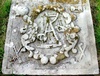
An elegant relief carved recumbent stone with motifs of a sextant and dividers clasped in hands surrounded by an ornate baroque cartouche of scroll work with memento mori at the corners. Presumably the grave of a navigator.
Dunnottar Cemetery Stonehaven, various memento mori
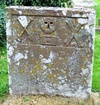
Tombstones dating from the 17th & 18th century may be engraved with emblems of mortality, such as skulls, bones, the sexton’s spade and turfcutter, or an hourglass symbolising the sands of time running out the words "memento mori" themselves are sometimes also inscribed . These older stones may be embellished with winged souls, often at the top of the headstone, to represent the hope of resurrection and immortality.
Dunnottar Cemetery Stonehaven, 17th Century Headstone
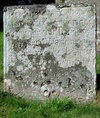
A tombstone dated 1685 with primitive engraved memento mori including a skull very like a bowling ball.
Dunnottar Cemetery Stonehaven, Celtic Cross
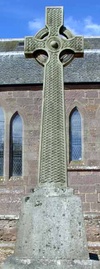
Early 20th century Celtic revival free standing stone Celtic Cross with fine carved relief decoration featuring strap work interlace
Dunnottar Cemetery Stonehaven, Headstone of Town Bellman
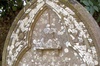
Upright stone of a typical Victorian 'Gothic revival' pointed arch shape for James Kemlo, town’s officer and bellman for sixteen years, died 1889 the stone also commemorates an Elizabeth Edward who died in 1868 aged 88. (the lichen makes athe inscrition hard to read but I think it says she was James Kemlo's mother). The stone is relief carved with a hand bell resting on a shelf flanked by stylised thistles.
Dunnottar Cemetery Stonehaven, Headstone with Tools
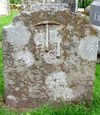
Dunnottar Cemetery Stonehaven, Merchants Headstone
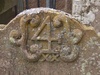
Dunnottar Cemetery Stonehaven, Skull on Churchyard Wall
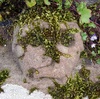
An extremely realistic and well executed carved skull set in the kirkyard wall above an upright stone that itself bears an upward looking relief of a skull, much eroded, on its top surface.
Dunnottar School, schoolhouse decoration
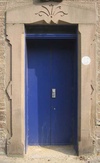
A rather dour late Victorian piece of public architecture in sandstone with some nice decorative details.
E
Ellerslie - door, ironwork & stained glass
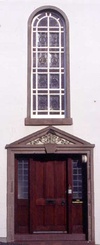
House dated 1892, altered and extended. 2-storey, 5-bay, rectangular-plan, end terrace house (sub-divided) with keystoned and pedimented moulded door-piece, tall round-arched stair window with decorative astragals and coloured glass (the round medallions containing portrait heads) and some fine interior detail; on ground falling to S and E. Painted ashlar with ashlar margins, quoin strips and base course to W; ashlar with 1st floor cill course and eaves cornice to E.
W (ENTRANCE) ELEVATION: bay to right of centre with broad door-piece incorporating deep-set vertically-panelled timber door and flanking lights giving way to stair window, regular fenestration to flanking bay with further door in penultimate bay to left and single window to each floor at outer left.
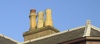
Embossed Lums
F
Far & Wide sign
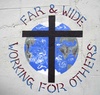
A painted globe with a superimposed cross and lettering, presumably the logo of a missionary organisation.
Features at Dunnottar Castle

The castle; probably occupies the site of a prehistoric fort. St Ninian established a church here about the beginning of the 5thC. It may also be the -Dunfoithir- besieged in 681. In the reign of William the Lion (1165-1214) -Dunnottar- was the place where warrants were returnable for the Mearns, and -le castiel de Dunostre- is mentioned at the beginning of the 13thC. Another castle was erected at the end of the 14thC. In its final form the castle was forfeited in 1716 and the roofs and floors removed and sold. In 1925 the systematic repair and excavation of the ruins was begun.In its present form the extensive remains date from various periods. The oldest portion is the early 15thC keep with a range of buildings extending to the E containing stables & storehouses. The gatehouse is approached by a steep path and defended by three tiers of splayed gun-loops. The arched entrance is the only opening on a solid wall of masonry set into a cleft in the rock; a very impressive and dominating entrance. The buildings to the NW grouped round a courtyard date from the late 16th or early 17thC, including a chapel. A huge water system lies within the courtyard. There is also a bowling green to the W of this later range. The Scottish Crown jewels (The Honours of Scotland) were hidden here in 1651 as it was considered one of the strongest places in the kingdom. In 1685 167 Covenanters were packed into a small vault, (the Whigs Vault) where 9 died due to the terrible conditions. Privately owned (Dunecht Estates) and open to the public. An oval motte was noted in 1970.
Fetteresso Castle Doocot
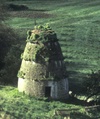
A well preserved 16th-century beehive dovecot stands on the edge of a field, Dovecot; tall beehive shaped dovecot of 16thC; three rat ledges; flight hole in top; stands beside a pond to the SE of the castle.
Fetteresso Castle Gates
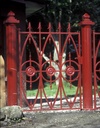
Modern painted ironwork gates, with a relief cast flower motif.
These gates lead into a private house on the site of the castle gatehouse. It is an unusual building, smallish, with an octagonal plan and roof.
The original Castle has been 'renovated' as a number of 'town houses' but most of the character of the original single building has been lost.
Fetteresso New Cemetery, Stonehaven: Gravestones,and wrought iron gates
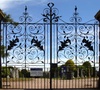
Large municipal cemetery on the outskirts of Stonehaven opened in 1902 to serve the increasing population of the area. There are about 1600 gravestones within Fetteresso New, the majority of which are constructed from local granite, the three illustrated are however later 20th century (80s and 90s) stones of imported black granite. They are of interest in showing a modern take on visual iconography, two of them illustrating occupations as do the gravestones of earlier times from some older graveyards. The grounds were extended to the north-west in the late 20th century with a new entry gate constructed for easy access.
Fetterresso Parish Church Door Stonehaven
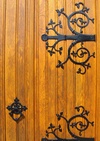
2-leaf, vertically-boarded timber door (replaced 1995), large decorative ironwork hinges, and deep timber-traceried, pointed-arch fanlight with diamond-pattern, leaded glazing and modern wall-mounted carriage lamps flanking.
Flower-pot men
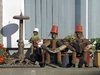
An installation of figures made from wood and flower-pots beside a ready made? sundial.
G
Gates at Gourdon / Inverbervie Cemetery
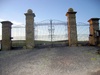
Gourdon/Inverbervie Cemetery cast iron grave marker
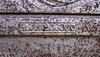
About 1m tall, an unusual memorial in cast iron. In contrast to the innovative material the style is after the neo-classical ideals of the 18th and 19th centuries, architectural in inspiration with fluted columns and relief decoration of swags, scallop shell and etc. . Erected by a William Wilkie to his wife Jane Stewart and also his own memorial. The inscription is on a greenish plaque in ceramic or enamel riveted or screwed to the main body of the memorial. It is also marked as by "Smith and Wellstood Bonnybridge Foundry" and bears a registration number. Presumably these memorials were at one time mass-produced but did not catch on.
Graffiti, Stonehaven
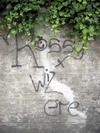
A fairly typical example of monochrome tag, text and cartoon based graffiti by an unambitious spry painter.
Greenden House Sign

H
Harbour/Tolbooth Sundial
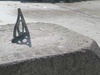
Dated 1710. Free standing sundial. Cubic sandstone head with chamfered angles; horizontal dial with wrought-iron gnomon. Short, square-section shaft, also with chamfered angles, off-set below
Harvieston farm Sign

A farm sign in painted wrought and sheet steel. With the name Harvieston in cut steel letters, the whole surmounted by a repoussé corn sheaf. The iconography suggests that the farm name is being interpreted as 'harvest town' understandable if linguistically unlikely. In the north east of Scotland the word town or toon is still commonly used in its older sense of a farm steading as well as in the modern sense of a conurbation.
Helicopter Wind Vane
Hercules Linton Memorial, Inverbervie
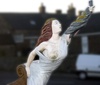
A full scale carved timber replica of the figurehead from the renowned tea clipper "the Cutty Sark" carved from Linton's original drawings 3 metres tall. with a black granite plaque engraved with the image of the ship. The figurehead depicts the young witch in Robert Burns' poem "Tam O Shanter" grasping the tail of Tam's mare, her right breast bared. In the Scot's language 'cutty sark' means a short shirt or shift, it is interesting that despite that fact and the otherwise erotic nature of the figure, the carving is actually wearing quite a long shift, perhaps the Victorian era was much more at ease with tits than with bums.
Hotel Sign - Royal Hotel, Allardice Street
House Sign - Smithy Cottages

A painted plastic house sign of the 'guess who lives here sort', a more modern take on the local cut steel tradition, with a nicely foreshortened grand piano
House sign - Threelums

Carved oak panel showing the three lums (Scots for chimneys) with the lettered word threelums like smoke above them
House sign and Post box - Gardners Cottage
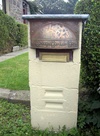
Masonry wood metal and slate house sign in the form of a miniature house with a block work postbox incorporating what looks like a copper fire-hood to protect the brass letterbox.
J
Jubilee Bridge Inverbervie, alternative names Bervie Water; Inverbervie, the New Bridge, Bervie Jubilee Bridge
Built on a curve, Bervie Jubilee Bridge is a fine reinforced concrete viaduct taking the main road (A92) from Montrose to Stonehaven over the Bervie Burn on seven spans. The bridge was completed in 1935 (the silver jubilee of George V) and by-passed an earlier single-arched masonry bridge built in 1799, which still survives adjacent to the north abutment.
K
King David of Scotland Episcopal Church
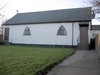
A corrugated iron church with truncated, gothic pointed cut out windows. A unusual bell support at one end of felted roof. Now becoming rare corrugated iron buildings were once something of a feature of the rural Scottish landscape. Village halls, churches, shops and houses were all produced in this material.
M
Mackie Academy War Memorial - Arduthie School
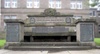
Sandstone, bronze
war memorial in the form of a large granite seat stands in front of Arduthie School in Stonehaven. It commemorates former staff and pupils of Mackie Academy who died during the first World War on the bronze plaques on either arm, while a bronze plaque at the back commerates the dead of 1939-1945.
Marine Hotel carved heads
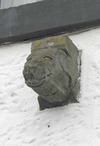
(possibly 17th century, certainly older than the 1884 date of the building) carved heads thought to have originated at the nearby Dunnottar Castle, situated to the south of Stonehaven. Although badly weathered, the fine carving can still be seen on those of the human and lion heads.
Wall-mounted clock set in slightly raised decorative pedimented panel at lintel level between outer bays at right, and 4 carved heads and central shield date stone (see related atefacts) regularly disposed between ground and 1st floors
Marine Hotel Shield Datestone

Mercat Cross Inverbervie

Like many post reformation Scottish mercat crosses not actually a cross at all. The chief purpose of these structures was to show the town or burgh had a right to hold a market in the place indicated rather than a religious one. It is a simple polygonal sectioned column surmounted by a cone-shaped ball on similarly polygonal stepping on a polygonal dais.
Mosaic entrance - Unique shop
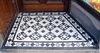
A well preserved example of a late 19th or early 20th century black and white mosaic shop entrance
Mosaic entrance - Unique shop
A well preserved example of a late 19th or early 20th century black and white mosaic shop entrance
Mosaic Obelisk
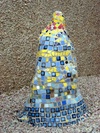
Mosaic Telecom access covers, Stonehaven
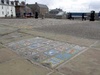
Mosaic tiles on a steel cover plate, arranged in a grid of 24 squares showing nautical and marine iconic imagery.
Muchalls War/Peace Memorial
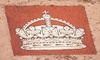
A mosaic of tesserae in earth colours showing a royal crown and the word 'PEACE' above with the date '1919' below, set in a shield of pinkish concrete. Most unusual among war memorials in actually celebrating peace as opposed to commemorating war.
N
National Cycle route marker, Stonehaven
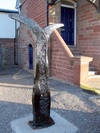
Cast metal Way-Marker erected to indicate a point on the national cycle route network. Contains images relating to local geology. The important fossil bearing strata of the local. Part of a millennium cycle route project funded by the Millennium commission. The shape of the whole piece is obviously intended to suggest the tail of a fish or a whale, I am not sure which.
New Street, Railings & serpent and eagle wall ornaments
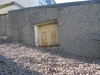
There are two sets of interesting railings opposite each other. The right hand one is composed of equal armed crosses, pommée, (bottom photograph) there is additional iron work relief set inside the garden wall to the left with a matched pair of eagles, painted black, in conflict with serpents painted red. They are in a cement wall which has railings on top. The figures are cast iron, they sit on an iron rail and the back of the recess is also lined with iron or steel. The recess in which they sit is mirrored on the opposite wall of the joint garden with No.10. That recess has rust marks which show that another pair of similar figures resided in that recess
The wall ornaments on the left are minimal but also seem to have a religious theme with Latin crosses that are both pommée (with balls) and triumphant (on orbs).
Newbigging house sign

Newbigging (std. Eng. new building) House sign in wrought iron, with scroll work and leaf decoration.
P
Pithie memorial sundial
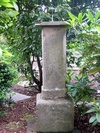
A sandstone sundial on a square section pillar with chamfered corners mounted on cuboid pedestal. There are words carved around the edge that indicate it is a memorial to '??thie born 8th June 1836'. Below there are words but they are not readable On the back there is 'A Pithie' then 'born', the next bit has gone but the year seems to be 1812. The base is inscribed "W. Pithie mason 1857"
Plague Stones - Gravestones
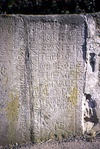
Near to plague burial-ground; plague or victims were interred not here but in a nearby hollow to the south east of Victoria Street, at a site known as The Maltman's How. The site is now occupied by modern buildings and gardens. Two gravestones were found about 1842 (which had lain on a what at that time was a piece of waste ground, they were then erected against a bank on the left of the path opposite the Bog Well ) and are now set into the E wall of a public footpath at NO 8741 8552. Stone to N dated 1608 with death's head and shield incorporating 'MT' monogram, reading 'Heir lyes ane honest man, Magnvs Tailiovr, seyman, qvha depairtit in November, (in the time of) pest 1608'. Stone to S dated 1648 and reading 'Heir lyes ane Honest mans bairns Alexander and William Brokie, sones lawful to Alexander Brokie, who departet the 12 of Jwnie, of the age of tvalf and nyn yeirs old, in ano 1648'.
Play group mural at Inverbervie
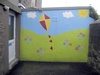
R
Railway bridge heraldic Shields / Crests

Carved sandstone shields with a lion holding a falchion type sword, The inscription is virtute et opera "by virtue and deeds"
Ramsays shop door, house entrance, mosaic and other details
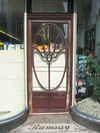
Full-width scroll-consoled fascia over ground floor shop with deep-set doors, with mosaic-tiled step, comprising bevelled glazing with beaded oval and curved astragals below deep plate glass fanlight, and flanking curved lights to bays.
Rickarton Cottages -cast iron railings - cast-iron parapet + memorial stone
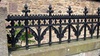
Single storey and attic, 8-bay, short terrace of cottages with rusticated porches and pavilion centre with timber verandah. decorative cast iron railings No 5 low saddle-back-coped ashlar boundary walls with battered ashlar gatepiers to No 3, and decorative cast-iron railings to No 5, cast iron parapet at No 3 and the memorial stone, it is inscribed "erected as a memorial of William Rickart Hepburn Esq of Rickarton who died 30th May 1873"
BOUNDARY WALLS, GATE-PIERS AND RAILINGS: low saddle-back-coped ashlar boundary walls with battered ashlar gate-piers to No 3, and decorative cast-iron railings to No 5
Three pieces of railings are visible on this group of houses, all are slightly different some of the interiors also feature decorative cast iron balusters
S
Sailboat Mobile
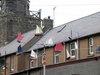
A colourful rotating exterior kinetic installation created from model sailing boats.
Sculpture at the Watchie
A painted steel sculpture in the grounds of this venue, it maintains a vigil that evokes the original raison d'être of the building.
Shell House

A small domed oven shaped building of old bricks, lined with mosaics of shells. Set in a hard landscaping of cobbles with a small pool etc.
Ships Cannon reused as a bollard
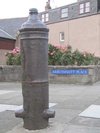
An old cast metal ship's cannon set vertically as a bollard into the pavement on the way from the town centre to Stonehaven harbour.
Shorehead Information board
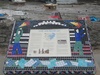
A sloping mosaic panel that surely draws on the local wealth of 'art deco' design, artefacts and buildings. With an inset information panel. It is set on a contrasting plinth of rough masonary.
Sign - Ian Edwards

An enamelled metal sign with a large red arrow and blue lettering and a representation of a 1930s convertible on a white background. I do not know whether this fairly recent sign is a commercial production or home-made but it resonates with the areas legacy of art Deco.
Slate cairn, Bervie Braes information point
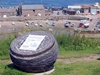
A hemispherical slate cairn with a, metal bound, circular slate-mosaic upper surface with an inset information panel.
St James the Great, Episcopal Church Stonehaven, carving of the head of Christ
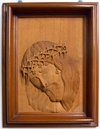
A contemporary bas-relief in wood of the head of a crucified Christ made in Jakarta Indonesia for Ian and Barbara McNab, who presented it to the church.
St James the Great, Episcopal Church Stonehaven, Duff Memorial
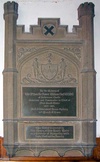
Relief carved stone panel in an architectural style with crenellated top and side columns, with armorial decoration, memorial to the Rt. Hon. Sir Robert William Duff of Fetteresso, Governor of New South Wales 1893-95. Presented by the 'women of New South Wales' as a tribute of sympathy to Lady Duff.
St James the Great, Episcopal Church Stonehaven, general
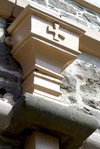
Architects Sir Robert Rowand Anderson, nave 1875-7; Anderson with Arthur Clyne, chancel, organ chamber and vestry 1883-5, builder John Morgan; Arthur Clyne, narthex and baptistery 1906, latter with Sir Ninian Comper glass of 1929. Transitional church with 5-bay nave, low buttressed side aisles and clerestorey, crowstepped lean-to narthex and semi-octagonal baptistery with prismatic roof. NE organ chamber, SE sacristy and choir vestry of semi-octagonal plan, adjoining slim tower with circular belfry stage; apsidal choir. Squared and snecked rubble with some Aberdeen bond, and ashlar dressings. Deep base course, continuous hoodmoulds forming string courses, eaves course and blocking courses to baptistery and vestry. Principally round-arched openings, quatrefoil and trefoil-headed to vestry, pointed-arch to NW aisle openings, and vessica to NW gablehead of nave. Squat, 2-stage coped buttresses; voussoirs; hoodmoulds with label stops; raked cills; chamfered reveals. 2-leaf vertically-boarded timber doors with decorative ironwork hinges. INTERIOR: fine arcaded Romanesque interior with round columns and uncut capitals, clerestory windows and hammeberbeam roof to nave; tall chancel arch and ribbed timber-lined barrel-vaulted roof to chancel and apse. Fixed timber pews. Narthex with 2-leaf screen door in pointed-arch opening with decoratively-astragalled leaded panels and fanlight. Apse with high altar and elaborately sculptured reredos.
St James the Great, Episcopal Church Stonehaven, organ
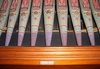
An example of a highly decorated neo-Gothic Victorian church pipe organ with gold-leaf and painted ornamentation.
St James the Great, Episcopal Church Stonehaven, pulpit
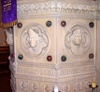
Decoratively carved Caen stone pulpit designed by Arthur Clyne, built under the supervision of sculptor James Bremner of Broughty Ferry, incorporating quatrefoil panels with carved heads of (according to the Listed Building Record): St. James, King David of Scotland 1124-1153, Bishop Forbes, Bishop Keith and Bishop Jolly bishop of Moray 1798-1838. This above information is contradicted by the information given in the church and Booklet on the history of St. James Church, available in the church, this lists the heads on the pulpit as: St Ninian (of Candidacasa aka Whitehouse) 397-432, St David King of Scotland 1124-1153, John Sinclair bishop of Brechin 1565-66, Alexander Jolly bishop of Moray 1798-1838, and Alexander Penrose Forbes bishop of Brechin 1847-75 (my own view based on the clothing/facial hair, much more like a Victorian interpretation of Middle Eastern clothing than Brythonic Celtic, is that the LBR is right about the first head being intended as St. James). Carved with the quote "heaven and earth shall pass away but my words will not pass away". The green marble balls at the angle of the panels above and below come from Egypt and the red from Victoria in South Africa.
St James the Great, Episcopal Church Stonehaven, Reredos
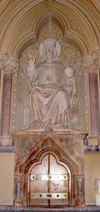
Elaborately sculptured reredos by Gambier Perry of London, memorial to Mrs Annette Maria Baird of Ury, nee Palk (1884), incorporating 4 crocketted and finialled, pointed-arch, trefoil-headed niches supported by columns of Devonshire stone, with five alabaster figures, of Sts Andrew, Peter, James and John (brother of James), flanking larger niche with seated Christ carved in high relief above an alabaster tabernacle, with brass bound wooden doors.
St James the Great, Episcopal Church Stonehaven, stained glass
STAINED GLASS: some fine coloured glass, including apsidal window depicting 'Christ crucified' by Clayton & Bell of London, flanked by windows depicting on left, the carrying of the cross and the flagellation, and on right the descent from the cross; West window is a memorial to Dean Christie showing 'Christ's Baptism' and 'Baptism from the Tolbooth window' (this illustrates the Rev. Alexander Greig baptising infants from the Tolbooth window while imprisoned in 1748 by the Hanoverian authorities for holding a service attended by more than 5 persons); memorial windows to nave including 'The Good Samaritan' commemorating Leslie Thomson and family of Invercowie House, 'St James' memorial to the Adams Family (1832-1955), and 'Angel' in memory of Alexander Innes of Raemoor, died 1882. Sir Ninian Comper's baptistery windows commemorate David MacDonald, headmaster of Episcopal school.
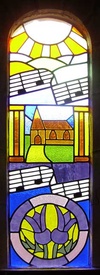
The contemporary window is a memorial to Alice Moira Christie 1932-1999 beloved wife of Jack Emslie it was designed and made by her daughters Elaine and Gillian Emslie in 2000
St Kierans well Stonehaven AKA St Ciaráns Well, Mineral Well Park fountain (Chalybeate)
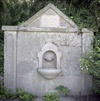
An elegant pedimented fountain of Peterhead granite, the basin is backed by an ornate niche decorated with a carved scallop shell in high relief. The plaque reads "St Kierans well erected by public subscription A.D. 1860"
St. Bridgets Church , Stonehaven
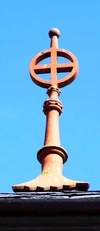
G P K Young, Perth, 1886. Arts and Crafts style church converted as church hall, with 6-bay buttressed nave, large shallow-pitched roof with canopied bell-housing, jerkinhead dormers and decoratively-finialled square-plan spirelet; piended session room and porch. Squared and snecked rubble with smooth ashlar dressings. Base course and cill course at gablehead window. Voussoired, round-headed door. 2-stage coped buttresses. Chamfered reveals, raked cills and timber mullions to cusped 3-light windows in rectangular openings. Modern flat-roofed hall.
Ecclesiastical building no longer in use as such. In 1885 it was decided by the Kirk Session of Dunnottar Parish Church that they needed a mission church to meet the needs of a growing population, mainly the fishing community of the Old Town. The cost of building was £1300, over half of which was met by funds raised at a two day sale of work. The Stonehaven Journal and Kincardineshire Advertiser of August 12, 1886, advertised the "Dunnottar Mission Church Bazaar" to "be opened on Thursday 19th August by J Badenach Nicolson, Esq of Glenbervie and on Saturday 21st August by Provost Wood, Stonehaven". Items for sale included gilt chairs from Paris and a chest containing 40lb of tea grown on the Fetteresso Estate, Ceylon, as well as fish and livestock. The church of St Bridget was opened on January 25, 1888, it was rededicated in 1970 after conversion to a hall church, and is now used as Dunnottar Parish Church Hall. A photograph of the church interior before conversion to a hall church shows fixed timber pews, carved pulpit and large round-headed traceried window to the north wall (behind current stage). Accompanying some elegant decorative ironwork light fittings is a model fishing boat suspended above the nave, a reminder of the fishing community associated with the original Mission Church.
St. Ciaráns Kirk Stonehaven, armorial plaques
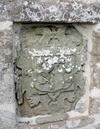
Two badly eroded and lichen covered armorial monuments, they are now hard to read or distinguish the devices but enough remains to indicate a high quality of decorative carving.
St. Ciaráns Kirk Stonehaven, bellcote detail
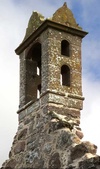
St. Ciaráns Kirk Stonehaven, blacksmiths stone
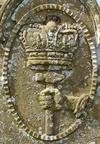
A beautifully cut stone almost like an engraved book plate of the period. The crown and hammer blacksmiths' symbol can be seen at the top of this headstone. It is inscribed " 1823 RSIMK To the memory of RICHARD SMITH once blacksmith of URE and late farmer of ALLARDICE who died the 6th Sept 1822 aged 67 years"
St. Ciaráns Kirk Stonehaven, Duff Memorial

A superb white marble tombstone to the memory of Rbt. Wllm. Duff of Fetteresso, dated 1834, features a finely carved armorial panel in a good pediment. Also inscribed to his wife Mary Abercromby Duff who died 1833, it was erected by their son Robert and the inscription also commemorates his early death at the age of 31 in 1861.
St. Ciaráns Kirk Stonehaven, gardeners stone
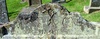
A memorial to 'John Smart late gardener at Barras who died 13th Feb 1798 aged 43 yrs' (the tools at the top of the stone of which the spade is familiar as a memeto mori thus here function as a trade emblem) an inscription is appended to his wife 'Christian Masson who died in 1847' two other commemorations follow to an Alexander Smart 1913 and to his wife Elizabeth Glegg Burnett 1926. Like other stones in this database with inscriptions produced from the end of the 18th to the beginning of the 20th centuries it shows an interesting modification some would say a deterioration in the standard lettering style.
St. Ciaráns Kirk Stonehaven, general
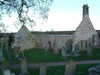
Scheduled Ancient Monument.
The Old Kirk : The old kirk is situated on a small hill that was once allegedly the site of the 6th - century Chapel of St. Ciaran. St. Ciarán was an Irish monk, missionary to the Picts (if it is was St. Ciarán founder of Clonmacnois who lived from circa 512-544AD it is hard to see how he had the time) there are also many other saints of the same name St. Ciarán [the Elder] of Ossory or of Saighir not to mention Saint Ciarán of Disert-Kieran, Saint Ciarán of Clonsost, Saint Ciarán mac Colga and an often confused St. Piran, in fact there are so many dark-age St Ciaráns it is something of an academic joke.
When Stonehaven became the county town of Kincardineshire in 1600, subsequent population growth necessitated the building of a New Kirk on Bath Street and St. Ciarán's fell derelict, but was rescued by the Duffs of Fetterresso who used it as their burial ground.
The Pictish period chapel was replaced by one built in the 13th – century of which the N.W. doorway and portions of the N. adjoining wall are said to belong. The main body of the present kirk dates from the second half of the 17th - century. Internally this elevation can be seen to have contained a number of window and door openings. The N.W. gable of the kirk is crowned by a bellcote, dated 1737, though the bell is no longer present. Internally the kirk contains a superb white marble tombstone to the memory of Rbt. Wllm. Duff of Fetterresso, dated 1834, and features a finely carved armorial panel in a good pediment. The memorial is in reasonably good condition.
Tombstones : There are approximately 71 recumbent tombstones, of which 12 are significantly decorated. There are many hundreds of upright tombstones of which a high proportion are stylish Victorian tombstones.
Some of the 18th century stones were engraved by a Mr. Cresswell, a farmer "who could not form a single letter with the pen".
St. Ciaráns Kirk Stonehaven, granite obelisk
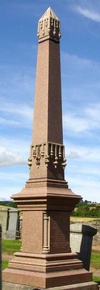
Pink granite obelisk in a classical style. The inscription reads: "In affectionate remembrance of William Mowat Leather Merchant
Stonehaven who died 11th May 1882 aged 69 years and of his wife Jane Silver who died 9th September 1895 aged 80 years
Also of his son Alexander Roberts Mowat who died 1st June 1883 aged 31 years"
St. Ciaráns Kirk Stonehaven, stones showing Mortality Emblems
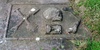
Various headstones with memento mori symbols. The oldest, in the top photograph, appears to be dated 1600 pre-dating most of the surviving ruins.
St. Ciaráns Kirk Stonehaven, various Victorian stones
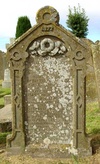
Stones of 1860s-70s in various styles derived from Victorian neo-gothic and neo-classical.
St. Ciaráns Kirk Stonehaven, watchmakers stone
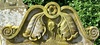
An elegant Victorian stone dedicated to a watchmaker, Robert Edwards, decorated with foliage, a flower motif and scrolls.
Stonehaven Art Deco Open Air Swimming Pool
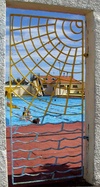
Rectangular-plan, 320,000 gallon, open air heated seawater swimming pool (55 yards x 20 yards) with long, single storey, pantiled, Art Deco, entrance range comprising turnstiles, café and flanking changing rooms; stepped buttressed enclosure walls. Painted poured concrete.
Stonehaven Beach Waveform
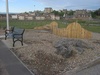
A dry garden of shingle, cut timbers and boulders, in a style derived at some distance from Japanese Zen dry gardens that seems to have become popular for public installations.
Stonehaven Boardwalk furniture
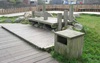
Public seating area with decking and modernist bench constructed from massive sawn timber
Stonehaven Boardwalk Bird with Fish sculpture
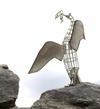
A new welded metal sculpture depicting a Common Shag, Phalacrocorax aristotelis (identifiable by its distinctive breeding crest that distinguishes it from the Great Cormorant Phalacrocorax carbo). It is holding a fish in its beak.
Stonehaven Boardwalk Salmon
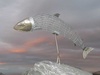
A welded metal sculpture of a cock salmon, if it was inspired by Andy Scott's nearby work I think the anonymous creator outdid that work with this piece that while being thoroughly contemporary has the resonance of the ancient Pictish Salmon symbol. It is to be hoped that its disappearance does not mean it has been destroyed by the sea or vandalism.
Stonehaven Court House Roof Railings
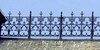
19th century gothic revival decorative ironwork based on a trefoil motive, installed along the roof ridge. The more recent seagull defences of chicken wire somewhat spoil the overall effect.
Stonehaven Mercat Cross

It is a simple stone-shafted cross, square at base but splayed above, resting on an octagonal base. The head of the cross was replaced by the present one which bears the Marischal Arms in 1887 when it was remodelled for Queen Victoria's golden jubilee visit.
The public barometer installed in 1852 on wall of Old Town House (1790, datestone over door) can be seen in the background of the top photograph. The town house clock tower is itself of interest; dated 1790; 4 stage, 1 window each face, quoined ashlar; cross-pattern timber balustrade, octagonal timber belfry stage with semi-elliptical triple key blocked openings, lead spire with weathercock; pedimented clock dated 1896; built by public subscription.
Stonehaven Railway Station Canopy
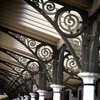
Station; opened c1850 by the Aberdeen Railway; a 2 platform through station, with the main offices on the up platform, in a 2-storey ashlar building, with the platform at first floor level. There is an unusually heavy cast iron-framed platform awning. Still in use. Cast by Saracen Foundry Glasgow manufactured by Walter Macfarlane & Co. The supporting brackets are decorated with ornate scrollwork.
Stonehaven Tolbooth Gates
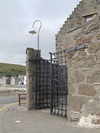
Heavy wrought iron gates in a grid pattern with protruding scrolls at top and bottom of the vertical bars. The building dates from the 1500s but I do not know if the gates are contemporary with it.
Stonehaven War Memorial
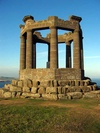
Sandstone and Granite The Stonehaven war memorial stands on a hill to the southeast of the town overlooking the bay. It commemorates the dead of both World War I & II. It is built to represent a ruined Greek temple, and is octagonal in shape with Doric columns supporting an entablature. It sits on a raised dais with eleven steps leading up to a small wrought iron gate. Stone benches run around the interior between the pillars. The names of battles are carved into the lintels over the pillars. The architect was John Ellis of Aberdeen and the memorial was dedicated on the 23rd of May 1923 at 3pm.
Stonehaven, Ship Inn Sign
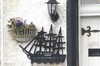
A cut (or perhaps forged) steel or iron sign in the form of a three masted schooner. The holes at the head of the fore and mizzen masts suggest the sign was originaly designed to hang.
T
Tewel - Farm Signs

The unique welded lettering on the gate is in keeping with the area's vibrant art deco heritage, the mass produced cast metal sign with charolais bull is however something that at the moment could be anywhere in Britain.
The Carron Restaurant
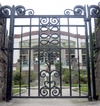
Colonel Tawse and Messrs Hall, 1936; renovated 1999-2000 by Hall and Tawse. Tall single storey and basement, 3-bay, piend-roofed, Art Deco restaurant with bowed concrete-pillared loggia/verandah and bowed front comprising Art Deco glazing to large windows combining vertical and horizontal patterning with Deco symbols, set on terrace above period garden. Banded brick and reinforced concrete. S (PRINCIPAL) ELEVATION: symmetrical. Double stair leading to loggia with Art Deco metalwork balustrade railing, centre bay of set-back face with large bow comprising narrow-centre 5-part full-height window with decoratively-astragalled top-lights, similarly-detailed 4-part windows to outer bays with outer lights as doors. W ELEVATION: tall piended bay at centre with tall raised-centre 5-light window, flat-roofed loggia to right with later infill glazing, and lower piended bay to left with symmetrical glazing. N (EVAN STREET) ELEVATION: listed separately as Art-deco Shops 26 to 32 Evan Street. Metal framed windows with decoratively-astragalled glazing patterns to S combining vertical and horizontal patterning with Deco symbols; largely multi-pane glazing elsewhere. Grey slates. INTERIOR: fine Art Deco interior comprising main apartment with vaulted ceiling, horizontal panelled walls incorporating some decorative metalwork panels, and counter with clock incorporated behind; E end wall with Art Deco engraved 'Picasso glass' mirror and tall curved mirrored supports (with lights?). Original light fittings. Toilets with original decorative floor and wall tiles and fittings. Wood floors reclaimed from Aberdeen College of Commerce. Top-lit link corridor leading to N entrance (Evan Street). TERRACED GARDEN, BOUNDARY WALLS, GATEPIERS AND GATES: rubble and brick terracing to ornamental garden, garden walls to street with period gate- and end-piers, ironwork archway incorporating name 'CARRON RESTAURANT' and boldly detailed wrought-iron gates.
The Cat at the Window
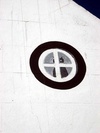
The First Burns Bust
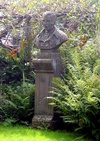
Sandstone bust of the poet Robert Burns (b. 25 Jan 1759 d. 21st July 1796, at the age of 37) on a columnar pedestal by Robert Taylor 'Ghosty Bob' a local monumental mason and sculptor (his nickname a result of his work carving many gravestones). This was the first statue of Burns that the artist did. Both works ultimately derive from the 1787 portrait by Alexander Nasmyth (1758-1840). This seems to be regarded as the definitive image and has been used as a source for most of the huge number of later representations, it is certainly more flattering than the portrait painted by Peter Taylor in 1786. This bust is in a much more classical style than his Burns Statue in the Burns Garden at David Street (see related artefact) which was created as a result of a commission resulting from this one, but was never collected. The characters Souter Johnie and Tam 'o Shanter look down on you as you view the Master, from the garden wall.
The Milestone and Commemorative Keystone
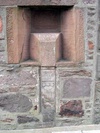
Sandstone commemorative stone worded 'THEOBALD BARCLAY 1150' 'MATHERS 1351 URIE' (see Notes below) from the 1781 bridge re-cut and set into wall below a milestone which is incised with BERVIE 10 / L(signifing Laurencekirk)14 / A(signifing Aberdeen)14.
The Mill Inn
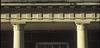
Late 18th century and circa 1830, converted to flats in 1998. 2-storey and attic, 7-bay, L-plan former coaching inn converted to flatted dwellings late 20th century, with hexastyle colonnade. Red sandstone ashlar with coursed squared rubble to sides, squared and snecked rubble and some harl to rear. Cornice and blocking course.
S (PRINCIPAL) ELEVATION: ground floor with colonnade, outer pilasters and Doric entablature with triglyphs, metopes and guttae, mutuled cornice and blocking course across 3 centre bays with window flanked by panelled timber doors with 4-pane fanlights, windows to remaining bays, and smaller regular fenestration close to eaves at 1st floor. Blocking course with raised centre comprising corniced ashlar tablet and painted panel reading 'THE MILL INN'. 2 slate-hung piended dormer windows to each side behind blocking course.
The White Bridge Stonehaven
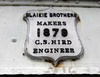
A highly decorative late-Victorian footbridge. Single span, shallow segmental-arched, cast-iron footbridge over Carron Water. Cast in 3 sections with dated makers plaque to centre of riveted girder, wrought-iron quatrefoil parapet, cast-iron standards with wrought-iron arch at centre, and pyramidally-coped, stop-chamfered ashlar terminal piers.
Made by Blaikie Brothers - Engineer was G.S. Hird.
Thistle Garden Gates
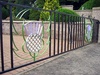
Painted welded steel decorative garden gates incorporating large Scottish thistle emblems.
U
Untitled Sculpture
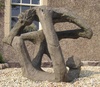
A concrete or ciment fondue sculpture of 2 figures joined in a gymnastic or acrobatic position.
V
Various cast iron gates railings and etc in Victoria Terrace, Montrose Road and Castle Terrace , Inverbervie
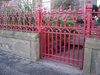
An unusually good group of cast iron railings all in the same area of this small town. Many such railings in the urban and suburban Scottish landscape were removed 'for the War Effort' in the 1940s, along with all those saucepans that were allegedly needed to make Spitfires. The collecting teams must have missed this little area leaving it with something of its original Edwardian appearance. Also noteworthy is the Inverbervie Church gate overthrow see the external links.
The second to last photograph also shows a very fine pillar top lantern, presumably originally gas-lit.
W
Weavers Cottage Stained glass House Door
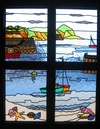
A contemporary front door with four inset stained glass panels forming a harbour landscape in naive style
Woodburn - house sign

Painted metal Bed and Breakfast sign using a lettering style reminiscent of mid-20th century trade signs.
This content was submitted by external contributors and does not necessarily reflect the views of the University of Aberdeen.