
K
Kirkside House Gatepiers

Probably early 19th century. Four ashlar piers, inner piers with eagle finials, outer pair with acorns (according to LBR but they look more like cones to me). category c listed. piers also bear armorial decorations.
S
Stone of Morphie, Alternative Name: Stone Of Morphy

Stone of Morphie: This standing stone (measuring 1m by 0.7m at the base and 3.4m in height) is immediately S of the public road in the stackyard of Stone of Morphie farm. Traditionally said (New Statistical Account [NSA] 1845) to mark the grave of a son of Camus, killed in a battle between the Scots and the Danes, it was knocked down shortly before 1856. Digging prior to re-erection revealed part of a human skeleton, buried in black unctuous earth. The stone is freestone, and is uninscribed. as ref RCAHMS 1982; J Stuart 1856; Name Book 1863
V
Various items at Old St.Cyrus cemetry
Reputed to be the site of a 13th - century kirk, there was said to be no visible signs of its position within the yard though a four-sided structure is present to the rear of the site bearing a carved stone lintel and chamfer-edged doorway. This enclosure, is said to be a burial ground. Built into a corner of the kirkyard is a small old watch-house with a good secure door and a small watch window.
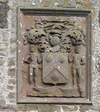
There are approximately 10 recumbent tombstones, of which 3 are particularly well-decorated. There are several burial enclosures of particular note: - The Stratton of Kirkside enclosure,complete with original railings, contains a huge polished pink sarcophagus, a memorial with a bronze portrait by John Steell and a shattered 17th - century sarcophagus.The most visually commanding structure is the Graham of Morphie Aisle. Rebuilt in the 19th -century of a crow-stepped form, it sports a good armorial panel over the doorway.
The three carved figures, shown in one of the photographs, although presumably representing biblical characters, are a little reminiscent of the genii cucullati (hooded gods) figures of Romano Celtic Europe/Britain in pose if not in hoodies.
This content was submitted by external contributors and does not necessarily reflect the views of the University of Aberdeen.