
P
Plaque datestone on the Salmon House Portsoy
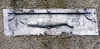
A carved painted datestone with a relief carved cock salmon between figures 18 and 34 within plain raised border with angle fluted 'fan' motif. The salmon is somehow more 'cuddly' than most representations of this popular subject
Portsoy Harbour depth indicator
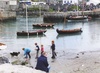
Numerals carved in nicely dressed blocks to indicate depth, they appear to change from Arabic to Roman between 9 and X, presumably to maximise clarity. See the external link to RCAHMS for aerial views etc.
Portsoy War Memorial
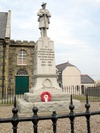
A war memorial of the common 'praying soldier' type. In this case the statue is on top of a tall carved plinth set on a two step base of roughly dressed granite. It is surmounted by a kilted soldier with Glengarry, standing head bowed holding an inverted rifle. It commemorates the dead of both World War I & II. Below the main inscription on the front is a carved wreath. The memorial is surrounded by a small wrought-iron enclosure.It was unveiled 11 November 1923.
Portsoy Wheat Sheaf and Anchor
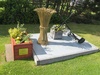
Assemblage of a painted welded metal representation of a wheat sheaf and anchor with planters on a concrete base beside the main road. The plaque reads "Wheat sheaf & fishermans anchor - sculptured by John McGrath, Sandend - Gifted to the people of Portsoy October 2008
R
R.A.F. Banff Strike Wing Memorial
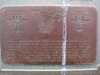
The inscription reads:
"This memorial commemorates the men and women who served with the six multi-national squadrons which formed the Banff Strike Wing at R.A.F. Banff between September 1944 and May 1945. Under the command of group captain the Hon. Max Aitken the mixed Mosquito and Beaufighter units mounted concentrated attacks on German surface vessels and U-boats in the North Sea and along the Norwegian coast. Their success in the closing months of World War II was important in the defeat of Germany and strike wing aircraft operating from the airfield near here inflicted heavy damage on enemy shipping and supply routes. Many thousands of tons of vital iron ore and other supplies were lost to the German forces as a result of rocket and cannon attacks carried out by this gallant strike wing. Losses amongst R.A.F. commonwealth and Norwegian squadrons were high. More than 80 aircrew gave their lives flying with the R.A.F. Banff Strike Wing."
S
St Colms Well Portsoy
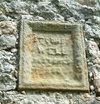
Rubble built tunnel type entrance, the well is said to have been built in the early part of the 7th century. The well 2ft diameter, and still flowing, is now covered by a stone cupola with an arched entrance. The well is hidden away in an earth mound (Perhaps a burial mound since it is adjacent to the cemetery) You can only see the well if you actually enter the cemetery by the gate at the bottom of the hill opposite the caravan for the warden of the caravan site. The plaque, made from the soft unstable yellow sandstone of the area, is just recognisable as St Colm's well but will be lost soon, the plaque dates from when the well was restored in 1893 though the date is now hardly readable.
Near the site of an ancient chapel, or oratory, said to have been dedicated to St Columba the last remnants of which disappeared in the early 1800s.
T
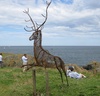
Temporary Installation of Horse and Stag sculptures, Portsoy
This content was submitted by external contributors and does not necessarily reflect the views of the University of Aberdeen.