
18th century archaic head
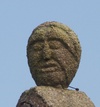
A granite carving of a human head, mounted on the south gable of the shed. This apotropaic (averting evil) carving has an extremely atavistic quality, with its appearance of a severed head it is powerfully reminiscent of Celtic Iron Age works relating to the cult of the head. Indeed if found buried in the peat bog one might think it was such. However it is presumed to date from the origin of the building to which it is attached. This is one of the oldest structures in the village one can clearly see where corrugated iron has replaced thatch, some aspects of the shed suggest it may have originally been a dwelling. It is situated near what would originally have been a major crossroad pre-dating the village square crossroad to the south and the Fraserburgh-Banff turnpike junction a mile to the north. Possibly this structure was part of the hamlet of Cyaak that preceded the village. The house on whose feu it stands No 48 High St is itself nearly as old as the foundation of the village in 1787 and was once a butchers, at which time the shed may have been used for slaughtering.
B
Bulls Head Gate Ornament
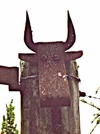
An assemblage by welding of old agricultural scrap. Although somewhat reminiscent of Pablo Picasso's treatment of the same subject using a bicycle saddle and handlebars, the different components create a more agrarian bull.
D
Double Decker Guards Van
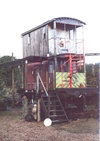
The railway guard's van has been modified by the addition of an upstairs and a spiral staircase, it is installed on a short section of track.
F
Fear Its Secret
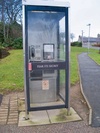
A simple intervention text work on a public phone box. The use of standard signage type lettering neatly applied gives this intervention a quasi official aura that may account for its longevity.
Fish and chip shop bear
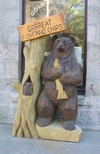
A carved and stained wooden sculpture of a brown bear holding a salmon beside a tree stump with an owl, adorned with a sign.
I
Installation of scarecrows
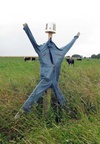
An installation of, about ten, simple tattie bogles (scarecrows) constructed of old overalls, buckets etcetera on wooden frames, these were arranged symmetrically on either side of a rectangular pasture to protect barley crops in adjacent fields.
L
Last of the Summer Wine benches
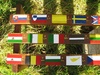
Top photographs show two benches one is a 'standard issue' park bench painted red the other assembled in situ and brightly painted with multi coloured wavy stripes, was the first installed, as of summer 2007 the red bench has been removed and the poem absent in the top 2 photos has been reinstated it reads: "The Seat. Yeve het feet, Tak a seat, Yere fer pecht, Doon yer wecht, Half wye roon, Sit ye doon, A lang wauk, Ye did tak, Jist tak care, Rest eence mair, Efter a fyle, Wauk in style, At yer best, Efter a rest. 1993" As of 2008 a second bench was re-installed, made of slats and painted with the flags of all the European Union states, with their respective population figures. Also added at this time was a tondo mounted on a post painted with what could be a conceptual representation of the EU with state names and the total population figure of 480 million in text.
N
Neep Chapper Beastie

The original implement used to chop turnips for cattle feed has been given a dramatic new persona with some subtle welded and assembled additions and a paint job.
New Pitsligo Millennium Memorial
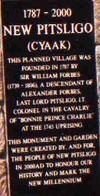
A monument consisting of a simple pillar of dressed granite, topped by a granite pyramid on a pedestal of coursed granite rubble with part dressed corners, in a formal setting of paving and planting with commemorative wooden benches. In the recent past New Pitsligo was noted for its granite quarries, all now closed, and was home to many masons and stonecutters. The form of this monument with its reused stone recalls this aspect of local history.
The inscription reads:
"1787 - 2000
NEW PITSLIGO (CYAAK)
This planned village was founded in 1787 by Sir William Forbes (1739-1806) descendant of Alexander Forbes last Lord Pitsligo, Lt Colonel in the cavalry of 'Bonnie Prince Charlie' at the 1745 uprising.
This monument and garden were created by, and for the people of New Pitsligo in 2000 A.D. to honour our history and mark the new millennium."
New Pitsligo War Memorial
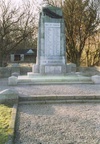
A village war memorial of cenotaph type constructed from granite ashlar blocks with appliqued bronze palm leaf and etc. The village and town war memorials of Scotland have distressingly long lists of remembered dead in proportion to the populations of the communities.
S
Serene Granite head
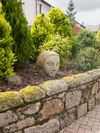
A much larger than life size carving of a head in granite that is strongly reminiscent of ancient Greco-Buddhist art of Northern India particularly the 1st -2nd century Buddha heads of Gandhara (a kingdom in what is now part of Pakistan and Afghanistan). These in turn owing their iconography to ancient Greek representations of Apollo.
Stone Placement
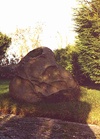
An intentional relocation and placement of a natural stone for aesthetic reason. An act that draws on oriental (Zen) precedent as well as the examples of our neolithic forbears so noticeable in the local environment.
T
The Broad Milestone - The Brade Milstane
A milestone in granite unusually wide for its height and most unlike the standard turnpike stones of the area, it perhaps pre-dates them? Included in part for its cultural importance, to the confusion of recent residents and travellers it is still very much a reference point for giving directions. Even when it has not actually been in situ. It has recently been reinstated and concreted in after road-works and the staining on the stone shows the previous ground level that made it very unlikely to be seen from a car. Inscription reads Fraserburgh 10 3/4
This content was submitted by external contributors and does not necessarily reflect the views of the University of Aberdeen.