
1754 tomb St Johns Gamrie
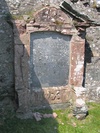
A slightly vernacular attempt at a Classical monument, the red sandstone pediment and architrave are literally falling apart. The inscription reads "Here lies interred the ashes of Margaret _____ Spouse to John Ord at ____ Crivie who died Jan the_ _ 1754. As also the ashes of Margaret Watt Spouse to John Ord sometime att Mill of Melross who died Jan the 7th 1707.
This is erected to their memory by Alex and John Ord's their lawful sons & grand sons.
I know that my redeemer liveth and that he shall stand at the later day upon the Earth & though after my skin worms destroy this body yet in my flesh shall I see God Job 19th 25 26"
A
Alex Patersons Ship Painters Shed

There is a tradition in this area of ship painters using the exterior of their premises try their colours and clean their brushes etc.. This results in heavily textured and intense abstract expressionist works of an impressive scale. Some might argue that they lack sufficient intentionality to be considered art works but they are definitely intended to be seen. This practice is also seen on other smaller sheds within the boatyard and even on roadside bollards.
B
Bodie Fountain

Category C listed.
Polished grey and red granite memorial fountain bearing a portrait bronze plaque, erected by local worthy Dr. Walford Bodie ("Dr" Walford Bodie, billed as "Electrical Wizard of the North," a show business personality with national reputation.) in memory of his daughter Jeannie. Originally sited by Macduff harbour, it was moved to Macduff Duff St, Macduff to make way for harbour improvements moved again to present site 2009. Bodie, a hypnotist, ventriloquist and performer of electrical tricks in Britain's music halls and theatres, had the (since demolished) public swimming pool and baths built on MacDuff High Shore. His use of "Dr" and "MD" (which he said stood for "Merry Devil" ) upset a number of doctors of the day. Bodie died in 1939.
Bruce-Gordon tomb St Johns kirk Gamrie
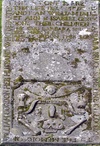
A typical early 18th cent grave slab with momenti mori, there are so many of these we stop noticing them but they are in their way not only remarkable works of art but also if legible historic records that tell poignant tales of the lives of our ancestors.
The inscription reads: "This stone is here set by Barbara Bruce sometime in Bloodymire to the memory of William Gordon her husband who departed this life Dec 14th 173(8?) and Jean William Janet Ann & Isbeel Gordons their children The said Barbara Bruce died March 28th 174* James Gordon thr son died April 4 17(5?)0
C
COAST 2013 banners
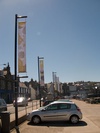
David Blyth worked with local school children as part of this commission. Two major source inspirations were a 1960 paper doll toy found in a local charity shop (the kind one used to cut out the clothes for with the little tabs that fold over) and the Macduff Marine Aquarium. The human/sea animal hybrid is also a concept widespread in Scottish folklore here however David focuses on corals, polyps, urchins and etc rather than the more traditional seals and fish of sylkies and merfolk.
Coast Festival, installation at Macduff Pier
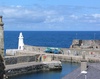
As part of the first Coast Festival (23rd-26th May2008 ). One of three commissioned temporary public art works. It consisted of 5 uprights in polished steel. These created a complex visual environment of reflections, shadows and reflected light beams. Constantly changing in accordance with the light and the viewers position.
Coat of arms Gardenstown public hall

Crovie Sculpture
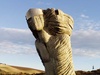
Large ash wood carving 12 foot high, with metal elements. The artist's title is "Scottish Athena" - Athena being the ancient Greek - "Goddess of wisdom, practical skills and prudent Warfare" hence the metal head piece.
"I called her that because of the prudent warfare bit because of Crovie being the place where people went during the clearing of the highlands - I thought she could be a protector therefore up on that cliff top ready with her helmet piece. The steel eyes were to reflect the sky or sunset etc to give that timeless expression. Also because in another definition she was termed patron of the arts and the piece was done as part of a Thankyou to the companies who had donated or supported the Scottish Sculpture Workshop at Lumsden."
Crovie, donations barrel
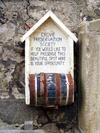
Collection barrel soliciting donations from the preservation society, that is itself in need of preservation, if you look closely has already been repaired by adding stainless steel straps the original steel rings having rusted away.
Crudie war memorial

It commemorates the dead from both World War I & II. It is a low squat memorial built of random rubble with the memorial plaque to World War I inset on the front, and the later World War II memorial added to the side. The top is also of random rubble.
E
Electra, Bodie Enclosure, Head on Pillow Stone
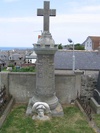
Carved pillow stone erected in memory of Isabella Henry or "La Belle Electra" assistant to Dr Walford Bodie.
Elizabeth Mantell Stained glass Memorial Windows
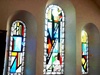
A set of three stained glass windows produced in memory of missionary nurse and Macduff resident Elizabeth B Mantell 1941-1998. The windows which combine old and new Celtic and African art. A centre panel of hand painted sections display a portrait of Elizabeth Mantell nursing a child, the Macduff Parish Church and the Mulanje Mission Hospital in Malawi, where she developed high quality nursing and midwifery over a period of 14 years. The side panels combine the Saltire Cross and the Malawi flag. Traditional Celtic border.Elizabeth mantell was born in Africa, where her father was an agent of the African lakes, In 1952 the family moved to Macduff where she grew up.
Emma Margaret Brigstocke memorial Gardenstown
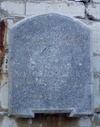
A simple and restrained granite monument to a grandmother, the inscription reads: "Erected by Francis William Garden Campbell of Troup and Glenlyon 1878 in memory of his mother's mother Emma Margaret Brigstocke who died August 20 1876 Psalm XCIII VER 3. 4."
Verses 3 and 4 of Psalm 93 are "The floods have lifted up, O Lord, the floods have lifted up their voice; the floods have lift up their waves.
The Lord on high is mightier than the noise of many waters, yea, than the mighty waves of the sea."
Has been recently (2007) restored and re-engraved the lower picture shows its previous state.
F
Farm sign Crovie Farm

A contemporary take on the cut steel sign tradition with a forged, welded and galvanised box section frame and a galvanised silhouette of a horse and ploughman on a black enamel ground.
G
GAMRIE WAR MEMORIAL
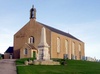
It has a needle obelisk sitting on a small three-stepped plinth above a solid rectangular base, the sides of which bear the inscriptions. At the base, on each corner, is a small rectangular projection above which sit carved scrolls running up the corners. The whole monument sits on a one-step base within a small walled enclosure above which is a low iron fence. There are two World War I war graves in the churchyard also. Commemorates the dead of both World War I & II.
K
Knowes War Memorial
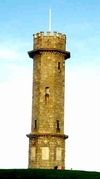
Category B listed Dominating the skyline in Macduff, the Knowes War Memorial stands 70 ft in height, an octagonal granite tower, erected in 1921 to commemorate those who gave their lives in the The Great War, 1914-1918.
It commemorates the dead from both World War I & II. It is a tall slender octagonal 5-stage tower of tooled grey granite, bullfaced at lower stages, on stepped based. There are tooled granite dressings with the lower stage defined by cornice with keystoned occulus immediately below in each face. Each face (except that with recessed doorway) has polished grey granite plaques inscribed with names of fallen of 1914-18 and 1939-45 wars. There are rectangular barred openings, to light internal stair, in alternate faces of the 1st stage and randomly sited in 2nd and 3 stages. A deep crenellated wallhead stage is delineated by a blocked cornice with blind crosslet in each face. There is a plaque stating that the foundation stone was laid on 15 April 1920 by Prince and Princess Arthur of Connaught, who was a daughter of the Duke of Fife.
M
Macduff anchor placement

A large fixed tine iron anchor with wooden crossbeam from a sailing ship. The depositing of redundent anchors from sailing ships in prominent positions is a bit of a coastal town cliche. This one has a very good view.
Macduff Parish Church or Doune Church
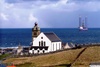
Incorporating 3 story domed tower, in 1865 the church was re-modelled and the original steeple replaced by a Italliante square tower with lead domed roof and cupola into which was installed the town clock.
Macduff soup kitchen/library royal arms
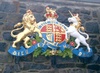
A standard issue 19th Century? cast metal 'UK Royal Arms', England, Scotland and Ireland (of a form first used from 1838) made by Walter Macfarlane & Co cast at the Saracen Foundry Glasgow. It originally adorned a 'public soup kitchen' at 21 High St. opened in 1887 to mark Queen Victoria's Jubilee, subsequently the building was the town's library (for man does not live by soup alone). The arms are of course displayed inverted (for Scotland) in Scotland the Unicorn of Scotland should be shown on the dexter side of the shield in England it is shown sinister. I do not of course know if this was the result of Victorian imperialist cultural insensitivity, bureaucratic ignorance or centralised mass production of soup kitchen décor.
Macduff, Burgh or Market Cross

Category B listed granite cross incorporating small carved plaque at apex, inscribed narrow slabs as arms mounted on square tooled granite plinth. Carving on apex depicts a figure on horseback and bears the arms of the Earl of Fife. Dated 1783 but incorporating earlier fragments. The cross bears the inscription, on 2 panels one on either side: Macduff Cross. Rebuilt at Macduff by the Earl of Fife, 1783 when the town was constituted a Royal Burgh by George III. May it flourish, increase in number and opulence, ----- while it's inhabitants gain the blessing of life by industry, diligence and temperance." The words on the inscription are taken to refer to the fact that a stone was taken from the ancient Macduff Cross in Fife and built into the Macduff one, to form some sort of symbolic connection between the ancient and modern bearers of the name Macduff. At the beginning of the last century it was popular for youths to light fires at the foot of the cross. As a result the cross fell and is now shorter.
Marine Aquarium Murals
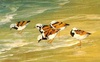
Marine aquarium murals, commissioned by Aberdeenshire Council. Murals depicting the wildlife living in and arround the Moray Firth. Painted in a fairly naturalistic, slightly simplified style, typical of popular visitor attractions of the 1990's.
Montcoffer doocot
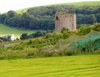
The dovecot at Mount Coffer House is cylinder-shaped. The walls are harled and rest on a plinth. A blocked up narrow slit recess, shaped as a cross at the top and a circle at the bottom, is present on the north and on the south side. The entrance is in the west side. Currently roofless probably late 18thC.
Mosaic house no Crovie
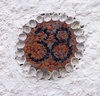
Limpet shells and coloured stones embedded in render to make a mosaic house no, in a village where the no and the name of the village are the entire address.
Myrus Cemetery Gates

Highly ornate wrought iron cemetery gates, bearing winged angels and painted town emblem with rider on horseback, also featured on MacDuff Town Cross and Town Hall.
Mystic Marie

Grave of Mary Walford Henry, or "Mystic Marie" assistant to Walford Bodie ("Dr" Walford Bodie, billed as "Electrical Wizard of the North," a show business personality with national reputation.). Upright dark grey/black polished granite tombstone with carved marble angel figure erected on top, also has portrait bronze plaque in the same style as Bodie Fountain.
The 4th photograph is a contemporary photograph of Marie Henry (Walford was a stage name) for comparison with the bronze.
The 5th shows the cover of some sheet music "The Bodie Hypnotic Waltz" based on "Dr Bodie's" and "Mystic Marie's" stage act. It is a good example of exuberant Victorian/Edwardian graphic design.
P
Pies for parking
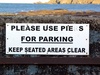
An example of that much favoured genre of vandalistic intervention that involves removing or adding to official signage text to say something more amusing or profound, in this case with a certain wit.
Puffin carving

R
RNLBI building and carved stones Deveron Bridge
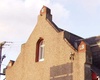
Painted decorative carved house shaped stones on the points of the gable wall, the central stone is a datestone while the other 2 have the letters RN (left) LBI (right).
S
SANDS headstone

Headstone erected by local branch of SANDS organisation (SANDS Stillbirth And Neonatal Death Society) and set in a small garden of remembrance, in memory of local children who died at birth or in infancy. Polished grey granite stone engraved with baby cradled in a hand.
SS Vigilant memorial

A stone cairn with a mortared top surmounted by a piece of marine scrap and an inscribed granite plaque, the inscription reads "TO COMMEMORATE THE BRAVERY OF THE MEN AND WOMEN OF CROVIE, GARDENSTOWN AND THE PARISH OF GAMRIE WHO ON FEBRUARY THE 11TH 1906 RESCUED THE CREW OF THE SS VIGILANT WHICH DURING A VIOLENT STORM RAN AGROUND ON THIS SHORE. ERECTED BY THE CROVIE PRESERVATION SOCIETY 2006"
St Johns Kirk Gamrie
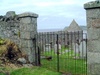
The ruined church of St Johns; the ruins of former parish church dedicated to St John the Evangelist said to be founded in 11thC. The present church has been built in two periods at least, the east end probably early 16thC and the rest 17thC; measures 28.75m long by 4.72m wide; rubble built, gable ends; wall and gable remain to roof height; ambry in E wall; 16thC Barclay of Tolly monument; 17thC onwards monuments in churchyard; fell in to ruin mid 19thC when new parish church built in 1830. Repointed in 1961.
In 1004 after a battle with the Danes the battle of the Bloody Pits (or pots) trophy skulls were brought here where they remained till fairly recently in a niche in the wall, Bloodymire (NJ 726 635) where Barbara Bruce lived is a possible site for the battle. One of the skulls went to the Banff museum. Arial photos of Bloodymire farm show crop marks of pits.
An entry in E. Cobham Brewer 1810–1897. Dictionary of Phrase and Fable. 1898. says " "Kirk of Skulls."Gamrie church in Banffshire: so called because the skulls and other bones of the Norsemen who fell in the neighbouring field, called the Bloody Pots, were built into its walls. " presumably relates to St Johns and not the newer 1830 Gamrie church.
T
Tarlair and environs

Tarlair – Art Deco outdoor swimming pool and boating pond opened in the 1930’s, it was once very popular with tourists, now falling into disrepair, no swimming allowed any more, disused since 1995, currently only used by model boat owners. Classified ‘A’ listed in 2007 by Historic Scotland.
John C Miller (Macduff Burgh Surveyor) 1930-31 with minor later alterations. Art Deco tidal swimming pool, boating pool and paddling pool surrounded by curved walkways, with associated tea pavilion at head of boating pool and changing rooms and kiosks to side. Concrete pools and buildings.
BOATING POOL, SWIMMING POOL AND PADDLING POOL: D-plan boating pool bounded by 3 broad walkways swept round from tea pavilion at head of pool; shallow steps cut into walkways at regular intervals; ramp for boats to E of tea pavilion. Rectangular paddling pool with curved corners enclosing natural rocky outcrop within the boating pool and directly in front of tea pavilion. Rectangular swimming pool to N (sea side) of boating pool with changing rooms at W end; continuation of lower walkway divides boating pool from swimming pool; middle walkway continued round to E end of pool.
TEA PAVILION: single storey, break-fronted rectangular-plan, flat-roofed Art Deco tea pavilion with 3-bay colonnade between taller end pavilions; steps at outer bays leading to roof terrace; simple horizontal railings to roof. Later 2-bay addition to W. Doors and windows boarded up (2006).
CHANGING ROOMS: low, flat-roofed group of 4 linked blocks with slightly advanced outer bays. Strip windows at eaves level (boarded up, 2006).
KIOSKS AND FENCE: probably early 1950s. 2 1-bay, roughly square-plan kiosks at pool entrance. Curved concrete fence with perforated top extends towards tea pavilion.
Tarlair Well – Tarlair Well a chalybeate spring east of Macduff was discovered in 1770 and ten year later in 1780 the Earl of Fife built the ‘Well House’ and the croft. The well was once renowned for its medicinal properties and was very popular for the ‘taking of the waters’ in the 19th century. The well ceased to flow after a German mine exploded when it came ashore in ‘World War Two’. Local drinks manufacturer Sangs traced the source of the well and are said to make all their drink products with this water. The well-house remains although in poor condition, nothing remains of the croft. The well house is category C listed.
Later 18th-early 19th century. Small rectangular rubble wellhouse with later harling. Blocked entrances in E and W gables. Small soak-away vent in base of N elevation. Piended bellcast concrete roof, probably replacing earlier stone slab covering.
INTERIOR: vaulted rubble interior; dished stone gutter runs through centre; rough stone benches against W wall.
A cottage/crofthouse once stood nearbye but during WW2 the same mine which came a shore destroyed it.
The Crazy Frog (Face in the rocks)
A natural face in the rocks which has had its mouth eyes and nostrils added to bring it out.
Painted in 2007.
Cleaved Head, Macduff – Site of a promontory fort, typical in type of the iron age, a scheduled ancient monument, two ditches and traces of a third are evident. The construction of a golf course (Tarlair Royal Golf Club) has altered the landscape around the ditches, but the easternmost ditch is still the best preserved, having a scarp 1.5m high and a counterscarp 0.5m high; no evidence of fortification was seen on the flattish top of the promontory . Grid ref NJ 721 647. Spectacular views of the rugged coastline eastward to Troup Head can be had from here.
Temple of Venus

Belvedere in the form of domed arcaded rotunda. Modern harl. 6 round headed keystone arches rising from a continuous plinth. Domed roof capped by a small ball finial. Built for the Earl of Fife on a hill over-looking Duff House, the Earl's folly once housed a statue of the goddess Venus. Built by the Earls of Fife to improve the skyline.
W
War Memorial Stained Glass Window

Two stained glass windows dedicated to the Glory of God and in memory of the men of the congregation who lost their lives in the First World War 1914-1919. The window on the east side of the pulpit is based on the text "This is the victory that overcometh the world, even our faith," 1 John v., 4. The window on the west side is known as the Children's Window, the theme of this window is the text "Suffer little children to come to unto me, and forbid them not, for such is the Kingdom of Heaven." The Children's window is an especially fine piece of work and had the distinction of being shown in the Royal Academy, London, prior to its installation. Windows signed CW or WC in monogram form.
This content was submitted by external contributors and does not necessarily reflect the views of the University of Aberdeen.