
17th century grave slab St Drostans kirk Aberdour

A 17th century grave slab with finely carved lettering and memento mori symbols in a primitive style.
18th cent tomb slab St Drostans Aberdour
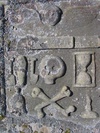
A stone slab carved with memento mori in a more primitive style than the nearby Clyne grave. The inscription is no longer legible.
18th century archaic head
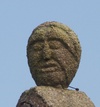
A granite carving of a human head, mounted on the south gable of the shed. This apotropaic (averting evil) carving has an extremely atavistic quality, with its appearance of a severed head it is powerfully reminiscent of Celtic Iron Age works relating to the cult of the head. Indeed if found buried in the peat bog one might think it was such. However it is presumed to date from the origin of the building to which it is attached. This is one of the oldest structures in the village one can clearly see where corrugated iron has replaced thatch, some aspects of the shed suggest it may have originally been a dwelling. It is situated near what would originally have been a major crossroad pre-dating the village square crossroad to the south and the Fraserburgh-Banff turnpike junction a mile to the north. Possibly this structure was part of the hamlet of Cyaak that preceded the village. The house on whose feu it stands No 48 High St is itself nearly as old as the foundation of the village in 1787 and was once a butchers, at which time the shed may have been used for slaughtering.
A
Aberdour cave graffiti
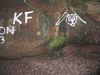
An assemblage of graffiti mostly consisting of simply painted names and dates but including the illustrated iconographic piece, showing a hound's head from an unusual straight on perspective.
Aberdour Dovecot
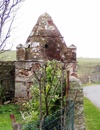
Dovecot; small square ashlar with some pinnings; stone nesting boxes; has squat octagonal gablet pinnacles; two rat ledges; possibly 16th/17thC origin; restored 1981.
Andrew Bruce Memorial
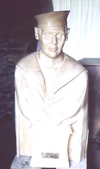
A memorial commemorating the artist's brother Andrew Bruce who lost his life during the sinking of H.M.S. Barham at 16.25 hrs. on the 25th November 1941. The memorial is to be installed in his home village of St. Combs.
B
Beach Café murals, Fraserburgh
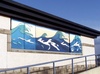
A mural of waves with a nod to Katsushika Hokusai and his famous print "In the Hollow of a Wave off the Coast at Kanagawa".
Compare this maritime icon, aimed at an audience of surfers and other recreational users of the littoral, with the murals on the harbour café designed for an audience who go to work with the sea.
Bulls Head Gate Ornament
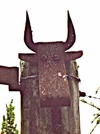
An assemblage by welding of old agricultural scrap. Although somewhat reminiscent of Pablo Picasso's treatment of the same subject using a bicycle saddle and handlebars, the different components create a more agrarian bull.
C
Cairness House
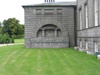
Cairness House is considered one of the finest examples
of neoclassical architecture in Britain. The house sits four miles south
of Fraserburgh in the County of Aberdeenshire, looking across to Mormond
Hill. It is the largest and finest country house in Buchan and one of the
great houses of Scotland.
Cairness was built between 1791 and 1797 to designs by architect James
Playfair and replaced an earlier house of 1781 by Robert Burn, which was
largely incorporated into the Playfair scheme. Sir John Soane assisted in
the final stages of the construction following Playfair’s untimely death
in 1794. The park was laid out by Thomas White, a follower of Lancelot
'Capability' Brown.
The building shows a strong influence of the French architects
Étienne-Louis Boullée and Claude Nicholas Ledoux. The design incorporates
a complex mixture of Masonic and pagan symbols as well as many
numerological and architectural conceits. It is a calendar house, and its
ground plan shows an adjoining “C” and “H”, variously standing for
Cairness House and Charles Gordon.
Constructed in finely detailed granite ashlar, Cairness House consists of
a 110-ft main block, flanked by two raised “bookend” wings. A tetrastyle
pedimented Roman Doric porch sits to the centre, its unjointed columns
hewn from menhirs taken from a nearby druids' temple (presumably actually a neolithic recumbent stone circle, possibly one that was at Rora about 6 miles to southeast) . A pair of lower
pavilions with representations of the Masonic Altar adjoin at the back.
From these spans a huge semicircular service wing, with a central bell
tower above a lunette arch, enclosing a courtyard at the rear of the
house. The centre of the courtyard is dominated by a round ice house
modelled on the Temple of the Winds in Athens. The main roof is surmounted
by 51 cast iron chimney cans in the shape of fluted Doric columns.
Cairness House was commissioned by Charles Gordon of Cairness and Buthlaw
and was part of a 9,000-acre estate that included the village of St. Comb’
s and the Loch of Strathbeg, today an important nature reserve. The second
laird, Major-General Thomas Gordon (1788-1841), a good friend of Lord
Byron, was a hero of the Greek Wars of Independence and wrote a celebrated
history of the conflict. The Gordon family sold the estate in 1937 to the
Countess of Southesk.
After the Second World War, the house was used as a farmhouse and
gradually fell into serious decline. The park was destroyed from the early
1950s onwards with the mass clearance of trees in order to reclaim land
for agricultural use. In 1991, the house was listed as a Building At Risk
by the Scottish Civic Trust. A major long-term restoration programme of
the house and grounds was instigated by new owners in 2001. Cairness House
now contains a very fine collection of furniture and works of art and is
open to the public.
Clyne grave 18th century grave slab St Drostans kirk Aberdour
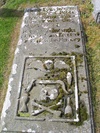
A nicely carved 18th century grave slab with classic memento mori symbols in a slightly more sophisticated style than some examples.
D
Double Decker Guards Van
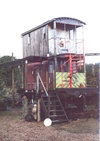
The railway guard's van has been modified by the addition of an upstairs and a spiral staircase, it is installed on a short section of track.
E
Egypt Farm Sign
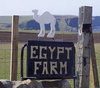
This popular cut out sign of a camel has been through more than one incarnation while keeping to essentially the same design
F
False window Pennan Harbour
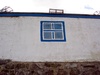
A blank white shed wall is relieved by a painted window frame that somehow evokes the view that it would have if it were real.
Fear Its Secret
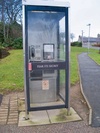
A simple intervention text work on a public phone box. The use of standard signage type lettering neatly applied gives this intervention a quasi official aura that may account for its longevity.
Fish and chip shop bear
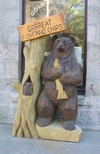
A carved and stained wooden sculpture of a brown bear holding a salmon beside a tree stump with an owl, adorned with a sign.
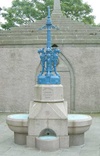
Fraser/Saltoun Mausoleum and Jubilee or Temperance Fountain
There are two Fraser/Saltoun Mausoleums the old one which is situated adjacent to the Old Parish Church and a more recent ? one which stands by itself in the Kirkton cemetery. They are almost identical in Gothic style, with curious stepped pyramid roofs surmounted by obelisks topped with an egg shape. The older 18th cent one is harled and the more recent is in exposed dressed granite.
The Jubilee fountain has been moved from elsewhere in the square. It consists of a geometric carved granite base with 4 basins at 2 heights (presumably for dogs and people) surmounted by a blue painted cast iron Victorian extravaganza of a finial adorned with four heraldic beasties, (wyverns ?). It is sad that so many of our fountains no longer provide water or are even connected to a water supply.
Fraserburgh entrance, lighthouse models
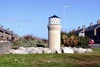
Large model lighthouses at the entrance to the town of the Banff and Strichen Roads surrounded by boulders and planting.
Fraserburgh Fish Sculpture
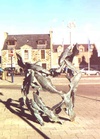
A sculpture in bronze in the form of shoaling fish. Has been used as a location for for pre-nuptial blackening rituals.
Fraserburgh Old Parish Church, fish weather vane
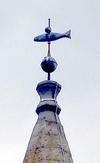
The slightly stumpy stone built spire of the church is adorned by a simple metal fish weather vane. See external link to church website for pictures of the whole building.
Fraserburgh Town Cross
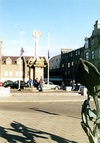
A polychrome market cross with the Royal Arms of Scotland on the North side surrounded by the insignia of the Order of St Andrew, on the South are the Royal Arms of the United Kingdom surrounded by the insignia of the Order of the Garter,on top of a shaft dating from 1736. The south of the shaft bears the burgh arms of Fraserburgh and the north the burgh arms of Faithlie. Faithlie being the burgh that preceeded and grew into Fraserburgh. The granite base dates from 1845. The finial was replaced in 1988 and the whole monument was moved a short distance in 1997.
Fraserburgh War Memorial
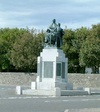
Comprises of a bronze sculpture of a female figure restraining a soldier ‘Justice guiding valour’ on a granite base. It commemorates the dead of both World War I & II. It has a large rectangular base with plaques on each face, and built-out small angled corner pieces, the faces of which also bear plaques. Above, on a three-step plinth, is the bronze cast of two classical figures. The larger is a cloaked & seated female (Justice) with a downturned sword in front of her. To her left side is a smaller figure of a cloaked warrior (Valour) with helmet & shield who is holding the sword in his left hand. It was unveiled on September 9, 1923.
Fraserburgh, Beach tunnel murals
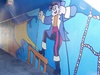
Brightly coloured cartoonish mural decoration in a style that many adults seem to regard as appealing to children.
H
Harbour Cafe, Fraserburgh
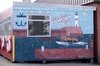
A cafe in a portakabin on the quayside decorated with seascapes and a harbour view, featuring fishing boats and the lifeboat.
The retro signwriting style is particularly interesting.
I
Installation of scarecrows
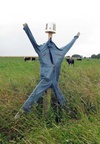
An installation of, about ten, simple tattie bogles (scarecrows) constructed of old overalls, buckets etcetera on wooden frames, these were arranged symmetrically on either side of a rectangular pasture to protect barley crops in adjacent fields.
Inverallochy War Memorial
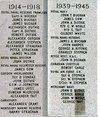
An art Deco style polished granite war memorial, with two stepped-back side blocks which bear the inscriptions of the names, the left for World War I and the right for World War II. The central larger panel is plain, apart from a small decorative panel near the top and the words 'In remembrance' below it. The symmetry shows it is obviously post world war two resulting in (to my mind) a more aesthetically pleasing monument than many originating from before WWII that have the dead of that conflict added later. The war memorial at Inverallochy commemorates the dead from both World War I & II from both Inverallochy and Cairnbulg.
L
Last of the Summer Wine benches

Top photographs show two benches one is a 'standard issue' park bench painted red the other assembled in situ and brightly painted with multi coloured wavy stripes, was the first installed, as of summer 2007 the red bench has been removed and the poem absent in the top 2 photos has been reinstated it reads: "The Seat. Yeve het feet, Tak a seat, Yere fer pecht, Doon yer wecht, Half wye roon, Sit ye doon, A lang wauk, Ye did tak, Jist tak care, Rest eence mair, Efter a fyle, Wauk in style, At yer best, Efter a rest. 1993" As of 2008 a second bench was re-installed, made of slats and painted with the flags of all the European Union states, with their respective population figures. Also added at this time was a tondo mounted on a post painted with what could be a conceptual representation of the EU with state names and the total population figure of 480 million in text.
LONMAY WAR MEMORIAL
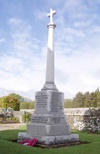
It is a tall, plain octagonal shaft with a cross surmounting it. At the base of the shaft, on a low plinth, is carved a wreath and slightly decorated angles.The cross stands on a solid rectangular base into which the names and inscriptions are carved. The base stands on a three-step plinth, the top one of which bears further inscriptions. The bottom one is of roughly hewn granite. It was unveiled on May 16, 1920. It commemorates the dead of both World War I & II.
M
Mausoleum Of The Frasers Of Park
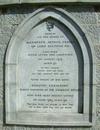
There are two Fraser/Saltoun Mausoleums the old one which is situated adjacent to the Old Parish Church in Saltoun Square, and a more recent ? one which stands by itself in the Kirkton cemetery. They are almost identical in Gothic style, with curious stepped pyramid roofs surmounted by obelisks topped with an egg shape. The older 18th cent one is harled and the more recent is in exposed dressed granite.
Memorial to lost lifeboat volunteers
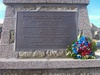
A life-size bronze statue of an RNLI crewman, cast bronze in the style of heroic realism so much favoured for memorials.
Memsie Cairn
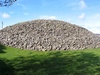
A very well preserved example of a larger round cairn, with no turf covering. Once part of a whole landscape of cairns that have been removed. The information board mentions some of the finds listed below (info from RCAHMS) but at this date it seems unclear where exactly particular artefacts were excavated and how accurate the descriptions of them were. The overall impression however is of a large important sacred site dedicated to funery rites over an extensive period of time.
Mormond Hill White Horse
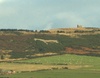
There are many different stories as to the origin of the horse. One is give below. The horse is constructed of quartz on Waughton Hill which is contiguous with Mormond hill (usually the whole prominence is referred to as Mormond). It is 162' long by 126' high. The horse was cleaned in 1937, 1949, 1968 and more recently in 1994. The hill is neither high nor steep but as the surrounding landscape is very flat, much of it peat bog, the hill and the horse are a significant presence in the landscape for some miles around.
Mounthooly dovecot
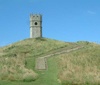
A tall dovecot with chamfered angles forming an octagonal plan. It is built of harl pointed rubble with tooled granite ashlar dressings and margins with heavy boulder footings. It is built in two stages with long elevations on the N, S, E and W with doorway in the west. There is an oval oculus in the E, W and S elevations above a continuous alighting ledge. The wallhead is slightly corbelled and crenallated wallhead with each merlon capped by ball finial (12 in number). The wallhead masks a pyramidal slate roof. Inside the interior is lined full-height with approximately 300 brick nesting boxes with the base of each box constructed of brick slabs. A tall potence ladder still survives although some of the rungs are missing. Dated 1800. It was built by Lord Garden of Gardenstown when he bought the Pitsligo Estate. Each ball finial is said to represent one for each of his 12 Estates.
N
Neep Chapper Beastie

The original implement used to chop turnips for cattle feed has been given a dramatic new persona with some subtle welded and assembled additions and a paint job.
New Aberdour Millennium Memorial
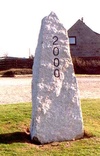
A minimalist monument consisting of a menhir of undressed granite, inscribed with the numerals 2000, recalling the megaliths of prehistory.
New Aberdour War Memorial
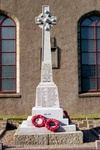
Typical village war memorial in the form of a Celtic cross, in a style that through the 19th cent Celtic revival ultimately derives from the circa 9th cent. crosses of Iona. These in turn draw on manuscript art and Pictish sculpture and metalwork.
New Pitsligo Millennium Memorial
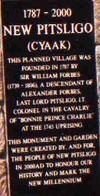
A monument consisting of a simple pillar of dressed granite, topped by a granite pyramid on a pedestal of coursed granite rubble with part dressed corners, in a formal setting of paving and planting with commemorative wooden benches. In the recent past New Pitsligo was noted for its granite quarries, all now closed, and was home to many masons and stonecutters. The form of this monument with its reused stone recalls this aspect of local history.
The inscription reads:
"1787 - 2000
NEW PITSLIGO (CYAAK)
This planned village was founded in 1787 by Sir William Forbes (1739-1806) descendant of Alexander Forbes last Lord Pitsligo, Lt Colonel in the cavalry of 'Bonnie Prince Charlie' at the 1745 uprising.
This monument and garden were created by, and for the people of New Pitsligo in 2000 A.D. to honour our history and mark the new millennium."
New Pitsligo War Memorial
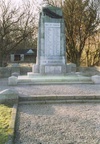
A village war memorial of cenotaph type constructed from granite ashlar blocks with appliqued bronze palm leaf and etc. The village and town war memorials of Scotland have distressingly long lists of remembered dead in proportion to the populations of the communities.
O
One of a Pair of Female Sphinxes on the Gate Piers
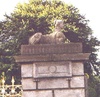
Cairness House is an important work by James Playfair the gate piers and sphinxes were added to mark the centenary of its building.
S
Saint Drostans Well
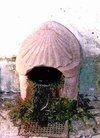
A Victorian pink granite basin and cover carved with a scallop shell motif, for a spring traditionally associated with the dark age St Drostan who is supposed to have landed on this beach before evangelising the Buchan area in Pictish times.
Saltoun Fountain
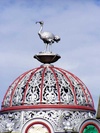
An Ornate cast iron fountain topped by an ostrich which is part of the town's crest.
Seagulls sculpture Fraserburgh
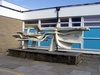
A reinforced concrete sculpture of seagulls/waves, quite appropriately for Fraserburgh. It was designed and made by Sydney James Burnett in the ? late sixties and won a Saltire Award in 1972. Sydney at the time was head of Gray's School of Art (Aberdeen) Sculpture Department.
Sydney Burnett was born locally and his father was an Art Teacher at the Fraserburgh Academy.
Serene Granite head
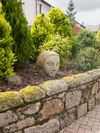
A much larger than life size carving of a head in granite that is strongly reminiscent of ancient Greco-Buddhist art of Northern India particularly the 1st -2nd century Buddha heads of Gandhara (a kingdom in what is now part of Pakistan and Afghanistan). These in turn owing their iconography to ancient Greek representations of Apollo.
St Peter’s Fraserburgh Episcopal Church plaque
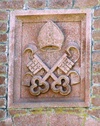
A deep relief carved red granite plaque showing the attributes of St. Peter (crossed keys and mitre) in ecclesiastical heraldry.
Stone Placement
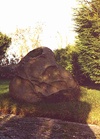
An intentional relocation and placement of a natural stone for aesthetic reason. An act that draws on oriental (Zen) precedent as well as the examples of our neolithic forbears so noticeable in the local environment.
Strichen Recumbent Stone Circle also known as Strichen House Stone Circle
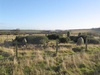
An atmospheric, restored, Buchan recumbent stone circle 13.5 meteres in diameter. The site has good views to the North-East of Mormond and Waughton Hill, and the White Horse, also overlooks the ruins of Strichen House. Currently (2005) a little overgrown with gorse
Strichen Roadside spring
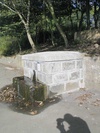
A spring flowing into a granite trough in what was once an elegant architectural setting with a curved backing wall flanked by fluted carved stone columns surmounted with carved balls. This fountain like so much of Aberdeenshire's public built environment has been rather spoiled by a disastrous combination of un-sympathetic 'restoration/stabilisation', neglect and the megalomania of the roads department. We make getting by car from A to B such a priority that we risk destroying any good reason to go, except of course pointless working and shopping which is the only reason for our existence in the minds of our leaders. The purpose of the new ashlar housing seems to be to display an ugly sign to tell us this is not drinking water. When did it cease to be and why?
Strichen war memorial
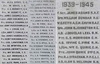
Strichen war memorial is a tall six-sided column surmounted by a decorated cross on a foliated plinth. It stands on a six-sided solid base in a two-step base. It commemorates the dead from both world War I & II. It was unveiled on August 25, 1920.
T
The Broad Milestone - The Brade Milstane
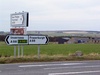
A milestone in granite unusually wide for its height and most unlike the standard turnpike stones of the area, it perhaps pre-dates them? Included in part for its cultural importance, to the confusion of recent residents and travellers it is still very much a reference point for giving directions. Even when it has not actually been in situ. It has recently been reinstated and concreted in after road-works and the staining on the stone shows the previous ground level that made it very unlikely to be seen from a car. Inscription reads Fraserburgh 10 3/4
The Raven Stone
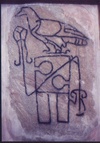
A class one Pictish stone showing the Sea Eagle and notched rectangle with z rod symbols the black infill is recent. As with all Pictish Symbol stones dating is somewhat contentious. The name 'The Raven Stone' probably originated as the result of a mistaken association of the stone and a nearby burial mound (in the manse garden) by the antiquarians of the past with Danish invaders.
The Wine Tower
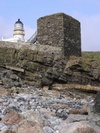
The oldest building in Fraserburgh, probably named from a past use as a wine cellar or possibly a corruption of "wynd tower".
Its original purpose is still the subject of some academic debate. It is roughly built of rubble with three vaulted storeys, the centre reached by a hatch from the uppermost. This first floor level is lit only by one small window in the E wall. The original entrance is at second floor level and had been reached by a ladder or moveable stair, arriving at a landing supported by two stone corbels which are still extant. The outer doorway admits to a small vestibule which is closed by an inner door beneath which is the hatch to the two lower levels. The upper chamber has a window in each of its four walls and has a remarkable series of finely carved heraldic pendant bosses, three in the main vault and one in each of the four arched window soffits. Bryce suggests that this upper chamber was designed to serve as a Roman Catholic chapel. The fact that this chamber was raised, concealed, semi-defended and provided with two -secret- chambers below, points to the true date of this enigmatic structure as belonging to the period of the Reformation in Scotland. from SMR
Tomb of George Baird of Auchmeddan, Old Aberdour
W
W. Bruces ship painters shed
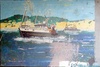
There is a tradition in this area of ship painters using the exterior of their premises try their colours and clean their brushes etc. This results in heavily textured and intense abstract expressionist works of an impressive scale. Some might argue that they lack sufficient intentionallity to be considered art works but they are definitely intended to be seen.
W. Bruce's shed has developed a degree of impasto that makes it almost sculptural with sections reminiscent of Anish Kapoor's early pieces, this is contrasted with a naive figurative painting on the door of a trawler in front of the nearby dunes.
Walking Way
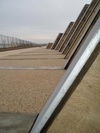
Fraserburgh’s former rail links have inspired a unique pathway with sculptural structures that connect the town to its seafront.
The 'Walking Way' is the creation of Scottish artist Jane Kelly. The winding pedestrian pathway of cast white concrete was laid late summer 2007. It covers an area from the grassy Links beside the town’s Leisure Centre car park, to the crossing at South Harbour Road. The shape has been influenced by the town’s former rail routes.
Eye-catching oak and steel structures have been used as points of interest to attract folk to the new-look public space. A seated area of timbers, inspired by railway sleepers, have been introduced to take advantage of magnificent views looking out across the sweep of the bay. Soft landscaping featuring white wild flowers, silver birch and wild cherry trees have been planted to either side of the pathway.
The Walking Way is the second of two artist-led interventions in the north east harbour town that have been designed to enhance the pedestrian route between the town centre and its waterfront. Work by landscape artist Julia Barton to brighten up the main shopping area was implemented in early summer 2007.
Funding for the Walking Way project was secured by Aberdeenshire Towns Partnership through the EU RevitHar programme (Revitalisation of Harbour Towns) and was supported by Fraserburgh Futures Partnership and Aberdeenshire Council.
Wrought Iron Sunflower
This content was submitted by external contributors and does not necessarily reflect the views of the University of Aberdeen.