A
Aberchirder wells
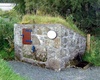
Solid granite built, pill box like well housings in the village of Aberchirder which like many 18th century planned villages is better known by the name of the farm toon that preceded it, in this case Foggieloan Moss from two Gaelic words foidh (peat moss) and lon (meadow), so Foggieloan means peaty or boggy meadow.
Abercrombie Coat of Arms
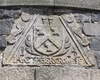
Category B, Abercrombie coat of arms, St Mary's churchyard inset into exterior wall
Anderson marriage datestone
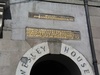
A restored and gilded marriage datestone for John Anderson and Helen Ogilvie dated 1699 above a religious text.
Archway with Mask Detail
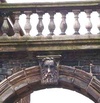
Listed Category A. Italianante building by Thomas Mackenzie, Elgin 1851-4 , with unusual queen-head capitals and Corinthian pilastered triparte with shell motif over centre light. Linked at south by tall round headed archway incorporating carved bearded head. The interior has 1st floor hall which takes up the entire frontage, the ceiling being supported by 6 pairs of draped female figures clasping laurel wreaths. The Town Hall was originally built as the St. Andrew's Lodge of Masons Hall.
B
Bairds of Auchmedden, Recumbent Figure Tomb
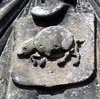
A fine recumbent figure tomb set in a gabled enclosure, the Medieval meets the Renaissance in a particularly Scots idiom. There is an interesting central motif below the figure of corn springing from bones. The wild boar in the crest is extremely rotund and has something almost oriental in its design. Inscriptions: (motto at top) Dominus fecit. (main plaque) An. Dom. 1636. Positum a Georgio Baird de Aucbmedden praeposito Burgi de Bamff in honors Dei & in memorii praedicessoru quorum corpora in die resurrectionis . hic sepulta jacent.(underneath with memento mori) G. B. Mors sceptra ligonibus aequans. Spes altera vitae. Coelum non solvm quaero.
Banff Abstract Sculpture
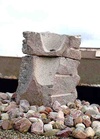
An abstract sculpture in granite, drawing to some extent on the traditional iconography of a broken column.
Banff Castle and Banff Castle Gates
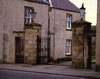
The new Banff Castle mansion, was built by Lord Deskford in 1749-52 the architect was John Adam, stands on the grounds of the original fortified castle. The Oglvies of Findlater and Deskford held Banff Castle and the ruins of the old remained beside the new for 70 years until demolished in 1820. All that now remains of the medieval Castle are the northern and eastern curtain walls, ditch and rampart, and the postern. The pavilion roofed mansion has flanking two-storey pavilions, and a 19th century porch.
Gates: Classical harled gate lodges and walls, with shallow arched recesses, pyramid roof. Gates rescued from Duff House.
Banff Museum and Library
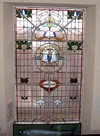
Stained glass window, incorporating Banff town coat of arms. With its insignia of the Virgin Mary and plant motifs in the art nouveau style.
Banff Museum and Library Interior
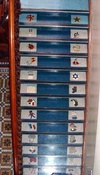
Two pictures of the staircase, lino cuts produced by the children at Banff Academy in the 1950's in association with the linoleum company each image representing a letter of the alphabet.
Biggar Fountain

Ornate Victorian Gothic drinking fountain with crown head, designed by John Rhind in 1878, commemorates Walter Biggar, one of the founders of the herring trade with the Baltic. The inscription on the Biggar fountain reads 'Presented to the town of Banff in Memory of Walter Biggar Esq. And Mrs. Anne Duff, his wife. 1878.' Biblical inscriptions on the East and West panels. I think the spouts are intended to represent fish heads, possibly dolphin fish?
Bishop Meldrum Marnoch
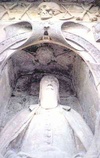
Boot Detail
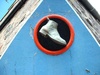
Boot sitting in a triangular, flattened, brightly painted corner of the house at Reidhaven Street, Whitehills. Looks to be cast from an actual boot and set into cement work. Former souter's (cobbler's) workshop
Boyndie Kirk bellcote
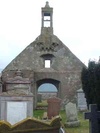
Category C listed, Scheduled monument . 17th century gable with ball capped bellcote, the sole remains of the kirk. Contains 58 table top stones of which 9 are significantly decorated and over 100 upright stones from the early 19th - 20th century. A high proportion of these stones are decorated with symbols of mortality, immortality and trade emblems.
Brain Coral fossil Banff Castle
C
Carved Marriage Datestone
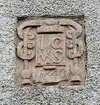
Listed Category B. Boyndie House 1740, an unusual house with a delicately shaped Dutch-gable, with two round eyes below the chimneys, and carved marriage stone as a shaped cartouche bearing the initials IG MS. Marriage stones appear to have been particularly popular in Banff. It was customary for the sons and daughters of town worthies to have an initialled datestone built into their houses in honour of their union.
Carved wooden poles
Castle Street War Memorial
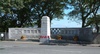
Listed Category B. Polished pale grey granite ashlar cenotaph, standing on shallow steps in shallow hemicycle wall Plaques recording the names of the fallen,1914-19 and 1939-45 set in the outer ends of the hemicycle, the chequered granite blocks with voids reveal glimpses of Banff. The foundation stone for the War memorial was laid by HRH Princess Royal, 27th May 1921.
Celebration, Colleonard
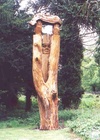
Clunie Street School Bellcote
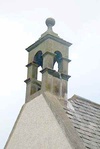
Former school, dated 1804 with ball- finialled apex bellcote which crowns the gable of the building. Datestone bears the inscription 'FREE SCHOOL Endowed by Alexander Pirie,1805'.
Coast Festival
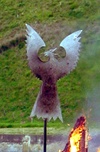
Coast Festival, benches installation
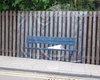
As part of the first Coast Festival (23rd-26th May 2008 ). One of three commissioned temporary public art works. A series of 5 separate installations of digitally printed banners each was a trompe l'oeil image of a bench in place where one might have been the background to match the wall. On each bench was a montage of objects on closer inspection one can see the distortion of scale used in these objects. For instance while the herring gull is life size, the abandoned plastic carrier bag it looks as though it is going to scavenge from is full of tiny street lights and other street furniture.
A comment is made on the surrounding landscape which a person sitting on the illusory bench might survey and inhabit, an interesting contrast between the objects that give our places unique character and those such as road signs and street lights that tend to homogenise the environment.
Coast Festival, Helen Denerley sculpture park
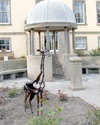
As part of the first Coast Festival (23rd-26th May 2008 ). The artist kindly loaned a number of her animalier works.
While many artists world wide produce sculptures of animals using the technique of welded assemblage Helen's pieces are outstanding in her apprehension of both the basic anatomy and the movement and expression of each species. She is also careful not to completely lose the original identity of the materials used in the works construction. The nature of the scrap used often add considerably to the numinous qualities of the finished piece. In my personal view the best of her works are those pieces that evoke rural Scotland (deer, sheep, horses, hunting dogs, native birds etc.) given extra poignancy by being made of the detritus of the rural economy of the recent past.
Coast Festival, sculptures by Rob Mulholland
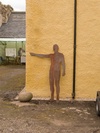
For COAST 2009 Rob created an installation of figures standing in the grounds of Banff Castle looking down toward the bay, with a lone figure down by the sea wall at Greenbanks pointing out to sea.This installation is a play on the seafaring traditions of Banff and Macduff, with the townsfolk looking out in search of the returning fleet and the distinct relationship that fishing families have with the sea. The figures have been cut in mild steel and riveted together to resemble the plate used in fishing boats; this choice and use of materials creates a resonance with our community and visitors alike.
Coast Festival, video piece
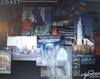
As part of the first Coast Festival (23rd-26th May 2008 ). One of three commissioned temporary public art works. A screen based piece using images and recollections from local residents, specifically about Tarlair Lido but also Banff and Macduff in general. You will notice many artefacts illustrated in this database in the stills shown here. A large part of the artist's creative contribution rests on his custom written 'slipstream' computer programme used to display the images and audio elements in continuously changing combinations.
Colleonard Sculpture Garden and Gallery
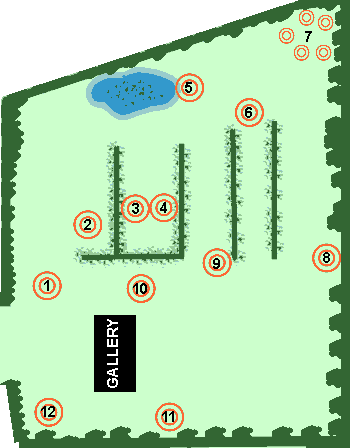
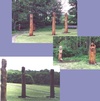
This was a five and a half acre garden in a sylvan setting; the garden contains some fine specimens of mature copper beech and Colombian pine. On a walk through the garden, past visitors could view 14 monumental sculptures - some as much as 25 feet in height. Frank Bruce, the sculptor, has perfected his own style, which he calls, "archetypal abstractionism". His monumental works maintain and prove the figurative sculpture can and should be easily understood.
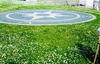
Compass Rose
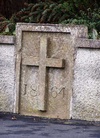
Cross and datestone Sandyhill Road Banff
Cupola, Weather Vane, etc
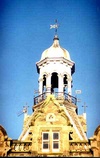
Extravagant Neo-Jacobean, tall gabled hospital with timber arcaded cupola with faceted lead roof and weathervane, 1860. Alexander Chalmers of Clunie (Marnoch, Banffshire) wine Merchant and ship owner in Banff left 'the site of his residence' and a bequest of £70,000 to build and endow the hospital.
D
Daniels piece
Doctor Alex Douglas armorial
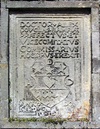
A re-sited 17th century carved stone armorial panel. Inscribed "DOCTOR ALEX DOVGLAS BAMFIAE PRAEFECTVS ET VICECOMITAVS COMMMISSARIVS HOC OPVS EREXIT D A.D. ANNO DOM (next line illegible) 165*
Domed Well Housing

Listed category A. Domed peristyle Well in Forecourt accompanied by Garden of Remembrance. The new Banff Castle, built by Lord Deskford in 1750, stands on the grounds of the original fortified castle.
Double Head sculpture Huntly
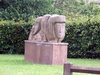
A contemporary stone carving of a double head also making a feature of the subjects hands.
Duff House Dogs Gravestones
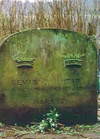
Gravestone erected by the Earl of Fife, in memory of families pet dogs Bevis (1872) , Tip (1873) and Barkis. Decorated with crown and coronet with dog's names and initials M and F (male / female?).
Duff House Mausoleum
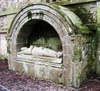
Rectangular Gothic Mausoleum and re-sited late 17th Century tomb. Fine cast and wrought iron gate incorporating complex designs of foliage, anthemion, rosettes, Earl of Fife's coronet and monogram JF. Deep stone frieze below eaves, 2 Coade stone crocketed pinnacles survive. Re-sited against centre of S elevation is a round headed figure tomb, decorated with symbols of mortality and rebirth. The tomb was supposed to be that of Robert the Bruce and was taken to give spurious antiquity to the new Earldom of Fife, however it was actually the tomb of Provost Douglas of Banff, with the inscription covered until in 1990 when it slipped uncovering the true identity. House open to the public. See their website for details.
Duff House Pediment
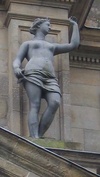
Substantial Baroque mansion 3 story on raised basement fluted Corinthian pilasters to tower heads, pediment to principal floor. The South (principal) elevation has the pedimented centre piece with exuberant armorial carving Duff Arms and Motto. The original lead statues are preserved in the house and have been replaced by fibre glass copies which stand above the pediment, representing Mars, Apollo and Minerva. On the north elevation Bacchus, Mercury and Diana.
House open to the public. See their website for details.
Duff House, the Fife Gates
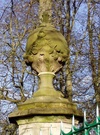
Pair of polished ashlar octagonal gate piers with moulded stepped caps supporting fine carved stone urns. Decorated with acanthus and swags of fruit and flowers. Gates probably made by the Banff Foundry (James Fraser) a firm which provided similar to other local country house estates, including Castle Fraser. House open to the public. See their website for details.
DUFF HOUSE, BANFF, BRIDGE STREET, BRIDGE OF BANFF LODGE
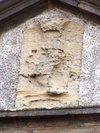
A small classical pedimented pavilion with Venetian windows (now blocked and painted with false panes). A solitary survivor of a pair that guarded the eastern entrance of the Duff House policies. It has been relocated and truncated and is now used as an electricity sub-station and the basement for supermarket trolleys.
Well weathered sandstone crests - May show a lion rampant which is the Fife family heraldic device and crest, adorn the East and West pediments of the gate house.
Duke of Richmond statue Huntly
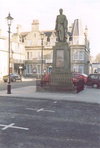
A Victorian portrait statue, inscription reads: Erected as a memorial of Charles Gordon Lennox Fifth Duke of Richmond, by the tenantry of the Lordship of Huntly.
F
Façade, Trinity and Alvah Church
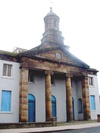
Listed category C. Designed by Robert Raeburn of Edinburgh in the Ionian mode of that city, with portico and cupola. Enlarged in 1876, fortunately the façade was left intact, it has a most unusual beamed roof inside.
Fanlight
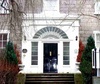
Listed category B.
An elegant building, entered through a Regency pilastered porch with spreading fanlight, originally built for provost George Robinson when it was known as Moray House. There is also some excellent plaster work circa 1790's , the hall being a scaled down copy of the ante- room in Duff House.
Fishing Temple
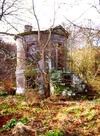
Octagonal fishing temple situated on an island in the middle of the River Deveron. Currently roofless and overgrown, original domed and surmounted by a gilded figure of fame. Category B listed
Fordyce Millennium Sculpture (Fordyce, Fuar Deas, The Cold South)
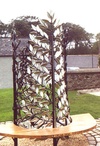
A sculpture based on a leaf and branch motif in welded metal surrounded by a bench with an inscription "Fordyce, Fuar Deas, The Cold South". The wooden seat has been replaced in metal by the original artist as it did not stand the exposure to the weather.
Fordyce Primary School Murals
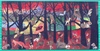
Brightly coloured naive paintings of the local landscape with rampant flora and fauna (some of the butterfly species are a bit optimistic).
G
George Duff memorial, Banff Castle
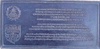
A roughly cut small sandstone menhir with an inset bronze plaque and Rotary Club insignia.
GIG IN THE GROUNDS, graffiti piece
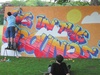
A large lettering based graffiti piece being created as a result of graffiti workshop run by Zap Graffiti Arts. A professional group that runs graffiti workshops for schools, youth and community groups.
Gordon Highlanders Memorial
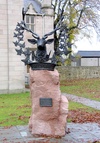
The regimental crest of a Hart's head with ivy wreath on top of the motto 'BYDAND' mounted on a plinth of undressed pink granite.
Gravestone with death figure, St Marys Graveyard, Banff
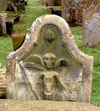
Gravestone carved in high relief with a winged 'grim reaper' death figure, with a scythe and hourglass.
Gravestone with four poster bed St Marys Kirkyard Banff
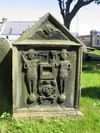
An 18th century stone carved with two angels one holding a trumpet the other an hourglass, both hold truncheon like objects in their other hands, they flank the deceased who is lying in a grand full canopied bed above a memento mori skull.
Gravestones, St. Brandons Kirk Cemetry Boyndie
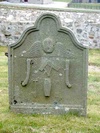
Located at side of narrow road, no parking facility. The stones include:
First image, An unusual pointed gravestone with carved figure. Holding what appears to be an hour glass in one hand (a symbol of passing time and immortality). Stone initialled "I E" . No date or name.
Third image, A more elaborate, less naïve version of the winged angel, as a symbol of immortality. In contrast, above, sits a simple skull, a symbol of mortality.
Fourth image, A fine example of monumental art with two angels carrying a basket of corn and winged angel's head, symbols of mortality and immortality. Also appears to display some trade emblems within a crest. It was customary around this period to show tradesmans tools as a mark of respect to the deceased worker.
Fifth image, shows a winged head at the top, in the centre above memento mori are a square and compasses that may indicate a Freemason.
Gravnie Braes Stone Circle

Remains of a stone circle; five stones altogether, two standing and three lying in an arc. Surrounded by a distinct stone mound which may be the result of ploughing. One stone has fallen since 1961.
Grotesque Human Mask, Date Stone
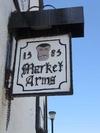
Category B listed building. The Market Inn is dated 1585 on a painted lunette stone with grotesque moustachioed head - you can see it by going through the pend arch. The building in it's present form could be as late as 18th century but incorporating earlier fabric, but it is certainly the oldest building in continuous occupation in Banff.
Grotesque Lion Mask, Lintel Decoration
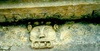
Category B listed building. Incorporated in this symmetrical fronted building, centre corniced door with shoulder lintel with carved grotesque head and heavily quoined jambs, there is hint of Adam Senior influence in the doorpiece.
H
House with Decorative Datestone and Angle Mural sundial
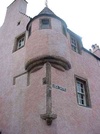
Category A listed building. Interesting and unusual survival of an early town house, the angle turret is a very rare feature, this distinguished dwelling also has a polygonal stair to the rear. The corbel stone bears the date 1675 and is decorated with two leaves. The building also incorporates an angle mural sundial. The building was restored by Banff Preservation Society circa 1970 and is now privately owned.
Huntly fountain
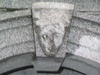
A fountain in various granites that looks as though it was designed to show of stone masons virtuosity. It is adorned with gilded Biblical texts relating to water.
Huntly war memorial
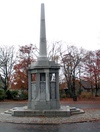
It is of a classical, elongated style in granite, octagon in plan with square piers and entablature panel screens between which are open at the top. It is surmounted by a four-sided tapering obelisk. There is a one-step base with a small flight of three steps leading up to it. It was unveiled 24 September 1922.
I
Inner Man, Colleonard
Innes plaque, Banff
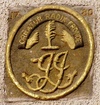
A small carved stone armorial plaque embellished with gilding. Plaque dated 1780. The plaque pre-dates the building it is affixed to. It shows the monogram JJ, the motto, of the Innes family,"ORNATUR RADIX FRONDE, The root is adorned by the foliage" with the palm frond crest of the Innes family. I believe the plaque may relate to John Innes, 8th of Edingight, Provost of Banff (b 22.02.1721, d 07.06.1790).
Innes/Russel enclosure, St Marys Graveyard, Banff
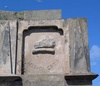
A very geometric neo-classical almost Egyptianate monument.
Inscriptions: Ornatur radix fronde (The root is adorned by the foliage) with the palm frond crest of the Innes and Memor esto, (be mindfull) beneath the boar's head.
Left panel. "To the memory of Alexande lnnes of Rosieburn, third son to John Innes of Edingight, who died 16th April, 1761, aged 60,
and of his spouse Katharine Abercromby (second daughter of Alexander Abercromby of Glassaugh, M.P.), who died the 8th October, 1784, aged 76.
Sacred also to the memory of their son Thomas Innes of Rosieburn, who died the 24th August, 1784, aged 35 years. Sacred also to the memory of John Russel, post captain in the Royal Navy, eldest son of Thomas Russel of Rathen, and Ann Innes of Rosieburn, who died at Aberdeen 16th October, 1813, aged 45 years."
Centre panel "To the memory of John Russel of Rathen (second son of Patrick Russel of Montcoffer), who died 3rd May, 1755, aged 55, and of his spouse Margaret Calder (eldest daughter of Sir Thomas Calder of Muirtown, Bart.), who died 11th July, 1770, in her 56th year. Katharine Russel, daughter of John Russel of Rathen, and spouse to John Hay, 3rd son of Andrew Hay of Mountblairy, died 12th August, 1775, and was buried in the church of Alvah. The remains of Mr. John Hay (who died in London 1785) are interred in St. Bartholomew Church. Sacred also to the memory of Ann Innes of Rosieburn, spouse to Thomas Russel of Rathen, who died 13th November, 1814, aged 67, and of Thomas Russel of Rathen, who died 12th April, 1827, in his 85th year."
right panel "Sacred to the memory of the following sons and daughters of the late Thomas Russel of Rathen and Anna Innes of Rosieburn, his spouse, all buried here, except where otherwise mentioned. Mary Abercrombie Russel died at Aberdeen 4th March, 1814, aged 29 years, and was buried there. James Russel, R.N., died at East Stonehouse, Devon, 27th February, 1829, aged 58, and buried there. Helen Russel died at Aberdeen 23rd of March, 1838, aged 59 years. Catherine Russel, wife of George Russel, Esq., Skelmuir, died at Aberdeen 28th March, 1844, aged 69, and buried there. Aletha Russel died at Aberdeen 22nd July, 1849, aged 67. Margaret Russel died at Aberdeen 8th July, 1851, aged 74- Jane Maxwell Russel, wife of the Reverend James Cordiner of St. Paul's Chapel, Aberdeen, died at Aberdeen 14th August, 1854, aged 67, and buried there. Elizabeth Russel died at Aberdeen 16th October, 1865, aged 82 years. Grace Russel died at Fraserburgh 21st April, 1866, aged 78."
Interior of Banff town hall, Coffered Ceiling Supported by 6 Pairs of Female Figures Clasping Laurel Leaf
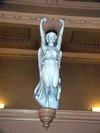
Listed Category A. Italianante building by Thomas Mackenzie, Elgin 1851-4 , with unusual queen-head capitals and Corinthian pilastered triparte with shell motif over centre light. Linked at south by tall round headed archway incorporating carved bearded head. The interior has 1st floor hall which takes up the entire frontage, the ceiling being supported by 6 pairs of draped female figures clasping laurel wreaths. The Town Hall was originally built as the St. Andrew's Lodge of Masons Hall.
L
Lowrie Grave St. Marys Banff
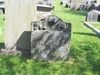
18th century stone with memento mori above the inscription "This stone is erected by James Lowrie, shoemaker in Banff, to the memory of John Lowrie and Janet -----, his father and mother, and John Lowrie, his son, who died October, 1755? aged . . ."
M
Madonna, Banff
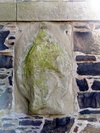
2 Panels depicting Virgin and Child, first datestone 1628, second much weathered possibly pre 1600's.
Mary Bourne pieces at COAST 2010
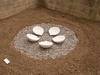
An exhibit of several recent pieces by the artist in a variety of natural stones, marble Caithness stone etc.
McPhersons Hanging
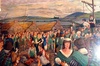
1980's mural depicting the hanging of freebooter James McPherson, at Banff Plainstones 1700. The mural depicts many local faces, councillors, business people as well as Scottish celebrities of the 1980s. A self portrait of the artist is also included, on horseback, assisting with the hanging. Legend has it that the clock in Banff was put forward one hour on the morning of the execution, an act which denied the freebooter a last minute reprieve from the Earl of Fife. According to many versions of the song "MacPhersons rant" he broke his fiddle before being hanged to prevent it being played by another.
Millennium
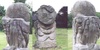
Unusually for the artist, Frank Bruce, this is a large stone carving. Made to celebrate the 2000 millennium.
Mural Sundial
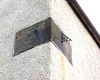
Angle mural sundial and date stone enscribed "George Massie, Elspet Morrison 1739 Gods Providence is ourInheritance."
N
New Strains at COAST 2010
Hanging acrylic panels engraved with Latin botanical names the English translations of which are used as women's names.
O
Ogilvie Tomb, Fordyce
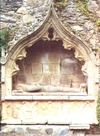
Magnificantly carved ogee-arched altar tomb of the Ogilvies of Findlater.
Remains of church; dates from before 1272; ruinous Medieval church; all that remains now is the roofed bell-tower in a fair state of preservation; the obvious later steps to the first floor on the E side of the tower bears an inscription and the date 1721. The old church consisted of a nave with aisles on the W & S; the former aisle belonged to the Ogilvies of Durn, and the latter, now divided into two, belonged one to Birkenbog and the other to Findlater & Boyne. W portion contains mural wall tomb of Ogilvy of Findlater; E portion a mural tomb of a recumbent effigy in armour c1509. A Post-Reformation tower stands with a richly carved double-arched bellcote dated 1661; the Abercrombie of Glassaugh burial aisle is late 17thC with small apex bellcote; burial ground has an interesting range of tomb stones. Church replaced in 1804 by present parish church.
Ogilvie tomb, St Marys kirkyard Banff
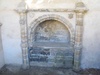
A simple 16th century table top tomb for a hausband and wife. Inscription reads: ANO. DNI. 1558.29 NOVE. OBIIT. VALTERVS. OGILVY. DE. DVNLVGVS. MILES . PRAEPOSITVS . HVIVS . VRBIS . ET . HIC. JACET. CV. ALISONA. HVME. EIVS. SPOSA. OBIIT. 23. JVLII. ANO. 1557.
Ogilvy Family Armorial Panels and Carvings

Five carved 17th and early 18th century monogrammed pediments and armorial panels reset in the South return gable of the Royal Bank. The panels were removed from the house of Thomas Ogilvy which formerly occupied the site. The property later became the town house of the Baird of Auchmedden, later being demolished and reset into The National Commercial Bank (now Royal Bank) in 1937. The Royal Bank, 1937 by James McCallum, Architect and Master of works, Commercial Bank of Scotland. The panel in the fourth photograph has the Ogilvy motto "secundat vera fides" (true faith prospers).
Old post office Banff, decorative carving

Old Woman, Colleonard
One World, Colleonard
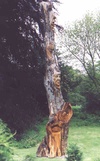
A massive timber sculpture by F. Bruce utilising the bifurcating tree trunk as part of its symbolism.
P
Part of Art, Space & Nature, at COAST festival 2010
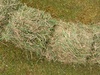
Three circular assemblages of neatly arranged bundles of cut grass, on the lawn in front of the castle.
Performance by Peter & Rossi at COAST festival 2010
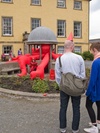
Site specific installation and performance piece with an inflatable and pointy red hats, by Ruby Pestor and Nadia Roster
Plaque datestone on the Salmon House Portsoy
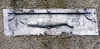
A carved painted datestone with a relief carved cock salmon between figures 18 and 34 within plain raised border with angle fluted 'fan' motif. The salmon is somehow more 'cuddly' than most representations of this popular subject
Portsoy Harbour depth indicator
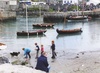
Numerals carved in nicely dressed blocks to indicate depth, they appear to change from Arabic to Roman between 9 and X, presumably to maximise clarity. See the external link to RCAHMS for aerial views etc.
Portsoy War Memorial
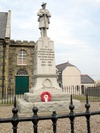
A war memorial of the common 'praying soldier' type. In this case the statue is on top of a tall carved plinth set on a two step base of roughly dressed granite. It is surmounted by a kilted soldier with Glengarry, standing head bowed holding an inverted rifle. It commemorates the dead of both World War I & II. Below the main inscription on the front is a carved wreath. The memorial is surrounded by a small wrought-iron enclosure.It was unveiled 11 November 1923.
Portsoy Wheat Sheaf and Anchor
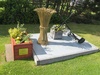
Assemblage of a painted welded metal representation of a wheat sheaf and anchor with planters on a concrete base beside the main road. The plaque reads "Wheat sheaf & fishermans anchor - sculptured by John McGrath, Sandend - Gifted to the people of Portsoy October 2008
Possible Hindu Sculpture
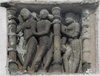
Built into house wall above entrance door on east side of street. A small stone carving showing two female and one male nude figures. This is a small sculpture about a foot across and set quite high up. The female figure on the left has suffered some unfortunate censorship (unintentional I hope) by cement render.
It is thought that the owner of the house at the time travelled widely and some are of the opinion that it may in fact be a piece of Indian Hindu sculpture brought back to Banff in the 18th century. Indeed now we have a higher resolution image I have no doubt that this work is Indian in origin: the details of jewellery, body ornaments and coiffure also the voluptuous female figures, the poses and the style of the columns all suggest an erotic temple sculpture. It also appears to be of great age. Perhaps of medieval or even earlier date it is certainly not a piece of pre-reformation European religious art.
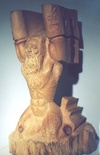
Post-Modern Finn MacOull
Q
Queens Head Capitals Detail
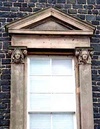
Listed Category A. Italianante building by Thomas Mackenzie, Elgin 1851-4 , with unusual queen-head capitals and Corinthian pilastered triparte with shell motif over centre light. Linked at south by tall round headed archway incorporating carved bearded head. The interior has 1st floor hall which takes up the entire frontage, the ceiling being supported by 6 pairs of draped female figures clasping laurel wreaths. The Town Hall was originally built as the St. Andrew's Lodge of Masons Hall.
R
R.A.F. Banff Strike Wing Memorial
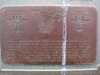
The inscription reads:
"This memorial commemorates the men and women who served with the six multi-national squadrons which formed the Banff Strike Wing at R.A.F. Banff between September 1944 and May 1945. Under the command of group captain the Hon. Max Aitken the mixed Mosquito and Beaufighter units mounted concentrated attacks on German surface vessels and U-boats in the North Sea and along the Norwegian coast. Their success in the closing months of World War II was important in the defeat of Germany and strike wing aircraft operating from the airfield near here inflicted heavy damage on enemy shipping and supply routes. Many thousands of tons of vital iron ore and other supplies were lost to the German forces as a result of rocket and cannon attacks carried out by this gallant strike wing. Losses amongst R.A.F. commonwealth and Norwegian squadrons were high. More than 80 aircrew gave their lives flying with the R.A.F. Banff Strike Wing."
Rainbow Maze at COAST festival 2010
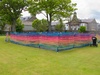
A maze constructed of various coloured yarn woven round wooden posts. This piece used thousands of yards of yarn much of it donated by the local community.
S
Sandyhills Dovecote
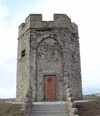
Hexagonal shaped dovecote in a fair state of preservation, interior is circular with nesting boxes all round and reaching to roof height. A battlement parapet which was probably added when the old Mercat Cross was erected on it in 1768 until 1900, probably contemporary with Duff House. Stands on the hilltop above the Deveron valley and Duff House as a folly and ornament to the landscape. Until the 1980s the dovecote stood in a field, now it is largely built over with modern residential development.Dovecote appears on John Clerk's topographical print of Banff, 1826
Saunders Heritage Coat of Arms Armorial Plaque

Category B listed building. Coat of Arms dated 1675, built into arched gateway. Plaque initialled IG IS to John Gordon and his wife Janet Saunders, incorporating coat of arms. The plot of ground was called Saunders Heritage. The plaque was reset above the archway at the East return gable of Banff's former Police station, later the Post Office.
Seatree sculpture Banff
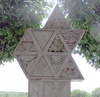
Commissioned by Aberdeenshire Council, with funding from Mobil? A stone sculpture in the form of a polygonal pillar with a capitol based on a 6 pointed star. Carved in relief with symbols, fish, shells, whales, ships, Pegasus and a mermaid included and inscriptions. It is inscribed with the motto "touch not the cat but a glove", this is the motto of several clan names: Chattan, MacIntosh, Gow, MacPherson, MacGillivray and etc. In this case I presume it is a reference to the outlaw MacPherson.
Shell Detail Seafield Street View
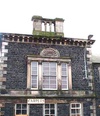
Listed Category A. Italianante building by Thomas Mackenzie, Elgin 1851-4 , with unusual queen-head capitals and Corinthian pilastered triparte with shell motif over centre light. Linked at south by tall round headed archway incorporating carved bearded head. The interior has 1st floor hall which takes up the entire frontage, the ceiling being supported by 6 pairs of draped female figures clasping laurel wreaths. The Town Hall was originally built as the St. Andrew's Lodge of Masons Hall.
Shelter shed murals Banff links
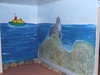
Mural painted inside one of the shelters at Banff links, a seascape showing a seal, a boat and a dolphin these were painted by young people as part of a Princes Trust project during November 2006.
Ship Inn public house sign
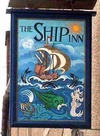
Ship Inn public house sign, mythical sea monsters and sailing ship depicted in a naive style, based loosely on early maritime chart illustrations
Shoemakers Land Plaques
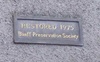
Listed category B. Plaque above pend entrance inscribed '1716. Rebuilt by the incorporation of shoemakers 1787' motif of a leather workers crescent shaped knife surmounted by a crown. Small lower plaque reads 'Restored by Banff Preservation Society 1975. The plaques were restored and painted by the Society in 2000
South Colleonard House
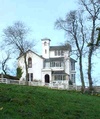
Privately owned and not accessible to the public.
Tall Italliante House, incorporating ground and 1st floor glazed conservatories with original glazing bars with mask decoration. Ornamental urn with anthemion and decorative detailing masks chimney stack above attic as apex finial, tall hand thrown chimney cans elsewhere. Decorative cast-iron apex finial to SW gable. Interior; Decorative plaster friezes, cast iron spiral staircase winds to attic view room, upper portion of tower constructed of bolted iron plates.
Influenced by a design by John Gordon. Murray was the owner of Banff foundry, hence the cast iron components in the house.
St Colms Well Portsoy
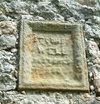
Rubble built tunnel type entrance, the well is said to have been built in the early part of the 7th century. The well 2ft diameter, and still flowing, is now covered by a stone cupola with an arched entrance. The well is hidden away in an earth mound (Perhaps a burial mound since it is adjacent to the cemetery) You can only see the well if you actually enter the cemetery by the gate at the bottom of the hill opposite the caravan for the warden of the caravan site. The plaque, made from the soft unstable yellow sandstone of the area, is just recognisable as St Colm's well but will be lost soon, the plaque dates from when the well was restored in 1893 though the date is now hardly readable.
Near the site of an ancient chapel, or oratory, said to have been dedicated to St Columba the last remnants of which disappeared in the early 1800s.
St. Marnochs Chair, Marnoch

St. Marys Graveyard, Renaissance style enclosure
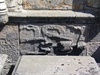
Renaissance style memorial complete with Corinthian columns and trumpeting angels. The relief lettering is badly eroded and now mostly illegible. However it is given in Annals of Banff list of inscriptions (see external link) as
"Memento mori. Time Flieth, Death persueth, Mind Mortality, Conquer Eternity. Sub hoc cippo reconduntur exuuiae generosae mulieris Sabellac Ogilvie, Gulielmi Scott aurificis huiusque urbis burgen: quondam coniugis quae fatis cessit 15 Augusti ann. dom. 1697 aetatis suae 55 ille . . ."
St. Marys kirkyard Banff, general background
A fascinating surviving burial ground of medieval origin in the heart of a town. It exhibits an almost theatrical assemblage of memorial art. It is enclosed by low rubble wall with railings and containing late 16th century Banff aisle, burial enclosures and tombstones. See external link for a complete list of inscriptions.
The old Kirk : The old kirk of Banff was erected in 1471 and demolished in 1797, the partially reconstructed 16th - century "Banff
Aisle" is all that remains. A low canted aisle with geometric traceried window and stone slab roof. Contains memorial tablet
dated 1580 recording erection of aisle. Also table tomb of Sir Walter Olgilvy of Dunlugas (and Banff), died 1558 and his wife Alison Hume died 1557.
Tombstones : There are approximately 220 table-top and recumbent tombstones of which 48 are significantly decorated, with many hundreds of upright stones dating from the 16th - to the 19th - century. There are amongst others, a fine
recumbent figure tomb of George Baird of Auchmedden, an exceptionally well executed pyramidal tomb with a white statuary marble tablet carved in relief, and a superb 1698 Renaissance style memorial complete with Corinthian columns and trumpeting angels.
Stained Glass Windows
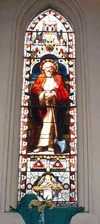
The architect was Archibald Simpson 1833-34. Tudor gothic style. Listed category B.
Standing Stones of Strathbogie

Two small standing stones that may once have formed part of a stone circle. One of them has been used as a Pictish symbol stone marked with the 'horseshoe' and 'double-disc' symbols, these are no longer legible.
Stone Head, Colleonard
Stuart Royal Arms, Banff

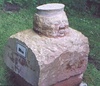
The Stuart Royal Arms built into wall adjacent to Banff's Town house steeple, situated at The Plainstones, res-et and painted.
After the union of the monarchy of England and Scotland 10th April 1603 after the ascension of James the VI in 1578 (James the I of England) In Scotland the Unicorn of Scotland is shown on the dexter side of the shield in England it is shown sinister.
T
Temporary Installation of Horse and Stag sculptures, Portsoy
The Archetype, Colleonard
The Mans the Gowd, Colleonard
The Mercat Cross, Banff
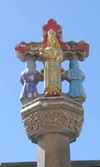
Scheduled, Category A Listed,Site of Regional Significance. The cross depicts the Crucifixion on one side and on the other the Virgin and Child. The Mercat Cross originally stood where the Biggar fountain now stands, but because of it's size and it's interference with the traffic was removed in 1767 and custody given to the Earl of Fife, who erected the capital on top of a dovecote at NJ682 632. In 1900 the cross was restored within the bounds of the burgh, and in 1994 an exact replica of the 16th century cross, polychromed as it would originally have been, was placed on its 17th century shaft, and restored to almost it's original location. The original carving was placed in Banff Museum. The Reformation in Scotland was begun by John Knox in 1541, and eventually led to a widespread destruction of artworks and manuscripts by iconoclasts. The Mercat Cross survived and was given a new shaft in 1627. It is a rare survival of such overtly religious pre reformation work.
The Onlooker, Colleonard
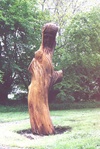
The Red Well

Red Well is a well fed by a chalybeate spring said to have healing properties. It lies within a tall circular structure with a beehive-shaped or domed roof. An iron gate forms the entrance.
The Thinker, Colleonard
Third World, Colleonard
Thistle decorated corbels
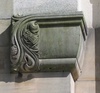
Corbels with deeply carved thistle decorations left entrance to legal offices as described below.
James McCallum, 1937. Scottish 17th century details. Asymmetrical 2-storey, 5-bay bank with return 3-bay gable to Strait Path. Varied materials; deep black polished granite basecourse below tooled ashlar sandstone 1st floor with some coursed rubble; elsewhere harled with generous use of tooled and polished ashlar dressings. Slightly advanced outer bays, at right with main bank entrance, at left with doorway to legal offices above bank. Moulded doorpieces to both entrances with carved crest of National Commercial Bank above main bank entrance, which has flanking side lights.
Thomas Edwards Gravestone
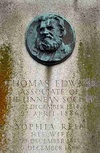
A Bronze plaque portrait on the gravestone of Thomas Edwards, a local naturalist and member of the Linean Society.
Two Patriots, Colleonard
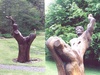
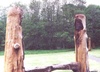
A wood carving utilising the division of the trunk to make its point, that in war we fight ourselves. In the words of the artist, Frank Bruce, "To make a war a patriot on both sides is needed. A winner and a loser. Eighty per cent of casualties are civilians. "
U
Unknown Marnoch
V
Victoria Fountain Aberchirder

W
Walker, Colleonard
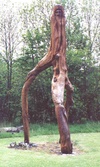
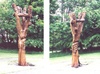
A large tree sized wood carving by F. Bruce, inverting the original trunk to give the sculpture its representative form.
This content was submitted by external contributors and does not necessarily reflect the views of the University of Aberdeen.