
B
Banchory War Memorial
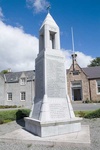
An unusual shaped war memorial that does not fall into the standard stock patterns. It commemorates both World War I & II. It is rectangular with a slightly skirted base standing on a raised plinth. It is surmounted by a 'bellcot' with a thin cross on top. It was unveiled on the 5th August 1923.
Banchory-Ternan Watchtower in Kirkyard
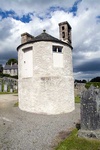
A circular white harled 2 story tower. Conical slated roof with round finial, a lum (for a fire to keep watchers warm) and bellcote (for bell to raise the alarm). Recently restored by the Banchory Rotarians. The warning bell is dated 1664 and probably came from an early church on the site, established as a missionary base by St Ternan around 490AD.
Battle of Corrichie, Memorial
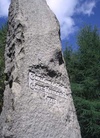
A roughly cut granite menhir with an inscription cut in relief. The Gaelic inscription reads: "Cuimhnichibh La Coire Fraoichidh" or "Remember the day of Corrichie". The battlefield is now mainly covered by commercial forest.
Burnett Arms Hotel, arms of the Duchess of Kent
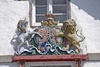
A polychrome 3 dimensional armorial panel, with the belted royal arms dexter and the Duchese's ? sinister, (I am unsure of the material this is made from it appears to be some sort of plastic compound, like coed stone or gesso).
Burnett Ramsay Memorial fountain

A neo-gothic style decorative fountain with 4 polished pink granite columns supporting arches carrying a pyramidal roof. Erected in 1870 by “tenants, neighbours and friends” in memory of Colonel William Burnett Ramsay of Banchory Lodge who died on 6th November, 1865, another monument to the same man is at Strachan Kirk
Burnett Ramsay Memorial fountain, Strachan Kirk
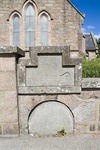
A memorial plaque set into the wall in front of the new church over a now filled in stone arched space that would originally have held a waterspout. The fountain dedication is now badly eroded but was dated 1866, the same year as the ‘new’ church was dedicated and is “in remembrance of William Burnett Ramsay of Banchory Lodge” who died in 1865. A slightly later and far more ornate monument to the same man is in Banchory.
C
Carnie Memorial Fountain

A very simple inscribed slab of polished pink granite, pierced with a spout that presumably once tapped a spring and fed the stone trough below. Erected in memory of John Carnie who volunteered for active service in South Africa (Boer War) and died from fever on 11th May 1900 aged 22. Perfect position on high point of road with view towards Clachnaben.
Crathes Castle, sundial, heraldic panels, weather vanes, doocot etc
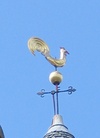
Crathes is particularly known for its ceiling paintings. Photography is not allowed in the castle but there are excellent photographs in the RCAHMS "canmore" database see: http://canmore.rcahms.gov.uk/en/site/36693/digital_images/crathes+castle/ .
Castle; an L-plan tower-house built in the mid-16thC with a later projecting wing. It is built of granite with rounded angles and rises to four storeys and an attic. The lower storeys are plain but above the first-floor level there is a profusion of corbelling, stringcourse, angle- and stair-turrets, heraldic decoration, gargoyles, and gabling which are unique to Scottish castellated architecture. The entrance, in the re-entrant angle is protected by an iron yett. The interior is famed for its plaster & magnificent wooden painted ceilings. The castle was built for the Burnetts of Leys who received the charter for the land from Robert the Bruce in 1323. Within the castle is a jewelled ivory horn, the Horn of Leys, which is said to have been presented to Alexander Burnett by the Bruce when he received the charter. The castle came into the hands of the National Trust for Scotland in 1951. SMR
Crathes Castle NO 735 966 doocot
doocot Small square, rubble, with forestair and slated pyramidal roof. Probably early 19th century. Rebuilt on present site 1935. Inset stone from Houses of Parliament. LBR
The sundial has an interesting decoration of 4 grotesque portrait masks but I can find no record of its date or creator.
E
Early Crosses, Banchory

A relic of St Ternan's Monastery still remaining at Banchory is a slab with two incised Celtic crosses, built into the Tilquilly vault in the chuchyard. Discovered by J W Robertson, Aberdeen.
J
James Hunter fountain, Banchory
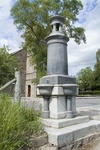
A column shaped fountain with 4 basins in black polished granite on a stepped pedestal of contrasting light stone.
Jock the Giant
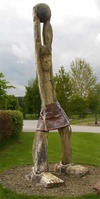
Large woodcarving of a boulder throwing giant, carved from a single trunk with an applied copper kilt. Created in 1990s installed here in 2000, after being on tour with Scottish Sculpture Open 9, Kildrummy Castle (1997), MacRobert Art Centre, Stirling (winter 1997-8), fabricated at Scottish Sculpture Workshop, Lumsden
S
Strachan War Memorial
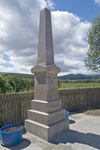
The Strachan war memorial commemorates the dead from both World War I & II. It stands outside what was the parish church. It is small simple rectangular obilisk surmounting a rectangular base on a three-step plinth. There is some slight fading of some of the World War II lettering on the side.
This content was submitted by external contributors and does not necessarily reflect the views of the University of Aberdeen.