
17th century grave slab St Drostans kirk Aberdour

A 17th century grave slab with finely carved lettering and memento mori symbols in a primitive style.
18th cent tomb slab St Drostans Aberdour
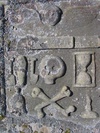
A stone slab carved with memento mori in a more primitive style than the nearby Clyne grave. The inscription is no longer legible.
18th century archaic head
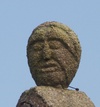
A granite carving of a human head, mounted on the south gable of the shed. This apotropaic (averting evil) carving has an extremely atavistic quality, with its appearance of a severed head it is powerfully reminiscent of Celtic Iron Age works relating to the cult of the head. Indeed if found buried in the peat bog one might think it was such. However it is presumed to date from the origin of the building to which it is attached. This is one of the oldest structures in the village one can clearly see where corrugated iron has replaced thatch, some aspects of the shed suggest it may have originally been a dwelling. It is situated near what would originally have been a major crossroad pre-dating the village square crossroad to the south and the Fraserburgh-Banff turnpike junction a mile to the north. Possibly this structure was part of the hamlet of Cyaak that preceded the village. The house on whose feu it stands No 48 High St is itself nearly as old as the foundation of the village in 1787 and was once a butchers, at which time the shed may have been used for slaughtering.
A
Aberdeen enclosure, Methlick

A low walled enclosure with a very ornate 'Celtic revival' cross shaped tombstone.
The inscription reads:
To the memory of
George John James Fifth Earl of Aberdeen
Born at Stanmore Priory September 1816
M.P. for the County of Aberdeen
Died at Haddo House March 22nd 1864 at the age of 47
also of his wife
Mary Baillie Countess of Aberdeen
Daughter of George Baillie of Jerviswoode
and sister of George 10th Earl of Haddington
Born August 4th 1814 and died at Kennet House Alloa
April 3rd 1900 at the age of 85
Their Works Follow Them
Aberdour cave graffiti
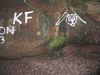
An assemblage of graffiti mostly consisting of simply painted names and dates but including the illustrated iconographic piece, showing a hound's head from an unusual straight on perspective.
Aberdour Dovecot
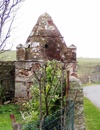
Dovecot; small square ashlar with some pinnings; stone nesting boxes; has squat octagonal gablet pinnacles; two rat ledges; possibly 16th/17thC origin; restored 1981.
Aboyne Jubilee Fountain
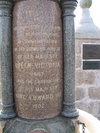
A commemorative drinking fountain in polished pink granite with contrasting gray decorative columns.
The inscription reads:
"Erected by the inhabitants of Aboyne and neighbourhood in commemoration of the Diamond Jubilee of Her Majesty Queen Victoria 1897 and the coronation of His Majesty King Edward VII 1902.
Aboyne Millennium Gates
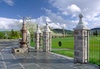
Pair of double wrought iron gates with masonry pillars with ornamental capstones, decorated with a bronze relief showing the Marquis of Huntly's Crest (being used as the Gordon clan badge?) with a ten tined stag's head and neck affrontee issuing from a coronet and the motto Bydand. Following a suggestion from the Marquis of Huntly, the Games' Chieftain, it was decided to echo the design of the tops of the gate pillars at the Parish Church across the Green, on the gates leading on to the Green and on to Huntly Road. (A similar pair exists in the grounds of Aboyne Castle). The more 'cylindrical' form of the Fountain was also incorporated by making the tops more circular in plan with a view to reflecting that influence thus effecting a degree of compatibility. The main parts of the pillars are constructed with local stone and blend well with surrounding buildings, particularly the Huntly Arms Hotel.
Aboyne Stained Glass, War Memorial
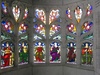
An ornate memorial setting of stained glass and elaborate stone mullions flanked by the rolls of honour. The six allegorical figures are from left to right: Valour, Patriotism, Victory, Peace, Freedom and Justice.
Aikey Brae stone circle or Parkhouse stone circle
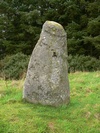
Elliptical Recumbent Stone Circle; Widest diameter 16.6 metres, narrowest diameter 12.8 metres five erect stones including recumbent and E pillar, five prostrate stones including W pillar. They are set upon a bank of small stones and earth 1.92m x 0.76m. c14.4 m in diameter, with kerbs formed by slab-like stones on the inner and outer faces, it appears flat, however below the surface, the interior is made up, at least partially, of a mass of small boulders. It was a considerable feat to haul all the great stones of the ring, including the massive, whale-like recumbent (weighing 21 tons), into position on this bank. Such banks are a particular feature of recumbent Stone circles in Buchan.
An arc of monoliths runs out from the fallen west flanker; the southern and central ones were perhaps selected for their distinctly phallic shape. These stones are exceptionally tall: the cast flanker stands 2.23 m high and its fallen partner on the west is 2.86 m long. Clear signs that the seven stones of the ring were graded in height can still be seen.
Most of the stones are of granite, but the fallen west flanker and the recumbent are of whinstone. The latter, 4.6 m long is rather uneven over its upper surface, yet overall quite level; it is beaked at the west end for ease of levering into position, but very straight at the east.
A very atmospheric site.
Alex Patersons Ship Painters Shed

There is a tradition in this area of ship painters using the exterior of their premises try their colours and clean their brushes etc.. This results in heavily textured and intense abstract expressionist works of an impressive scale. Some might argue that they lack sufficient intentionality to be considered art works but they are definitely intended to be seen. This practice is also seen on other smaller sheds within the boatyard and even on roadside bollards.
Andrew Bruce Memorial
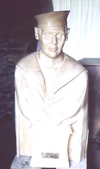
A memorial commemorating the artist's brother Andrew Bruce who lost his life during the sinking of H.M.S. Barham at 16.25 hrs. on the 25th November 1941. The memorial is to be installed in his home village of St. Combs.
Anne Rochfords Gravestone - Tree of Life

An inspired contemporary gravestone, by Helen Denerley, with a brass and copper relief appliqué in the form of the tree of life in a sinuous style. A mouse and a lizard are nestled among the tree's roots.
Arnage Home Farm sign

A fairly recent addition to the regions collection of cut metal signs showing the current favourite iconography of a man with a pair of horse and a plough. Behind is an older primitive painted board sign now almost illegible.
Asleid 1
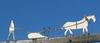
Asleid 2

A cut sheet metal sign by the same artist as Asleid 1, on another entrance to the farm this time illustrating a horseman with a box cart.
Asleid 3
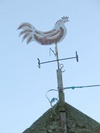
A sheet metal painted weather vane created by the brother of G Christie who made the related farm signs.
B
Bagpuss faux windows, Peterhead
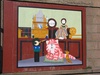
False shop window murals on plywood one is a homage to the 1970s children's TV programme 'Bagpuss' created by Oliver Postgate and Peter Firmin. The other represents an antique shop at the turn of the last century. Commissioned by the Aberdeenshire Towns Partnership to aid the regeneration of the area.
Barthol Chapel war memorial
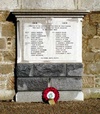
A simple small stone tablet on a pediment of darker granite ashlar. Like many rural Scottish WW1 memorials the length of the list of names in relation to the tiny size of the settlement is very striking. It commemorates the dead of World War I. It has a classic cornice below which are carved, in the centre of the memorial, the entwined letters B & C. It was unveiled 23 November 1919.
Battle of Harlaw Memorial Monument

Erected in 1911 by the Burgh of Aberdeen a large polygonal tower shaped monument of coursed roughly dressed stone blocks with cornerstones in a contrasting redder stone. It has an outstepped base the angles of the main section are set with large square decorative bosses and it has a stepped top with protruding rainwater spouts. The lettering of the inscriptions in particular and the overall design in general has much of the 'arts and crafts' movement about it.
Beach Café murals, Fraserburgh
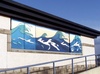
A mural of waves with a nod to Katsushika Hokusai and his famous print "In the Hollow of a Wave off the Coast at Kanagawa".
Compare this maritime icon, aimed at an audience of surfers and other recreational users of the littoral, with the murals on the harbour café designed for an audience who go to work with the sea.
Beaton gravestone Methlick

A huge granite Celtic cross memorial that dwarfs the more ornate Aberdeen memorial in the same graveyard.
The inscription reads:
Erected in memory of James Beaton, Farmer Middlethird Methlick,
who died on the 7th Nov. 1908
aged 73 years,
and (on the second step of the stepped base)
also his brother Thomas Beaton, who died at Ythan Villa Methlick
on 25th March 1920 aged 82 years
BELHELVIE WAR MEMORIAL

It is a tall Celtic cross, with interlacing, surmounting an angled base with lettering on the front and back. It stands on a one step plinth of rough dressed granite. It was erected on May 22nd 1921. It commemorates the dead of both World War I & II. There are a number of war graves in the cemetery as well.
Bennachie Story Wall Hanging

A large textile wall hanging, celebrating the relationship of people and landscape, around Bennachie an outlier of the Grampian mountains that dominates the immediate area. One of its summits has a vitrified hill fort and it has been suggested as a possible location for the defeat of the Caledonians under Calgacus by Agricola's Roman troops at the battle of Mons Graupius.
Bodie Fountain

Category C listed.
Polished grey and red granite memorial fountain bearing a portrait bronze plaque, erected by local worthy Dr. Walford Bodie ("Dr" Walford Bodie, billed as "Electrical Wizard of the North," a show business personality with national reputation.) in memory of his daughter Jeannie. Originally sited by Macduff harbour, it was moved to Macduff Duff St, Macduff to make way for harbour improvements moved again to present site 2009. Bodie, a hypnotist, ventriloquist and performer of electrical tricks in Britain's music halls and theatres, had the (since demolished) public swimming pool and baths built on MacDuff High Shore. His use of "Dr" and "MD" (which he said stood for "Merry Devil" ) upset a number of doctors of the day. Bodie died in 1939.
Bonnie Birken Tree
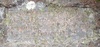
Inscribed granite stone, Possibly made for Sir William Cuncliffe Brooks, Laird of Glentanar who
died in 1900. The inscription reads: "the pine is King of Scottish woods
and the Queen ah who is she
The fairest form the forest kens
The bonnie birken tree"
There are many beautifully inscribed stones on the Glen Tanar estate, particularly at springs and wells, some poetic and some enigmatic in sentiment.
Brandsbutt stone

A class I Pictish symbol stone that may re-use a megalith from the stone circle that once stood here. 3 feet 6 inches high by 4 feet 2 inches wide by about 3 feet thick. It is re-assembled from fragments found in a dyke and some missing parts are substituted with cement. The south-east face bears the crescent and V rod and serpent and z rod symbols to the left of the symbols is an ogam inscription which reads IRATADDOARENS some part of which may be a version of the name Ethernan (as in St.Ethernan).
The stone circle was partially excavated by I A G Shepherd and Bill Sievewright (of Ellon Plant) in January 1983. Basically the top soil was removed revealing five stone-holes and evidence of the deliberate destruction of the circle. The deduced outline of the original circle is now indicated by the modern hard landscaping of the site.
Bulls Head Gate Ornament
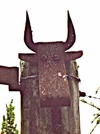
An assemblage by welding of old agricultural scrap. Although somewhat reminiscent of Pablo Picasso's treatment of the same subject using a bicycle saddle and handlebars, the different components create a more agrarian bull.
C
Cairness House
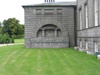
Cairness House is considered one of the finest examples
of neoclassical architecture in Britain. The house sits four miles south
of Fraserburgh in the County of Aberdeenshire, looking across to Mormond
Hill. It is the largest and finest country house in Buchan and one of the
great houses of Scotland.
Cairness was built between 1791 and 1797 to designs by architect James
Playfair and replaced an earlier house of 1781 by Robert Burn, which was
largely incorporated into the Playfair scheme. Sir John Soane assisted in
the final stages of the construction following Playfair’s untimely death
in 1794. The park was laid out by Thomas White, a follower of Lancelot
'Capability' Brown.
The building shows a strong influence of the French architects
Étienne-Louis Boullée and Claude Nicholas Ledoux. The design incorporates
a complex mixture of Masonic and pagan symbols as well as many
numerological and architectural conceits. It is a calendar house, and its
ground plan shows an adjoining “C” and “H”, variously standing for
Cairness House and Charles Gordon.
Constructed in finely detailed granite ashlar, Cairness House consists of
a 110-ft main block, flanked by two raised “bookend” wings. A tetrastyle
pedimented Roman Doric porch sits to the centre, its unjointed columns
hewn from menhirs taken from a nearby druids' temple (presumably actually a neolithic recumbent stone circle, possibly one that was at Rora about 6 miles to southeast) . A pair of lower
pavilions with representations of the Masonic Altar adjoin at the back.
From these spans a huge semicircular service wing, with a central bell
tower above a lunette arch, enclosing a courtyard at the rear of the
house. The centre of the courtyard is dominated by a round ice house
modelled on the Temple of the Winds in Athens. The main roof is surmounted
by 51 cast iron chimney cans in the shape of fluted Doric columns.
Cairness House was commissioned by Charles Gordon of Cairness and Buthlaw
and was part of a 9,000-acre estate that included the village of St. Comb’
s and the Loch of Strathbeg, today an important nature reserve. The second
laird, Major-General Thomas Gordon (1788-1841), a good friend of Lord
Byron, was a hero of the Greek Wars of Independence and wrote a celebrated
history of the conflict. The Gordon family sold the estate in 1937 to the
Countess of Southesk.
After the Second World War, the house was used as a farmhouse and
gradually fell into serious decline. The park was destroyed from the early
1950s onwards with the mass clearance of trees in order to reclaim land
for agricultural use. In 1991, the house was listed as a Building At Risk
by the Scottish Civic Trust. A major long-term restoration programme of
the house and grounds was instigated by new owners in 2001. Cairness House
now contains a very fine collection of furniture and works of art and is
open to the public.
Candle Stone

A large very phallic standing stone 3.1 m high located just below a low summit, on a slope which shelves gently to the SE.
Carers Garden Mosaics
Carved Stones, Fetternear House

Photo 1:Carved sandstone, fragmented, set in the front of Fetternear House which was destroyed by fire in 1919.
Text of top fragment Reads abbr, Jesu Maria with a Greek Cross and another symbol, lower fragment shows the letters PEL, M and I, an outline holly leaf and the date1691.
Photo 2: Carved sandstone set in the front of Fetternear House shows the Coat of arms of the Count Patrick Leslie 1693.
Clyne grave 18th century grave slab St Drostans kirk Aberdour
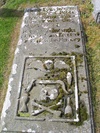
A nicely carved 18th century grave slab with classic memento mori symbols in a slightly more sophisticated style than some examples.
COAST 2013 banners
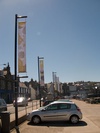
David Blyth worked with local school children as part of this commission. Two major source inspirations were a 1960 paper doll toy found in a local charity shop (the kind one used to cut out the clothes for with the little tabs that fold over) and the Macduff Marine Aquarium. The human/sea animal hybrid is also a concept widespread in Scottish folklore here however David focuses on corals, polyps, urchins and etc rather than the more traditional seals and fish of sylkies and merfolk.
Coast Festival, installation at Macduff Pier
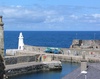
As part of the first Coast Festival (23rd-26th May2008 ). One of three commissioned temporary public art works. It consisted of 5 uprights in polished steel. These created a complex visual environment of reflections, shadows and reflected light beams. Constantly changing in accordance with the light and the viewers position.
Coldwells Sign

A wonderful cut steel sign of a Clydesdale Horse in working harness, the harness detail suggests a working horseman's intimate knowledge, this plus the style and overall condition suggest it is of considerable age.
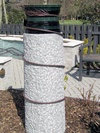
Continuum
Cowie Chapel George Ironside tomb
Upright grave slab with Celtic cross with interlocking knotwork in high relief with a carving of a chalice in the centre of the cross. It is inscribed in Latin: Georgius Ironside ecci: Scot: Sacerdos - In Xto. Obdormivit iiij Non. Oct MDCCCLXI Det Illi Dominus (the rest is obscured)
Crovie Sculpture
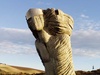
Large ash wood carving 12 foot high, with metal elements. The artist's title is "Scottish Athena" - Athena being the ancient Greek - "Goddess of wisdom, practical skills and prudent Warfare" hence the metal head piece.
"I called her that because of the prudent warfare bit because of Crovie being the place where people went during the clearing of the highlands - I thought she could be a protector therefore up on that cliff top ready with her helmet piece. The steel eyes were to reflect the sky or sunset etc to give that timeless expression. Also because in another definition she was termed patron of the arts and the piece was done as part of a Thankyou to the companies who had donated or supported the Scottish Sculpture Workshop at Lumsden."
Crovie, donations barrel
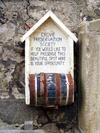
Collection barrel soliciting donations from the preservation society, that is itself in need of preservation, if you look closely has already been repaired by adding stainless steel straps the original steel rings having rusted away.
Crudie war memorial

It commemorates the dead from both World War I & II. It is a low squat memorial built of random rubble with the memorial plaque to World War I inset on the front, and the later World War II memorial added to the side. The top is also of random rubble.
Culsh Monument

The 80ft (24m) Culsh Monument, erected 1876 in memory of William Fordyce MP of Brucklay , Aberdeenshire's first MP.
Viewing platforms are provided at the base, and at the top of the spiral staircase within the tower. On a clear day the distant Caithness Hills can be seen to the north, Ben Rinnes at Dufftown in the west, the Grampian Mountains to the south and Peterhead to the east.
Culsh Monument Viewpoint
A sculptural granite, viewing and orientation point, located next to a steepled tower built as a memorial.
Culsh souterrain or earth house

Souterrains are a type of iron-age architecture that seems to have been fairly common in the area that is now Aberdeenshire, the most common assumption is that they were used for storage of grain and other food-stuffs. Souterrain curved and lined with dry stone walls (the walls have been mortared in modern times) and heavy roof slabs. Accessible but the visitor will require a torch to explore the few metres of passageway inside.
Various authorities report 1 or 2 possible cupmarks on left wall (cupmarks are usually thought to have been created in earlier periods, their occurrence in iron age and later artefacts could be taken as an indication of some special respect for these older interventions).
The 19th century excavation finds were reported by A Jervise 1865, as the floor being littered with ashes, 2 querns, some unglazed pottery shards, cattle bones and a large bead.
D
Deer Abbey, commerative plaque to St Mary and St Drostan
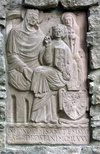
A carved stone relief. St Drostan is a legendary evangelist of the area, his name a Pictish form of Tristram.
Delgatie Castle

Delgatie Castle dates from about 1030. The main tower dates from the 1100s while its final extension with the battlement walk above the string course was completed in 1579. Both wings were added in 1743. From 1314 until the recent death of Captain Hay of Delgatie the castle has belonged to the Hay family. It is now managed by a charitable trust. The painted ceilings from 1592 and 1597 are amongst the finest surviving in Scotland. Their iconography has interesting comparisons to the much earlier Aberdeen Bestiary and even earlier Pictish sculpture. See The Pictish Arts Society The castle boasts an eclectic range of architectural decorations and sculpture. Delgatie is open daily from 10a.m. to 5p.m. every day throughout the year and is only closed Christmas and New Year weeks. There is also a tearoom serving home baking and snacks. Accommodation is available see Delgatie's own site for details www.delgatiecastle.com or e.mail Delgatie Castle
Delgatie Doocot

An unusual pink harled circular structure with three tiers of decreasing diameter. A circular dovecot in good repair: three sharply diminishing stages with batten, rubble-built. Entrance with chamfer and relieving arch, widened at lower courses. 708 stone nesting boxes. Similar to those at Auchry and Huntly but appears to be considerably older.
Delgatie, Maries Bower

A text work painted on the ceiling beams in a room reputed to have provided lodging for Mary Queen of Scots, this painting confuses me as the text is the same as 2 stanzas in the poem "Kilmeny" by James Hogg 1770–1835 (it is a part of her prophetic vision during her stay among the fairies) . I admit my ignorance, I do not know if the ceiling painting is in fact a modern work or if this part of the poem was copied by Hogg from an earlier source.
Dog statue, Delgatie

Gatepost ornament, Red sandstone carving of a dog? holding a shield. The late Captain Hay of Delgatie was an inveterate collector and the castle has many decorative elements that are now difficult to attribute to exact dates and provenances.
Double Decker Guards Van
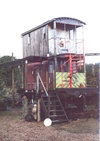
The railway guard's van has been modified by the addition of an upstairs and a spiral staircase, it is installed on a short section of track.
Dr Danny Gordons cairn and a memorial bench

A small memorial cairn of mortared rubble inset with an oval panel of pink granite carved in relief with the words "Dr Danny Gordon's widdie" nearby is a bench presumably a memorial carved in relief with interlace and the words "WIGHT GLENLOGIE".
Dry lines , no fish stone

A stone inscribed with the words: "Dry lines , no fish" and a cross like mark the inscription showing some trace of colour. Possibly by Sir William Cuncliffe Brooks, Laird of Glentanar who died in 1900. There are several other inscribed stones on the estate many at the sites of springs/wells.
Dunecht estate office armorial plaque

A large, curious and very imposing armorial plaque on the wall of the estate office in 1920s style. The supporters are particularly unusual they are on the dexter side a man in a diving suit, and on the sinister side a figure in sandals and a fringed poncho intended as a Mexican paeon. These are the arms of Weetman Dickinson Pearson, 1st Viscount Cowdray and MP ( born July 15, 1856, Shelley Woodhouse, Yorkshire, Eng. died May 1, 1927, Dunecht House, Aberdeen, Scot.) who became the sixth richest man in Britain out of the huge wealth he made from exploiting Mexico's first oil production under the dictator Porfirio Diaz. His extensive interests in Mexico, from construction of railways, dams, harbours and tunnels to mining and manufacturing, from rural estates (on the eve of the Mexican Revolution in 1910 Pearson's Mexican Estates Company controlled well over a million acres of land) to his ownership of the 'El Aguila' oil company, meant that he was so often absent from the House of Commons that he earned the nickname 'The Member for Mexico'.
E
Easter Aquhorthies RSC

An impressive recumbent stone circle, 19.5 m in diameter, consisting of nine erect stones, the recumbent, two flankers and, in addition, two massive blocks which form a reserved area in front of the recumbent The circle is located near the crest of a hill shoulder, at 175 m OD. The characteristic differentiation between the recumbent with its flankers and the other circle stones can be seen vividly, both in terms of height of stones and their geological origin. The stones are graded in height from the 2.25 m tall flankers to the 1.7 m high stones on the circumference opposite, and, while the nine circle stones are of rough pinkish porphyry or (in the case of the second stone to the east of the flanker) a glowing red jasper, the flankers are of grey granite and the recumbent of reddish granite from near Bennachie. The outer face of the 3.8 m long recumbent has been smoothed carefully. The circle stones are set in a low bank. The very slight rise in the interior and a 1934 reference to a cist suggest the existence of a later ring cairn, now extremely vestigial. Its almost perfectly circular plan places this circle early in the series of recumbent stone circles
Egg sign free range neeps
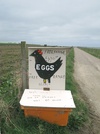
A painted and collaged eggs and neeps for sale sign, with an honesty box that has sadly been re-classified as a dis-honesty box as far as eggs are concerned.
The concept of a "free range neep" (turnip) is a little disturbing, but the hen has a definite charm.
Egypt Farm Sign
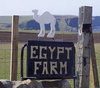
This popular cut out sign of a camel has been through more than one incarnation while keeping to essentially the same design
Eider Duck bench Forvie
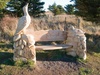
A carved wood bench the side supports representing the eider ducks, for which the reserve is famous, on columns of shell and weed encrusted rock, the back board is carved to suggest the estuary landscape the bench faces.
Electra, Bodie Enclosure, Head on Pillow Stone
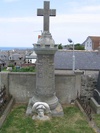
Carved pillow stone erected in memory of Isabella Henry or "La Belle Electra" assistant to Dr Walford Bodie.
Elizabeth Mantell Stained glass Memorial Windows
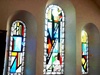
A set of three stained glass windows produced in memory of missionary nurse and Macduff resident Elizabeth B Mantell 1941-1998. The windows which combine old and new Celtic and African art. A centre panel of hand painted sections display a portrait of Elizabeth Mantell nursing a child, the Macduff Parish Church and the Mulanje Mission Hospital in Malawi, where she developed high quality nursing and midwifery over a period of 14 years. The side panels combine the Saltire Cross and the Malawi flag. Traditional Celtic border.Elizabeth mantell was born in Africa, where her father was an agent of the African lakes, In 1952 the family moved to Macduff where she grew up.
Ellon War Memorial
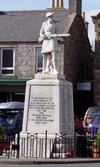
It commemorates the dead of both World War I & II. It is a rectangular block standing on a three-stepped base, surmounted by a kilted soldier, in Glengarry, in a challenging position with gun at ready across his front. Erected August 5th 1923. It stands within a low wrought-iron enclosure. Another small plaque was erected in 2000 to commemorate all people killed in conflicts since the World War II.
F
Faddonhill Farms Sign
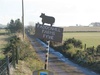
A silhouette farm sign in the shape of a fat ox. These cut out signs were once ubiquitous in the area in the forms of pigs, cattle, horses and etc. they are now becoming rare. The original 20th century sign (illustrated here for reference) was replaced in 2004 after storm damage. The new sign retains the ox of the original but the painted lettering has been replaced with gilded cut out metal lettering and 2 decorative gilded fleur de lys.
False window Pennan Harbour
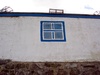
A blank white shed wall is relieved by a painted window frame that somehow evokes the view that it would have if it were real.
Farm sign Crovie Farm

A contemporary take on the cut steel sign tradition with a forged, welded and galvanised box section frame and a galvanised silhouette of a horse and ploughman on a black enamel ground.
Fear Its Secret
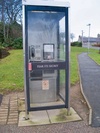
A simple intervention text work on a public phone box. The use of standard signage type lettering neatly applied gives this intervention a quasi official aura that may account for its longevity.
Features at Tolquhon castle

Apart from the original Preston tower this is not a building with serious defensive intent, more a stylish country palace. As with the tomb for the same client and the other castles he was involved in the design of, Leper has combined what was then modern style with older traditions to create a fusion that is peculiarly Scottish. He has an approach that resonates with C. R. Mackintosh in a much later era.
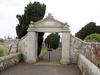
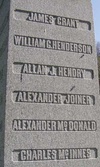
Fetterangus cemetery gate / war memorial
Fetterangus Pictish Symbol Stone

A class 1 symbol stone lies at the entrance to the graveyard of Fetterangus Church. It is of whinstone, 1.1m x 0.78m, and is much weathered, the carving is almost invisible to the naked eye, Near the top was a triple disc and bar or "cauldron" symbol below which was a rimmed "mirror case" its base containing opposed arcs with a palimpsest of another circular symbol overlapping it, at the bottom was a figure composed of a horizontal line and 2 curved lines one with a spiral end. Note some published descriptions are given with the stone the opposite way up to the above. Fairly clear photographs taken by Professor James Ritchie circa 1904 can be seen on the RCAHMS website (Archive Numbers: SC 676586, SC 676550, and SC1081353 the first stone shown on the linked page SC 676546 is another class 1 stone I cannot identify) follow the external link below .
Fish and chip shop bear
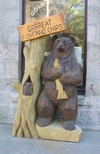
A carved and stained wooden sculpture of a brown bear holding a salmon beside a tree stump with an owl, adorned with a sign.
Fisher Jessie sculpture
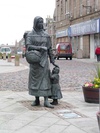
Naturalistic bronze cast statue of a fish-wife and little girl, the woman carrying a creel and a basket.
Fishermens Memorial, Peterhead
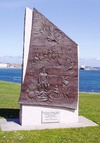
Size overall: 180cm x 350cm x 50cm, sail shaped cast bronze relief modelled with scenes of early 20th century fisher life, mounted on a granite slab.
Flying Visit

Large welded metal sculptures of a 'Family' of Crows feeding outside a supermarket. Each is made from parts from former farm implements - ploughs, dividers, links, grubber wheels, bolts etc
Forglen War Memorial
Of a more original design than most war memorials. It is a tall rectangular block of granite which is capped with a pyramidal shape with small projecting points at each corner. The names are carved in wide bands around all sides of the obelisk on two sides they are extremely clear while the other two are rather weathered. On the front face near the base is a carved wreath with 1914 , 1918 within it. It sits on a cross-shaped two-step plinth with a step up on either side. It commemorates the dead of both World War I & II.
Formaston Stone

A fragment of a class II Pictish Symbol Stone. It is carved on one face only with a small rimmed ‘mirror’ symbol and part of an interlace filled cross-shaft. The mirror has a long handle with a boss at the end. There are two vertical Ogam inscriptions, Ogam was probably introduced to the Picts from the Gaelic speaking Scots in the 8th Century, they read MAQQoiTALLUORRH and NAHHTVROBBACCAANNEVV. MAQQ may mean son of or descendant of. The oi following is expressed as a small circle.
Pictish stones are classified as follows:
Class I are incised stones bearing the formalised Pictish symbols usually in pairs.
Class II are relief carved slabs bearing symbols in addition to a cross.
Class III are cross slabs without the symbols such as the related Kinord stone at Loch Kinord to the West of Aboyne.
Fraser/Saltoun Mausoleum and Jubilee or Temperance Fountain
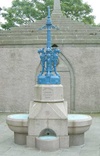
There are two Fraser/Saltoun Mausoleums the old one which is situated adjacent to the Old Parish Church and a more recent ? one which stands by itself in the Kirkton cemetery. They are almost identical in Gothic style, with curious stepped pyramid roofs surmounted by obelisks topped with an egg shape. The older 18th cent one is harled and the more recent is in exposed dressed granite.
The Jubilee fountain has been moved from elsewhere in the square. It consists of a geometric carved granite base with 4 basins at 2 heights (presumably for dogs and people) surmounted by a blue painted cast iron Victorian extravaganza of a finial adorned with four heraldic beasties, (wyverns ?). It is sad that so many of our fountains no longer provide water or are even connected to a water supply.
Fraserburgh entrance, lighthouse models
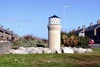
Large model lighthouses at the entrance to the town of the Banff and Strichen Roads surrounded by boulders and planting.
Fraserburgh Fish Sculpture
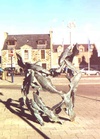
A sculpture in bronze in the form of shoaling fish. Has been used as a location for for pre-nuptial blackening rituals.
Fraserburgh Old Parish Church, fish weather vane
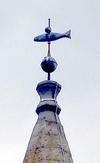
The slightly stumpy stone built spire of the church is adorned by a simple metal fish weather vane. See external link to church website for pictures of the whole building.
Fraserburgh Town Cross
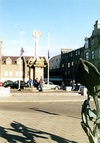
A polychrome market cross with the Royal Arms of Scotland on the North side surrounded by the insignia of the Order of St Andrew, on the South are the Royal Arms of the United Kingdom surrounded by the insignia of the Order of the Garter,on top of a shaft dating from 1736. The south of the shaft bears the burgh arms of Fraserburgh and the north the burgh arms of Faithlie. Faithlie being the burgh that preceeded and grew into Fraserburgh. The granite base dates from 1845. The finial was replaced in 1988 and the whole monument was moved a short distance in 1997.
Fraserburgh War Memorial
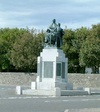
Comprises of a bronze sculpture of a female figure restraining a soldier ‘Justice guiding valour’ on a granite base. It commemorates the dead of both World War I & II. It has a large rectangular base with plaques on each face, and built-out small angled corner pieces, the faces of which also bear plaques. Above, on a three-step plinth, is the bronze cast of two classical figures. The larger is a cloaked & seated female (Justice) with a downturned sword in front of her. To her left side is a smaller figure of a cloaked warrior (Valour) with helmet & shield who is holding the sword in his left hand. It was unveiled on September 9, 1923.
Fraserburgh, Beach tunnel murals
Brightly coloured cartoonish mural decoration in a style that many adults seem to regard as appealing to children.
Fruits of Labour

Carved from Indian Black Granite, a partial sphere with two larger hemispherical shapes suggestive of a sliced fruit, a peach for instance, each has a hemispherical void in its centre that matches the smaller sphere which is itself suggestive of the fruit stone. Contrast is provided by polished and unpolished surfaces.
Fyvie 1

Fyvie Parish Church is at the east end of Fyvie, on the south side of the B9005. Set in the east wall of the church are three worn Pictish class I symbol stones, all have been trimmed.
Fyvie 1 was once built into the wall of the schoolhouse. On it is the 'elephant' or 'Pictish Beast' symbol, the bottom part of a 'crescent and V rod' and most of a 'mirror' symbol.
Fyvie Church also contains important stained glass by L. C. Tiffany. South-east of the church in a railed enclosure, marked by an obelisk is the old tombstone of "Mill of Tifty's Annie" (1673), subject of the eponymous ballad.
Fyvie 2

Fyvie Parish Church is at the east end of Fyvie, on the south side of the B9005. Set in the east wall of the church are three worn Pictish class I symbol stones, all have been trimmed.
Fyvie 2 was found built into the wall of the church. On it is the right hand part of a 'double disc symbol' and the centre part of an 'eagle symbol' facing left to right.
Fyvie Church also contains important stained glass by L. C. Tiffany. South-east of the church in a railed enclosure, marked by an obelisk is the old tombstone of "Mill of Tifty's Annie" (1673), subject of the eponymous ballad.
Fyvie church fountain
A polished pink granite fountain in a neo-gothic style. Inscribed ‘ Presented by captain A.H. Gordon 1875 John 13 – 14’
Fyvie Cross
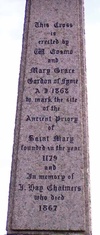
Corrennie granite Cross (erected 1868) and cairn – all
that remains on the site of the former St Mary’s priory Fyvie a cell of Arbroath Abbey. Founded in
1285 by Reginald de Cheyne. (the last traces, of the buildings, vanished in 18th century).
Fyvie stone carved relief figure holding head

Stone carved figure covering face with hand, the other hand appears to be cradling the head of an infant at waist height. Interpretation is slightly speculative as the stone is quite badly eroded.
G
Gaval Stone

Remains of recumbent stone circle; one remaining stone, impossible to say whether in situ or has fallen and been re-erected. The area of the circle, complete until about 1844, may have extended to the E of the stone. Apart from the stone, there is no trace of the other remains of the circle.
It is said to have been intentionally destroyed with explosives but I do not know how reliable this is.
Geordies Kist planter

Planting feature, as part of a village wide planting project. Description an installation of bedding plants in a 'horseman's kist', the lid interior featuring a painting in the local folk style of two Clydesdale horses in agricultural show harness.
George and Ann Thomson Memorial Fountain
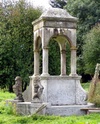
An Italianate fountain with a sophisticated urban look that does not really suit its current location where it looks a bit lost.
Gibbet Stone
Glen Tanar decorated drinking trough

A beautifully engraved source. Engraving: possibly by Sir William Cuncliffe Brooks, Laird of Glentanar who
died in 1900.
"Drink weary traveller in the land
and on thy journey fare
t'is sent by God's all giving hand
and stored by human care"
There are several other inscribed stones on the estate many at the sites of springs/wells.
Gold Close 7 Kirk St Peterhead
The rough walls of a narrow close (a covered alley) 20' feet long 4' wide and 10' high, in a street of pink and grey granite tenements. The artist has covered the walls with gold lead thus creating a light installation when the sun illuminates it. The reflected light emphasises architectural features that were previously obscured by the general deriliction and old surface coatings. The work creates an intense visual impact on the street in the right light conditions.
Golf View sculpture

Metal and Granite, modernist sculpture with an iconography related to the game of golf. The sculpture is a reminder that the surrounding housing development is built on land that formed part of Inverurie old Golf Course.
H
Hackley Bay beach sand drawing

Harbour Cafe, Fraserburgh
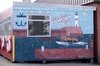
A cafe in a portakabin on the quayside decorated with seascapes and a harbour view, featuring fishing boats and the lifeboat.
The retro signwriting style is particularly interesting.
Haughton Farm sign

A painted sign in a folk art style with fine lettering reminiscent of fairground art, it shows a head of a bull and a sheep (probably intended as Limousin and Suffolk respectively), also a sheave of oats and three eggs indicating the farms enterprises.
Heraldic Panel, Drum

Carved stone panel on the exterior of the castle with the arms of the Irvines of Drum Family The crest is a banded sheaf of nine holly leaves. The motto is "Sub sole sub umbra virens" Increasing both in sunshine and in shade
I
In the beginning, Tarland
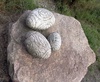
Sculpture using engraved granite one large and three smaller stones, that clearly references local precedents particularly from the neolithic and megalithic periods in both the style and decoration of the piece and, of course, the title.
Insect Sculptures
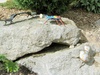
Welded metal insects decorating a garden dedicated to 'carers in the community'. Designed and made by "Just Bohemian" and painted by young carers from throughout the Grampian region.
Installation of scarecrows
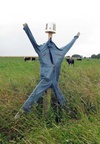
An installation of, about ten, simple tattie bogles (scarecrows) constructed of old overalls, buckets etcetera on wooden frames, these were arranged symmetrically on either side of a rectangular pasture to protect barley crops in adjacent fields.
Inverallochy War Memorial
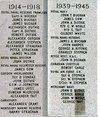
An art Deco style polished granite war memorial, with two stepped-back side blocks which bear the inscriptions of the names, the left for World War I and the right for World War II. The central larger panel is plain, apart from a small decorative panel near the top and the words 'In remembrance' below it. The symmetry shows it is obviously post world war two resulting in (to my mind) a more aesthetically pleasing monument than many originating from before WWII that have the dead of that conflict added later. The war memorial at Inverallochy commemorates the dead from both World War I & II from both Inverallochy and Cairnbulg.
Inverurie 3 and 2

Inverurie 3 is the lower part of a Class I Pictish slab showing most of a double disc and z rod symbol and what may be the lower part of a disc symbol. Inverurie 2 is a very small fragment showing part of an ornately patterned mirror symbol. As well as Inverurie 4 (the famous Inverurie Horse), Inverurie 1 is located in the same place but is too worn to photograph well.
Inverurie 4

A class I Pictish stone showing a horse the only occurrence of the horse in symbol form although hunting scenes with horses and riders are a frequent element of class II stones. As with all Pictish Symbol stones dating is somewhat contentious. As the stone is somewhat eroded a superimposed drawing is included to show detail. As well as Inverurie 3 and 2, Inverurie 1 is located in the same place but is too worn to photograph well.
Inverurie War Memorial

A war memorial of the figurative type with a life size statue of a soldier of a Highland regiment. It commemorates the dead from both World War I & II. It was unveiled on 20 September 1921. It has a tapering rectangular base of rough hewn granite with the name plaques of World War I set in the front and sides. Above the front plaque is carved a wreath behind which are a crossed rifle and sabre. Surmounting it is a statue of a kilted soldier in battledress with a rifle in his right hand resting on its butt. The memorial stands on a three-step base, the centre one of which has the names of the dead from World War II carved into three sides.
J
James Mitchell Memorial fountain, Kemnay

In memory of James Mitchell (1773-1857), carrier, and to provide water for carters' horses, a late symphony in local granites, comprising a well and urn of pink granite with a square grey (Kemnay) granite arched superstructure bearing a sensitive pedestrian statue of Mitchell with roped pack, all in a railed hemicycle granite-walled enclosure with gate piers.
The inscription reads: "IN MEMORY OF JAMES MITCHELL, CARRIER 1773-1857, ALL YE WHO THIRST, COME DRINK FROM THIS FLOW OF PURE WATER WHICH SPRINGS AT DALFLING IN THE SHADOW OF BENNACHIE"
K
KEMNAY WAR MEMORIAL

Its sides, back and three-step base are of rough hewn granite. The monument itself is a tall rectangular obelisk topped with a 'pitched-roof' shape from which projects a thin iron cross at right angles to the ground. Below this on the front are two carved panels, the upper of which has a Celtic cross in relief and below that a St Andrews cross within a shield shape. The memorial plaque to World War I is on the front while a side panel commemorates the dead of World War II. It was unveiled 24 September, 1922.
Kincardine ONeil War Memorial

The Kincardine o'Neil war memorial stands on the main street in the village near the old church. It commemorates the dead of both World War I & II. It is a rough hewn standing stone onto which is carved a sword pointing downwards. This stone surmounts a rectangular base with inset plaques on the face. On either side are piled loose boulders. It was unveiled September 12th 1920.
Kincardine ONeil, street decorative feature

The backdrop to the old restored St Erchard’s Well with the ruins of the old 1st Century Kirk across the road. Recent addition provided by Aberdeenshire Council along with traffic calming and more defined lay-by’s for parking.
Kinord Stone

A large class III Pictish cross slab in pink granite 6 feet 3 inches high by 3 feet 1 inch wide carved on one face.
Kintore 1

class I Pictish stone discovered underground in the churchyard (re used as a gravecover?). Now stands near the churchyard wall in a recess to the right of the entrance.
The South face bears a triple-disc ('cauldron') symbol under a salmon symbol. The North face bears a crescent and v rod over the symbol known as the 'elephant' or the 'Pictish beast'. The South side of the stone is noticably better carved and may be by a different hand and at a different date.
There are 4 stones known from Kintore. Kintore 4 is now in Inverurie museum a few miles away. 2 and 3 are in the National Museum of Scotland in Edinburgh.
Kintore 4

A class I Pictish stone found in a garden in Kintore in 1974 at NJ790162 now in Inverurie museum it has a well executed Pictish beast and a rectangular symbol of which this is the only known occurrence, also a plain mirror but no comb.
Kirkton of Bourtie Recumbent Stone Circle

The remains of this recumbent stone circle are situated in a cultivated field and comprise the recumbent, the E flanker, and two stones on the W arc. All the stones are of granite, the recumbent measuring 5.1m in length by 1.9m in height and 1.7m in thickness. The E flanker measures 2.9m in height by 1.45m in breadth and 1m in thickness. A large void beneath the E end of the recumbent has been filled in antiquity with a large boulder. The erect stones on the WSW and WNW of the circle measure 1.7m and 2.2m in height respectively. RCAHMS
Remains of a stone circle; consisting of the recumbent, now broken, the east flanker and two other stones. The recumbent lies on a definite mound and at one time the circle was -rudely paved-. The area has been used as a dump for field clearance & has been ploughed. Now there is no trace of paving or any internal features. SMR
While the circle itself is fragmentary, it has perhaps the largest recumbent stone known, the setting makes it worth a visit and the nearby occurrence of 3 early carved stones (although not in situ, they have probably not travelled far) suggests an important site with a long continuity of respect.
Knowes War Memorial
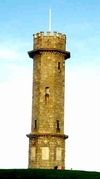
Category B listed Dominating the skyline in Macduff, the Knowes War Memorial stands 70 ft in height, an octagonal granite tower, erected in 1921 to commemorate those who gave their lives in the The Great War, 1914-1918.
It commemorates the dead from both World War I & II. It is a tall slender octagonal 5-stage tower of tooled grey granite, bullfaced at lower stages, on stepped based. There are tooled granite dressings with the lower stage defined by cornice with keystoned occulus immediately below in each face. Each face (except that with recessed doorway) has polished grey granite plaques inscribed with names of fallen of 1914-18 and 1939-45 wars. There are rectangular barred openings, to light internal stair, in alternate faces of the 1st stage and randomly sited in 2nd and 3 stages. A deep crenellated wallhead stage is delineated by a blocked cornice with blind crosslet in each face. There is a plaque stating that the foundation stone was laid on 15 April 1920 by Prince and Princess Arthur of Connaught, who was a daughter of the Duke of Fife.
L
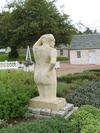
Large Nude Statue, Fyvie Castle Garden
Last of the Summer Wine benches
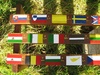
Top photographs show two benches one is a 'standard issue' park bench painted red the other assembled in situ and brightly painted with multi coloured wavy stripes, was the first installed, as of summer 2007 the red bench has been removed and the poem absent in the top 2 photos has been reinstated it reads: "The Seat. Yeve het feet, Tak a seat, Yere fer pecht, Doon yer wecht, Half wye roon, Sit ye doon, A lang wauk, Ye did tak, Jist tak care, Rest eence mair, Efter a fyle, Wauk in style, At yer best, Efter a rest. 1993" As of 2008 a second bench was re-installed, made of slats and painted with the flags of all the European Union states, with their respective population figures. Also added at this time was a tondo mounted on a post painted with what could be a conceptual representation of the EU with state names and the total population figure of 480 million in text.
Leopard
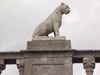
3d stone carving of a leopard decorating a balustrade. The late Captain Hay of Delgatie was an inveterate collector and the castle has many decorative elements that are now difficult to attribute to exact dates and provenances.
Light buoy installation
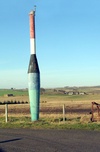
An installation in a field of a light buoy, an object one normally only sees the very top of emerging from the sea. The same track end also has surreall traffic lights which surprise the viewer as they are unexpected on a farm track.
Lion Fountain, Drum
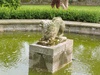
A stone carving of a lion crouched to spring in the middle of a large circular pool.
Little Ardo sign
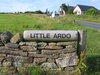
A reused old fashioned granite roller with deeply cut plain lettering "LITTLE ARDO" blacked in with paint or similar.
Loanhead of Daviot Recumbent-stone circle
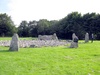
Recumbent stone circle containing a ring cairn with adjacent cremation cemetery. One of the stones, next to the flanker to the east of the recumbent, bears 12 cup marks. The stone circle precedes, in time, the cairn which covers cremations and the scattering of bone, flint and pottery. Excavation of the cairn showed use from the second to the first half of the first millennium B. C. . The adjacent Bronze Age cremation cemetry dates from circa 3500 years ago. At least 31 cremations and burials occured around a central pit, 8 of them children between 3 and 6. 11 deposits in urns have been found and 9 in pits some deposits containing several individuals. This place was used as a sacred site over an extended period of several thousands of years.
LONMAY WAR MEMORIAL
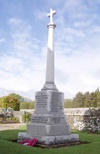
It is a tall, plain octagonal shaft with a cross surmounting it. At the base of the shaft, on a low plinth, is carved a wreath and slightly decorated angles.The cross stands on a solid rectangular base into which the names and inscriptions are carved. The base stands on a three-step plinth, the top one of which bears further inscriptions. The bottom one is of roughly hewn granite. It was unveiled on May 16, 1920. It commemorates the dead of both World War I & II.
Lumphanan War Memorial

It is a simple granite built rectangluar shape with an inset plaque of white marble surmounted by a pointed angle within which is a carved celtic cross-head. It lies within a small memorial garden. commemorates the dead of both World War I & II. It was erected December 5th 1920.
M
Macduff anchor placement

A large fixed tine iron anchor with wooden crossbeam from a sailing ship. The depositing of redundent anchors from sailing ships in prominent positions is a bit of a coastal town cliche. This one has a very good view.
Macduff Parish Church or Doune Church
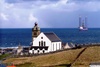
Incorporating 3 story domed tower, in 1865 the church was re-modelled and the original steeple replaced by a Italliante square tower with lead domed roof and cupola into which was installed the town clock.
Macduff soup kitchen/library royal arms
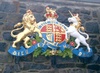
A standard issue 19th Century? cast metal 'UK Royal Arms', England, Scotland and Ireland (of a form first used from 1838) made by Walter Macfarlane & Co cast at the Saracen Foundry Glasgow. It originally adorned a 'public soup kitchen' at 21 High St. opened in 1887 to mark Queen Victoria's Jubilee, subsequently the building was the town's library (for man does not live by soup alone). The arms are of course displayed inverted (for Scotland) in Scotland the Unicorn of Scotland should be shown on the dexter side of the shield in England it is shown sinister. I do not of course know if this was the result of Victorian imperialist cultural insensitivity, bureaucratic ignorance or centralised mass production of soup kitchen décor.
Macduff, Burgh or Market Cross

Category B listed granite cross incorporating small carved plaque at apex, inscribed narrow slabs as arms mounted on square tooled granite plinth. Carving on apex depicts a figure on horseback and bears the arms of the Earl of Fife. Dated 1783 but incorporating earlier fragments. The cross bears the inscription, on 2 panels one on either side: Macduff Cross. Rebuilt at Macduff by the Earl of Fife, 1783 when the town was constituted a Royal Burgh by George III. May it flourish, increase in number and opulence, ----- while it's inhabitants gain the blessing of life by industry, diligence and temperance." The words on the inscription are taken to refer to the fact that a stone was taken from the ancient Macduff Cross in Fife and built into the Macduff one, to form some sort of symbolic connection between the ancient and modern bearers of the name Macduff. At the beginning of the last century it was popular for youths to light fires at the foot of the cross. As a result the cross fell and is now shorter.
Maitland Grave Methlick

A fine example of an 18th century tombstone. Decorated with a cherubic angel's head in front of clouds from behind which emanate solar rays. The beautifully executed inscription commemorates Patrick Maitland late in little Ardoch, Jean Robertson his spouse several of their children and Charles Maitland
Mannie

Stone carving, used as a gate post decoration, of a caricatured human figure. The late Captain Hay of Delgatie was an inveterate collector and the castle has many decorative elements that are now difficult to attribute to exact dates and provenances.
Marine Aquarium Murals
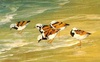
Marine aquarium murals, commissioned by Aberdeenshire Council. Murals depicting the wildlife living in and arround the Moray Firth. Painted in a fairly naturalistic, slightly simplified style, typical of popular visitor attractions of the 1990's.
Maud War Memorial
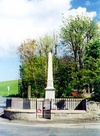
A war memorial in the shape of a four sided obelisk on a pedestal with a relief motif of crossed rifles and laurel wreath. It commemorates the dead of both World War I & II. It has a rectangular base sitting on a two-step plinth.
Mausoleum Of The Frasers Of Park
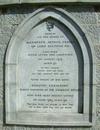
There are two Fraser/Saltoun Mausoleums the old one which is situated adjacent to the Old Parish Church in Saltoun Square, and a more recent ? one which stands by itself in the Kirkton cemetery. They are almost identical in Gothic style, with curious stepped pyramid roofs surmounted by obelisks topped with an egg shape. The older 18th cent one is harled and the more recent is in exposed dressed granite.
Meethill monument - Reform tower Peterhead
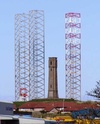
A tall tapering five storey tower, Greek cross in section, with a crenellated parapet corbelled out over the remainder.
In the photograph it is being towered over by an oil rig in the bay ' Galaxy I' estimated at around 100m high since the monument is 58m above sea level. the stone over the door is inscribed; Reform Tower Erected 1832, Renewed by Kenneth Smith Of Meethill 1907
Meldrum Arms and a datestone

Situated above the entrance to Old Meldrum town hall are a polychrome armorial plaque of the 'Meldrum Arms' modelled in high relief and bearing the date 1741 in Roman numerals, immediately below is a datestone also in Roman numerals bearing the date 1877
Memorial to lost lifeboat volunteers
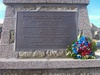
A life-size bronze statue of an RNLI crewman, cast bronze in the style of heroic realism so much favoured for memorials.
Memsie Cairn
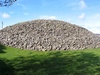
A very well preserved example of a larger round cairn, with no turf covering. Once part of a whole landscape of cairns that have been removed. The information board mentions some of the finds listed below (info from RCAHMS) but at this date it seems unclear where exactly particular artefacts were excavated and how accurate the descriptions of them were. The overall impression however is of a large important sacred site dedicated to funery rites over an extensive period of time.
Methlick war memorial
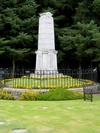
A very large granite ashlar cenotaph, standing on a circular mound surrounded by a low wall topped with iron railings
Midmar Recumbent Stone Circle

The kirk yard contains a recumbent stone circle; This is a landscaped and slightly re-arranged recumbent stone circle, 17.3m in diameter; it consists of the recumbent, two flankers and five others. The two flankers, each c2.5m high (matched and shaped into two enormous canine teeth), flank a massive recumbent 4.5 m long which weighs some 20 tons it has some markings on the top. The present church was built in 1797 when the old church near Midmar was pulled down . The old graveyard continued in use until 1914 when the new one was laid out around the stone circle. It is likely that the ring cairn was tidied away, probably when the graveyard was laid out around the circle in 1914. Very well maintained
The old kirk yard is nearby at NJ 702 059 called the old church of St Nidan or St Nidian's, it has a good collection of gravestones from the 16thC onwards, including that of George Bell, master mason of Midmar & Craigievar castles.
Migvie Class II Pictish Symbol Stone

Class II Pictish Symbol Stone 180 x 70 x 38 cm. A low relief cross composed of coarse double interlace is carved in low relief on the east face from the angles of the arms and the top corners of the cross there are short projections ending in rings, which may represent hanging rings. In each quadrant is a symbol in very low relief. Upper left a small clumsy double disc and z rod, upper right even smaller horseshoe and v rod. To the lower right the remains of a mounted figure and two lower left a pair of shears the only known example of this symbol. On the reverse of the stone is a long haired horseman in low relief. This stone is striking by comparison to most Class II Pictish stones in the amateurishness of its execution. I can imagine a customer who could not come at the price demanded by a professional sculptor and instead commissioned a local handyman who was a bit out of his depth. The rider on the reverse seems much more accomplished perhaps a good stencil?
Millennium Stone
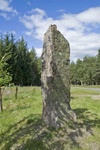
Dedicated on 1st January 2000 with nearly 300 people from local communities of Finzean, Ballogie and Birse in attendance. Anointed with waters from the boundary rivers of the community. The stone came from Craig of Woodend, near the Finzean quarry that was the source of the Birse War Memorial stones, stone donated by the Farquarsons of Finzean estate.
Mintlaw War Memorial

A ring cross war memorial, unsympathetic planners have turned the, lozenge shaped 19th century square, into a large roundabout. A roundabout such as one would expect to find on a town bypass not in the centre of a village. The memorial is isolated in the middle of this roundabout and any close inspection requires a hazardous road crossing.
Montcoffer doocot
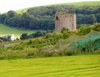
The dovecot at Mount Coffer House is cylinder-shaped. The walls are harled and rest on a plinth. A blocked up narrow slit recess, shaped as a cross at the top and a circle at the bottom, is present on the north and on the south side. The entrance is in the west side. Currently roofless probably late 18thC.
Mormond Hill White Horse
There are many different stories as to the origin of the horse. One is give below. The horse is constructed of quartz on Waughton Hill which is contiguous with Mormond hill (usually the whole prominence is referred to as Mormond). It is 162' long by 126' high. The horse was cleaned in 1937, 1949, 1968 and more recently in 1994. The hill is neither high nor steep but as the surrounding landscape is very flat, much of it peat bog, the hill and the horse are a significant presence in the landscape for some miles around.
Mosaic house no Crovie
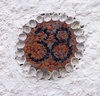
Limpet shells and coloured stones embedded in render to make a mosaic house no, in a village where the no and the name of the village are the entire address.
Mounthooly dovecot
A tall dovecot with chamfered angles forming an octagonal plan. It is built of harl pointed rubble with tooled granite ashlar dressings and margins with heavy boulder footings. It is built in two stages with long elevations on the N, S, E and W with doorway in the west. There is an oval oculus in the E, W and S elevations above a continuous alighting ledge. The wallhead is slightly corbelled and crenallated wallhead with each merlon capped by ball finial (12 in number). The wallhead masks a pyramidal slate roof. Inside the interior is lined full-height with approximately 300 brick nesting boxes with the base of each box constructed of brick slabs. A tall potence ladder still survives although some of the rungs are missing. Dated 1800. It was built by Lord Garden of Gardenstown when he bought the Pitsligo Estate. Each ball finial is said to represent one for each of his 12 Estates.
Myrus Cemetery Gates

Highly ornate wrought iron cemetery gates, bearing winged angels and painted town emblem with rider on horseback, also featured on MacDuff Town Cross and Town Hall.
Mystic Marie

Grave of Mary Walford Henry, or "Mystic Marie" assistant to Walford Bodie ("Dr" Walford Bodie, billed as "Electrical Wizard of the North," a show business personality with national reputation.). Upright dark grey/black polished granite tombstone with carved marble angel figure erected on top, also has portrait bronze plaque in the same style as Bodie Fountain.
The 4th photograph is a contemporary photograph of Marie Henry (Walford was a stage name) for comparison with the bronze.
The 5th shows the cover of some sheet music "The Bodie Hypnotic Waltz" based on "Dr Bodie's" and "Mystic Marie's" stage act. It is a good example of exuberant Victorian/Edwardian graphic design.
N
Neep Chapper Beastie

The original implement used to chop turnips for cattle feed has been given a dramatic new persona with some subtle welded and assembled additions and a paint job.
New Aberdour Millennium Memorial
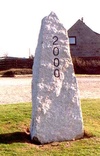
A minimalist monument consisting of a menhir of undressed granite, inscribed with the numerals 2000, recalling the megaliths of prehistory.
New Aberdour War Memorial
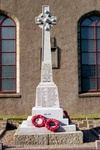
Typical village war memorial in the form of a Celtic cross, in a style that through the 19th cent Celtic revival ultimately derives from the circa 9th cent. crosses of Iona. These in turn draw on manuscript art and Pictish sculpture and metalwork.
New Byth war memorial

New Deer War Memorial
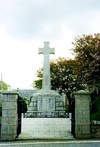
A war memorial of the Celtic Cross type decorated with knotwork on the head only. It has a large angled base of rough-dressed granite into which are set plaques with the names of the dead of both World War I & II.
New Pitsligo Millennium Memorial
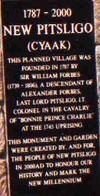
A monument consisting of a simple pillar of dressed granite, topped by a granite pyramid on a pedestal of coursed granite rubble with part dressed corners, in a formal setting of paving and planting with commemorative wooden benches. In the recent past New Pitsligo was noted for its granite quarries, all now closed, and was home to many masons and stonecutters. The form of this monument with its reused stone recalls this aspect of local history.
The inscription reads:
"1787 - 2000
NEW PITSLIGO (CYAAK)
This planned village was founded in 1787 by Sir William Forbes (1739-1806) descendant of Alexander Forbes last Lord Pitsligo, Lt Colonel in the cavalry of 'Bonnie Prince Charlie' at the 1745 uprising.
This monument and garden were created by, and for the people of New Pitsligo in 2000 A.D. to honour our history and mark the new millennium."
New Pitsligo War Memorial
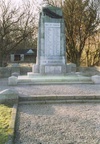
A village war memorial of cenotaph type constructed from granite ashlar blocks with appliqued bronze palm leaf and etc. The village and town war memorials of Scotland have distressingly long lists of remembered dead in proportion to the populations of the communities.
Newmachar War Memorial
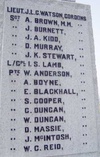
It commemorates the dead of both World War I & II. It is a tall, rectangular, slightly tapering, plain cross, with an inner solid ring making it somewhat intermediate between Celtic/Roman, standing on a slightly tapering rectangular base, with the inscriptions on each face of the base. The base in turn sits on a three-step plinth of roughly hewn granite. Within a circle, in the centre of the crosshead on either side, are the dates of the two world wars. It is surrounded by an iron fence.
Newstead, farm sign Cuminestown

An elegant sheet metal cut out sign. The image while at first appearing to be simply an icon of the farm's livestock has an element of dark comic narrative, the tiny chick is threatened by an omnivorous and greedy sow, it is unaware of its possible impending doom while the mother hen leads it to shelter beneath the indifferent cow maybe escaping one gruesome end to suffer another.
North Sea first air crossing memorial

A small monolith of pink Peterhead granite set upright on a rotunda of masonry itself set on a pavement of irregular slabs all in rough Peterhead granite, a bronze plaque has this inscription "From the sands of Cruden Bay on the 30th July 1914 the Norwegian Aviator Kommander Tryggve Gran D.F.C made the first crossing of the North Sea by air."
Underneath in smaller letters "RGC"
O
Old Meldrum Sailor
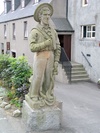
Near life size stone statue of a sailor in period costume holding a pipe in one hand and an anchor in the other.
Old Meldrum War Memorial

A kilted soldier type, light coloured stone war memorial almost identical to the one at Portsoy except for this one having a smooth dressed pediment. It commemorates the dead of both World War I & II. It is rectangular with a splayed base standing on a two-stepped plinth. It is surmounted with the statue of a kilted soldier with a Glengary bonnet, standing head bowed and holding an inverted rifle.
One of a Pair of Female Sphinxes on the Gate Piers
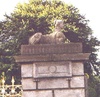
Cairness House is an important work by James Playfair the gate piers and sphinxes were added to mark the centenary of its building.
Otter sculpture Ellon
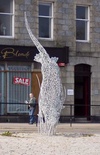
A 3.6 metre high steel otter in the town of Ellon, which celebrates the environmental regeneration of the River Ythan.
P
Patrick Gordons Cairn
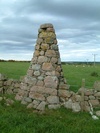
An elegant elongated cone shaped cairn with in-curved sides in coursed dry stone, without any interpretative sign. It is on the lands of Auchleuchries that Patrick Gordon belonged to.
Peterhead Pends
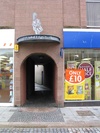
As part of an attempt to regenerate the area and preserve the historic associations of the pends and closes running back from the street they were given these canopies with cut metal signs,
1: Smithy Close: named after a smiddy that was there in the 19th and early 20th century, the canopy depicts a Clydesdale horse and a representation of show harness is inset into the close threshold stone.
In the comparatively short period of its ascendancy, between the period of the ox plough and the tractor, the horse had a huge impact on local culture (reaching its apotheosis in the magico/religious elements of the "Horseman's Word" secret societies) and still exerts an influence although it has gone from most people's everyday life.
2: Proclamation Pend: Shortly after the beginning of the 1715 Jacobite Rebellion, George Keith, 9th Earl Marischal of Scotland, read out a proclamation, at the nearby Peterhead Tolbooth, stating that James Stuart (father of Bonnie Prince Charlie), was the rightful King of Britain. The Earl was accompanied by his younger brother James Keith, later to become a field marshal in Frederick the Great's Prussian army.
James Stuart landed at Peterhead from France on the 22nd of December 1715 and stayed overnight before proceeding South. He returned to France in February 1716 after the failure of the rising.
The canopy shows three figures at the reading of the proclamation and the Keith clan crest is inset into the threshold.
3: Tolbooth Close: named after the Tolbooth which was nearby on the site of the present Townhouse. The Tolbooth was the centre of administration, justice and ceremonial life, where tolls and customs were collected. It was also used for meetings of the burgh council and court and as a prison for remanded criminal suspects and debtors.The original Peterhead Tolbooth was erected in the Longate toward the end of the 16th century, a new one was built in the Broadgate in the 1660s, this was demolished in 1786 and the present Townhouse erected in 1788. The canopy shows a prisoner behind bars and a representation of a James VI eight penny peice is inset into the threshold.
4: Empress Close: named after the Empress Ballroom which occupied the ground floor of the Music Hall that once stood here, the canopy shows a dancing couple, dance step patterns are inset into the threshold.
5: Drummer's Close: named after Drummer's Corner which was situated at the other side of Marischal Street. Woollen mill worker James Milne was an army drummer in the Crimean War (1853-56) he returned to Peterhead and kept a small shop, at the corner of Marischal Street and Albion Street, as well as being the town drummer, his premises became known as 'Drummer's Corner', the canopy shows a drummer with a series of pipe band drummers inset into the threshold.
Peterhead video piece
The artist (Dutch film maker, Jean Bei Ning) filmed local residents walking in front of a mobile blue screen. This footage was then mounted into slides showing landmarks in Tibet, Africa, Scotland, Thailand, Syria and Indonesia. This created the effect that local people were travelling in 'other worlds'. The artist also produced a sound piece located elsewhere in the town consisting of stories recorded in interviews with local people.
Peterhead War Memorial
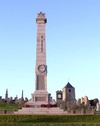
It is a tall rectangular obilisk with an unusual decorated top. The name plaques are near the base of the sides within egg & dart borders, each surmounted by a wreath. Above the wreath on one face is a cross. The obilisk stands on a slightly splayed base on top of a three-step base. It was unveiled 6 August 1922 and handed over to the Town Council on August 6 1923. The World War II memorial forms the gate piers in to the churchyard. They are squat rectangular pillars with the coats-of-arms of the different services and regiments as well as the names. Inside the churchyard is another memorial to the men buried in the churchyard and three other war graves.
Peterhead, Late Victorian Datestone
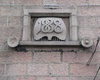
One of several ornate carved 19th century datestones on buildings in the town centre. The pink Peterhead granite is the towns signature material. The metal spikes are an attempt to limit nesting places for the Herring Gulls that throng this fishing port in huge numbers.
Prop of Ythsie
A bit of an ugly and intimidating monument to the hereditary principle and the divine right of the aristocracy/rich to rule the rest of us for their own advantage, however it is worth the climb up both the hill and the stairs for the view toward Bennachie. Erected to the memory of the Prime Minister the Fourth Earl of Aberdeen. A square tower of coursed red granite with dressed quoins and a corbelled and crenellated parapet. The lower stage is steeply battered. SMR
Puffin carving

R
Reform Monument
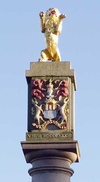
Monument; erected in 1833 , it was erected by local ‘Tories’ (Conservatives) on the site of the market cross to celebrate Parliamentary reform. A Roman Doric column surmounted by the arms of the Earl Marischal with a lion above; this coat of arms was originally in a gateway to Inverugie castle, recently restored.
Rhynie 5

A class I Pictish stone made of gabbro showing a 'double disc and z rod symbol' with a symbol variously interpreted as a dog's head or as a mask made from the skin of a hind, accompanied by the mirror and comb regarded as a qualifying symbol. As with all Pictish Symbol stones dating is somewhat contentious. There are cup marks on the back of the stone suggesting Pictish re-use of a stone made significant in the Neolithic. Two other fragmentery stones, Rhynie 6 and 8, are at the same location. In all 8 symbol stones are known from Rhynie (suggesting a site of major importance) including the 'Rhynie Man' carving 7. Rhynie 4 has been broken up and lost, Rhynie 1 'The Craw Stane' is in situ 2 and 3 stand in the village sqare but their carving is now illegible to the human eye.
Rhynie 6

A fragment of a class I Pictish stone made of pink granite the very bottom of a vertical double disc and Z rod can just be seen above a plain crescent and V rod and a mirror. Two other stones, Rhynie 5 and the fragmentery 8, are at the same location. In all 8 symbol stones are known from Rhynie (suggesting a site of major importance) including the 'Rhynie Man' carving 7. Rhynie 4 has been broken up and lost, Rhynie 1 'The Craw Stane' is in situ 2 and 3 stand in the village sqare but their carving is now illegible to the human eye.
Rhynie War Memorial

The granite war memorial stands in the middle of the square at Rhynie. It is rectangular in shape surmounted by a statute of a soldier standing on a stepped plinth. He is wearing a great coat and peeked cap, standing with bowed head and holding an inverted rifle. In front of the memorial is another plaque with the names of those killed in World War II. The memorial is surrounded by a wrought iron fence. Unveiled May 30th 1920.
RNLBI building and carved stones Deveron Bridge
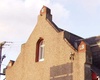
Painted decorative carved house shaped stones on the points of the gable wall, the central stone is a datestone while the other 2 have the letters RN (left) LBI (right).
Rob Roy Statue, The Mannie on the Rock, Peterculter
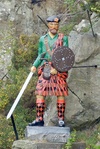
A polychrome carved wood statue in a folk style depicting the popular archetype of the 18th century highland warrior. In tartan plaid armed with broadsword, pistol and targe. Romantically situated on a rock in the side of the burn's gorge.
Rothiebrisbane Symbol Stone

Fyvie Parish Church is at the east end of Fyvie, on the south side of the B9005. Set in the east wall of the church are three worn Pictish class I symbol stones, all have been trimmed.
The Rothiebrisbane stone was found in use as a drain cover on the road (now the B992) running south from Kirkton of Auchterless. The nearest to complete of the 3 stones at Fyvie. On it is a 'horseshoe symbol' over a 'disc symbol'.
Fyvie Church also contains important stained glass by L. C. Tiffany. South-east of the church in a railed enclosure, marked by an obelisk is the old tombstone of "Mill of Tifty's Annie" (1673), subject of the eponymous ballad.
S
Saint Drostans Well
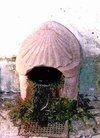
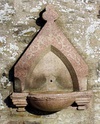
A Victorian pink granite basin and cover carved with a scallop shell motif, for a spring traditionally associated with the dark age St Drostan who is supposed to have landed on this beach before evangelising the Buchan area in Pictish times.
Salmon Above The Flood , Don-Ury Ury-Don

A Stainless Steel sculpture designed by Alison Simpson celebrating the town created on the confluence of the rivers Don and Ury. The salmon symbol evokes the Pictish symbol that is extant in sculptures still apparent in the local environment and thus the continuity of the settlement's cultural heritage.
Saltoun Fountain
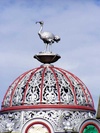
An Ornate cast iron fountain topped by an ostrich which is part of the town's crest.
SANDS headstone

Headstone erected by local branch of SANDS organisation (SANDS Stillbirth And Neonatal Death Society) and set in a small garden of remembrance, in memory of local children who died at birth or in infancy. Polished grey granite stone engraved with baby cradled in a hand.
Sandstone carving Municipal Building Turriff

A small sandstone carved figure holding a scroll. The seated pose with scroll in both hands and the outfit, naked except for a kilt/sarong type garment is similiar to a carving at Delgatie Castle (see related artefacts link 'Mannie' below)
Savoch War Memorial

The Savoch war memorial stands in the churchyard of Savoch church, to the southeast of the building. It is rectangular pink granite standing on a two-step base and surmounted by a tall tapering rectangular 20ft obelisk. It commemorates the dead of both World War I & II.
Seagulls sculpture Fraserburgh
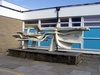
A reinforced concrete sculpture of seagulls/waves, quite appropriately for Fraserburgh. It was designed and made by Sydney James Burnett in the ? late sixties and won a Saltire Award in 1972. Sydney at the time was head of Gray's School of Art (Aberdeen) Sculpture Department.
Sydney Burnett was born locally and his father was an Art Teacher at the Fraserburgh Academy.
Serene Granite head
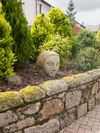
A much larger than life size carving of a head in granite that is strongly reminiscent of ancient Greco-Buddhist art of Northern India particularly the 1st -2nd century Buddha heads of Gandhara (a kingdom in what is now part of Pakistan and Afghanistan). These in turn owing their iconography to ancient Greek representations of Apollo.
Snakeswell Stone

Carved granite marker with the fascinating wording: "The worm of the still is the deadliest snake on the hill" and a reference to whisky distilling that took place in this area of the and gave its name to a place called Snakeswell. Built by Sir William Cunliffe Brooks, Laird of Glentanar who died in 1900.
Snakeswell: noted as a Spring on the OS 1:10,000 map of 1972, Within a semi-circular drystone-walled compound, there are a spring and a stone which bears this inscription. There are several other inscribed stones on the estate many at the sites of springs/wells.
SS Vigilant memorial

A stone cairn with a mortared top surmounted by a piece of marine scrap and an inscribed granite plaque, the inscription reads "TO COMMEMORATE THE BRAVERY OF THE MEN AND WOMEN OF CROVIE, GARDENSTOWN AND THE PARISH OF GAMRIE WHO ON FEBRUARY THE 11TH 1906 RESCUED THE CREW OF THE SS VIGILANT WHICH DURING A VIOLENT STORM RAN AGROUND ON THIS SHORE. ERECTED BY THE CROVIE PRESERVATION SOCIETY 2006"
St Colms well

Granite boulder marking the well, inscribed with the words "well beloved" and a cross in concentric circles. The well marks the boundary of the parish of Birse to the south. The laird of Glen Tanar Sir William Cuncliffe Brooks, Laird of Glen tanar who
died in 1900, had the words "well beloved" inscribed on the stone in the 19th century. There are many beautifully inscribed stones on the Glen Tanar estate, particularly at springs and wells, some poetic and some enigmatic in sentiment.
ST ERCHARDS WELL (new)
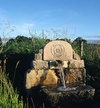
Well; The original -St Yarchard's Well- is a covered spring of which there is no trace. The water was piped to a public fountain, 400yds to the SW (NO 592 997), which is built of masonry, surmounted by a small iron cross; built in the mid-19thC. it no longer functions. (see related artefact). This new well with continuous running water has been built to the east side of the road, opposite the original site; it is named St Erchard's Well.
ST ERCHARDS WELL (old)

Spelt “St Erchan” in inscription and dated 1858 but recently restored by Alastair Urquhart in 1997. Square masonry housing for fountain with iron lion mask spout and iron finial. The original -St Yarchard's Well- is a covered spring of which there is no trace. The water was piped to this public fountain, 400yds to the SW, which is built of masonry, surmounted by a small iron cross; built in the mid-19thC. it no longer functions. A new well with continuous running water has been built to the east side of the road, opposite the original site; at NO 595 997 it is named St Erchard's Well. (see related artefact)
St Lesmos Church (new)

Church; 19thC; built over the ruins of the little mansion of the Lairds of Braeloine. The west extension of the church incorporates an arch and to the north a small bell-tower from this 17th C building. Still in use as a church. To the south of it a small farmstead called Braeloine, consisting of three buildings, is depicted on the OS map of 1867 but not on the 1888 edition.
St Meddans, Medieval Gravestone
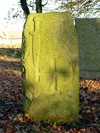
Gravestone in abandoned churchyard made of crude slab of grey granite
about 3 feet high by 1'6" wide incised with a Greek cross and with a relief of a sword or dagger. An early memorial aimed at a non-literate audience.
St Peter’s Fraserburgh Episcopal Church plaque
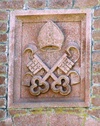
A deep relief carved red granite plaque showing the attributes of St. Peter (crossed keys and mitre) in ecclesiastical heraldry.
St. Meddans, Sacramental Recess
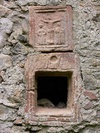
The sacramental recess for the communion cup in the ruin of St Meddans Church, Carved relief calvary in dark pink granite c. 15th century, showing the crucifixion with 2 Saints?
Statue of Marshall Keith
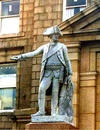
1869. August 16th Marshal Keith monument unveiled by the Earl of Kintore.
Marshal Keith (James Francis Edward Keith) was born at the family home, Inverugie Castle, near Peterhead in 1696. A professional soldier, he was forced into exile for his activities on behalf of the Stuart pretender to the throne (1715 and 1719). It must be remembered that the Old Pretender, James, chose Peterhead as his secret port of arrival when he came home to Scotland to raise an army in December, 1715. James Keith went on to serve Frederick II as Field-Marshal in the Prussian army and after a distinguished career, was killed at the Battle of Hochkirken in 1758. The statue, which stands outside the Old Town House in Peterhead's Broadgate, was a gift to the town from King William I of Prussia, a copy of the original which stood in Berlin. James' older brother, George, was the last of the Keiths to bear the title Earl Marischal. The title originated when Malcolm II knighted Robert Keith and created him hereditary Grand Marischal of Scotland after Robert defeated the Danish army under Camus in the early years of the eleventh century. This high office continued through the family until 1715.
The Keiths were Jacobites who, like many others who shared their loyalties, had their land confiscated by the Crown when the Jacobite cause was lost.
Stephen Healy & Sperm Whale
Glasgow based Stephen came to an outsider’s conclusion, based on the architectural layout and history of Peterhead that he had observed, that “Peterhead is and has always probably been an unpretentious working class community. Taking into account the town's social and economical history and its reliance and existence on the fishing industry, there seems to be a functional no nonsense attitude when it comes to the towns general look." He also noted a lack of any decadence with the town’s character, in the form of frills, “aesthetics for aesthetic sake”. His intervention aimed to address some of these issues that the granite town portrays.
His artwork, an animated neon light depicting a sperm whale in motion, introduced a suggestion of colour to the granite town. Neon light was chosen because of its cultural use in other British coastal towns, notably Blackpool’s illuminations. Presented in the style of a 3ft by 2ft boxed exterior shop feature and located outside a traditional local fishmonger's, the whale quietly pulsated, attracting attention and curiosity to the location. The whale is a reminder to the inhabitants of the town that their
forefathers, on regular expeditions to Greenland, would have witnessed these magnificent creatures in the last true wilderness of the planet; a natural phenomena which only a few of us are likely to see in our life times.
Stone Placement
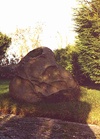
An intentional relocation and placement of a natural stone for aesthetic reason. An act that draws on oriental (Zen) precedent as well as the examples of our neolithic forbears so noticeable in the local environment.
Strichen Recumbent Stone Circle also known as Strichen House Stone Circle
An atmospheric, restored, Buchan recumbent stone circle 13.5 meteres in diameter. The site has good views to the North-East of Mormond and Waughton Hill, and the White Horse, also overlooks the ruins of Strichen House. Currently (2005) a little overgrown with gorse
Strichen Roadside spring
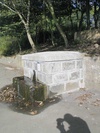
A spring flowing into a granite trough in what was once an elegant architectural setting with a curved backing wall flanked by fluted carved stone columns surmounted with carved balls. This fountain like so much of Aberdeenshire's public built environment has been rather spoiled by a disastrous combination of un-sympathetic 'restoration/stabilisation', neglect and the megalomania of the roads department. We make getting by car from A to B such a priority that we risk destroying any good reason to go, except of course pointless working and shopping which is the only reason for our existence in the minds of our leaders. The purpose of the new ashlar housing seems to be to display an ugly sign to tell us this is not drinking water. When did it cease to be and why?
Strichen war memorial
Strichen war memorial is a tall six-sided column surmounted by a decorated cross on a foliated plinth. It stands on a six-sided solid base in a two-step base. It commemorates the dead from both world War I & II. It was unveiled on August 25, 1920.
Stuartfield Bell
A combined seat, weather vane and bell mount, set on a cobble stone circle. The main frame in green painted tubular steel supports at its base a circular wooden seat and at its apex a bell surmounted by a weather vane in the shape of a swan.
The concept is from accounts of the (then new) village in 18th century "A bell mounted on a pole at The Square was rung three times a day to regulate the working life of the village".
Sundial Castle Fraser

Sunhoney Recumbent Stone Circle

The monument is very well preserved recumbent stone circle, 25m - 26.7 in diameter, lying in an area bounded by a 19th-century plantation wall. The circle comprises 11 standing stones and the recumbent. The recumbent and one of the uprights bear cupmarks. Within the circle is a raised platform measuring some 7m across, probably the remains of a ring cairn. The circle is on a hilltop surrounded by trees above Sunhoney farm.
The unusualy large, 5.3 m long grey granite recumbent stone has fallen inwards. On its (currently) upper surface, originally the stone's outer face are over thirty cup marks (some sources give 7 as now visible) . Its colour contrasts stongly with the red rock (granite and gneiss) of the other stones in the circle. The tall stones flanking the recumbent stone are about six and a half and seven and a half feet tall.
Sustrans Way Marker

A "Sustrans" bicycle route way marker on the route of the Buchan Way that follows the disused railway route.
T
Tank trap with world war II graffiti

A square concrete block of the kind that once covered much of the coasts of Britain and Europe, with carved graffiti. Blocks of concrete such as this still stretch all the way from Aberdeen to the mouth of the River Ythan at Newburgh. There are also extant examples on more northerly Aberdeenshire beaches that could have been used for landing. Built in 1940 they were designed to prevent tanks landing during the feared Nazi invasion. Some have simple graffiti on them but this one was richly decorated by Louis Lawson. There is a caricature of Churchill who is watching Hitler looking upwards at a bomb falling from the sky. At the bottom there is the chilling message "Hitler's Graveyard".
Tarlair and environs

Tarlair – Art Deco outdoor swimming pool and boating pond opened in the 1930’s, it was once very popular with tourists, now falling into disrepair, no swimming allowed any more, disused since 1995, currently only used by model boat owners. Classified ‘A’ listed in 2007 by Historic Scotland.
John C Miller (Macduff Burgh Surveyor) 1930-31 with minor later alterations. Art Deco tidal swimming pool, boating pool and paddling pool surrounded by curved walkways, with associated tea pavilion at head of boating pool and changing rooms and kiosks to side. Concrete pools and buildings.
BOATING POOL, SWIMMING POOL AND PADDLING POOL: D-plan boating pool bounded by 3 broad walkways swept round from tea pavilion at head of pool; shallow steps cut into walkways at regular intervals; ramp for boats to E of tea pavilion. Rectangular paddling pool with curved corners enclosing natural rocky outcrop within the boating pool and directly in front of tea pavilion. Rectangular swimming pool to N (sea side) of boating pool with changing rooms at W end; continuation of lower walkway divides boating pool from swimming pool; middle walkway continued round to E end of pool.
TEA PAVILION: single storey, break-fronted rectangular-plan, flat-roofed Art Deco tea pavilion with 3-bay colonnade between taller end pavilions; steps at outer bays leading to roof terrace; simple horizontal railings to roof. Later 2-bay addition to W. Doors and windows boarded up (2006).
CHANGING ROOMS: low, flat-roofed group of 4 linked blocks with slightly advanced outer bays. Strip windows at eaves level (boarded up, 2006).
KIOSKS AND FENCE: probably early 1950s. 2 1-bay, roughly square-plan kiosks at pool entrance. Curved concrete fence with perforated top extends towards tea pavilion.
Tarlair Well – Tarlair Well a chalybeate spring east of Macduff was discovered in 1770 and ten year later in 1780 the Earl of Fife built the ‘Well House’ and the croft. The well was once renowned for its medicinal properties and was very popular for the ‘taking of the waters’ in the 19th century. The well ceased to flow after a German mine exploded when it came ashore in ‘World War Two’. Local drinks manufacturer Sangs traced the source of the well and are said to make all their drink products with this water. The well-house remains although in poor condition, nothing remains of the croft. The well house is category C listed.
Later 18th-early 19th century. Small rectangular rubble wellhouse with later harling. Blocked entrances in E and W gables. Small soak-away vent in base of N elevation. Piended bellcast concrete roof, probably replacing earlier stone slab covering.
INTERIOR: vaulted rubble interior; dished stone gutter runs through centre; rough stone benches against W wall.
A cottage/crofthouse once stood nearbye but during WW2 the same mine which came a shore destroyed it.
The Crazy Frog (Face in the rocks)
A natural face in the rocks which has had its mouth eyes and nostrils added to bring it out.
Painted in 2007.
Cleaved Head, Macduff – Site of a promontory fort, typical in type of the iron age, a scheduled ancient monument, two ditches and traces of a third are evident. The construction of a golf course (Tarlair Royal Golf Club) has altered the landscape around the ditches, but the easternmost ditch is still the best preserved, having a scarp 1.5m high and a counterscarp 0.5m high; no evidence of fortification was seen on the flattish top of the promontory . Grid ref NJ 721 647. Spectacular views of the rugged coastline eastward to Troup Head can be had from here.
Tarves War Memorial

It is in the form of a celtic cross, with interlacing decoration, surmounting a squat angled rectangular base which bears the names of the dead from World War I. It sits on a two-step base, the upper step of which bears the names of the dead from World War II.
Temple of Venus

Belvedere in the form of domed arcaded rotunda. Modern harl. 6 round headed keystone arches rising from a continuous plinth. Domed roof capped by a small ball finial. Built for the Earl of Fife on a hill over-looking Duff House, the Earl's folly once housed a statue of the goddess Venus. Built by the Earls of Fife to improve the skyline.
The 1592 Ceiling, Delgatie

This ceiling is decorated on the beams only, mostly with a long inscription on the sides, with decorative work on the underside.
The 1597 Ceiling, Delgatie
One of the most important surviving 16th century painted ceilings in Scotland The iconography has interesting comparisons to the much earlier Aberdeen Bestiary and even earlier Pictish sculpture.
The 1800 Laundry, Delgatie

A curiously and ornately decorated small cottage. With ogee window arches, gothic finials at the ends of the gables and a motif of ox yokes.
The Broad Milestone - The Brade Milstane
A milestone in granite unusually wide for its height and most unlike the standard turnpike stones of the area, it perhaps pre-dates them? Included in part for its cultural importance, to the confusion of recent residents and travellers it is still very much a reference point for giving directions. Even when it has not actually been in situ. It has recently been reinstated and concreted in after road-works and the staining on the stone shows the previous ground level that made it very unlikely to be seen from a car. Inscription reads Fraserburgh 10 3/4
The Craw Stane (Rhynie 1)

Class I Pictish symbol stone. The stone faces south it is a large stone 180cm by 102cm by 43cm. It has near the top a large Salmon symbol above a Pictish beast. It stands at one side of the inner entrance to an almost imperceptable (but clear in ariel photgraphs of crop marks) multi-vallate circular enclosure crowning the end of a low spur. It could possibly have been a structural feature re-used in situ as a symbol stone.
The Eternal Present
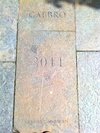
A sculpture consisting of three large spheres of granite, gneiss and gabbro; sourced from Aberdeenshire quarries. Carved in designs based on the enigmatic neolithic stone balls known as 'petrospheres' that are estimated to have been produced between 5,000 and 2,000 B. C. These neolithic objects, of hand holding size, and of unknown function are peculiar to Scotland (except for 1 Irish and 4 Northern English finds) and have been found in considerable number particularly in the North-east, currently 425 known . They are decorated with varied numbers of knobs or more precisely convex discs anything from 3 to 160. Perhaps the best known because one of the most highly decorated is the Towie Ball. See external link to NMS
The False Doocote, Delgatie detail
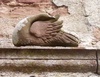
The Faux Doocote, Delgatie
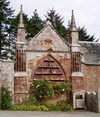
The folding of the land

OS ref is approximate. A serpentine arrangement of lengths of round timber set upright in the ground. Each post is branded with a letter on the top so that the whole piece spells out the aphorism "The folding of the land is the unfolding of the way"
The Port Arch, Port Elphinstone

The two arches of this bronze symbolise the bridges over the River Don and the Aberdeenshire Canal since it is because of these that Port Elphinstone (that part of the settlement on the South bank of the Don) came into being. The plinth section represents standing stones, The spaces between the three sections of the granite base represent the river and the canal. The symbols in the top surface were designed and executed together with children from Port Elphinstone school and represent episodes from the history of the town.
The Raven Stone
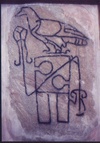
A class one Pictish stone showing the Sea Eagle and notched rectangle with z rod symbols the black infill is recent. As with all Pictish Symbol stones dating is somewhat contentious. The name 'The Raven Stone' probably originated as the result of a mistaken association of the stone and a nearby burial mound (in the manse garden) by the antiquarians of the past with Danish invaders.
The Wine Tower
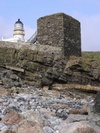
The oldest building in Fraserburgh, probably named from a past use as a wine cellar or possibly a corruption of "wynd tower".
Its original purpose is still the subject of some academic debate. It is roughly built of rubble with three vaulted storeys, the centre reached by a hatch from the uppermost. This first floor level is lit only by one small window in the E wall. The original entrance is at second floor level and had been reached by a ladder or moveable stair, arriving at a landing supported by two stone corbels which are still extant. The outer doorway admits to a small vestibule which is closed by an inner door beneath which is the hatch to the two lower levels. The upper chamber has a window in each of its four walls and has a remarkable series of finely carved heraldic pendant bosses, three in the main vault and one in each of the four arched window soffits. Bryce suggests that this upper chamber was designed to serve as a Roman Catholic chapel. The fact that this chamber was raised, concealed, semi-defended and provided with two -secret- chambers below, points to the true date of this enigmatic structure as belonging to the period of the Reformation in Scotland. from SMR
Tillylodge viewpoint indicator
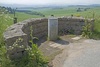
Offers spectacular views over the River Dee Valley and known as the Queen’s View with claims that Queen Victoria stopped to admire the vista to the distant Mountain of Lochnagar. The Indicator was erected in 1970 by the Deeside Field Club to mark its Jubilee.
Tolquhon Tomb and 17th/16th - century tombstones
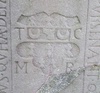
The Tolquhon Monument, built by Thomas Leper in 1589, of a chocolate- coloured sandstone, to commemorate William Forbes of
Tolquhon (perhaps to Forbes' design) and his wife Elizabeth Gordon, is supposed to be the relic of the S. aisle of the old kirk. Rich arched altar tomb mixed gothic and Renaissance motifs inspired by Dunbar tomb at St. Machar's, Cathedral.
It is somehow very Scottish in style.
Present pedimented setting probably of 1798. The monument is housed in a classical surround believed to be of 1798 in date, though a large porch has been erected by Historic Scotland consisting of sheets of perspex with bronze structural supports. The tombstone is remarkably well preserved with its representative figures, though the structure preserving it rather resembles a domestic green house.
Coats of arms as shown for William is 'Forbes quartered with Preston' and shown for his wife is 'Forbes impaled with Gordon'.
The charges on the shields show, heads of boars, unicorns and muzzled bears. The unicorns appear again at the top of the arch either side of the crown flanked by hounds hunting on the right a deer and on the left another animal I cannot definitely identify (perhaps a fox or martin).
Tomb of George Baird of Auchmeddan, Old Aberdour
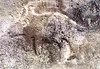
Tomnaverie (Tarland) Stone Circle

The recumbent stone circle is a form unique to North East Scotland.
This site was in a ruinous condition as a result of instabilities caused by an adjacent quarry but was restored and excavated in 2000.
The recumbent and its flankers are situated at the South West of the circles and often appears to have been carefully levelled. It has been speculated that they provided artificial horizons for the observation of the moon and other astronomical bodies.
Of 175 Aberdeenshire circles recorded as existing in 1911, only about 74 remain. A fact that is a depressing testimony to the 20th century's attitudes.
The photographs were taken shortly after an extensive excavation and restoration of the site, this is the reason for the bare earth.
An interactive map of all British stone circles and links to other pages relating to stone circles can be found at www.megalith.ukf.net/
Turra Coo
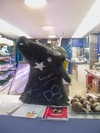
A life size bronze cow decorated with cast garlands and a rope halter, behind the cow is a series of cast cow footprints. On the right flank in slightly raised and differently coloured metal representing the painted lettering on the historical "Turra Coo" at her return, are the words "FREE !! DIVN'T YE WISH THAT YE WERE ME". The sculpture was created by a casting process from an actual cow's body. The historical coo was an Ayrshire cross Shorthorn, no suitable cow of that variety could be obtained so the animal used, a Jersey-Blonde cross, was picked as similar looking to photographs of the original beast. Also illustrated are examples of the "Coo Heads" created by Turriff Academy pupils during the education package associated with the sculpture project and exhibited in the town shops during the month of the unveiling.
Turriff Mercat Cross

The present 20 foot high cross was erected in 1865 and is made from red sandstone like most of the town. Octagonal pillar rises from a Gothic style base by James Duncan with sculptures by Thomas Goodwillie
U
Unicorn, Delgatie

A pair of stone unicorns gaurding the main entrance of the castle. The late Captain Hay of Delgatie was an inveterate collector and the castle has many decorative elements that are now difficult to attribute to exact dates and provenances.
W
W. A. & S. Higgins sign

W A & S Higgins Agricultural Engineers; an unusual sign, an old farming implement (a wheel driven potato or turnip lifter), painted welded to a frame with a new sheet metal sign on the top.
W. Bruces ship painters shed
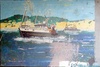
There is a tradition in this area of ship painters using the exterior of their premises try their colours and clean their brushes etc. This results in heavily textured and intense abstract expressionist works of an impressive scale. Some might argue that they lack sufficient intentionallity to be considered art works but they are definitely intended to be seen.
W. Bruce's shed has developed a degree of impasto that makes it almost sculptural with sections reminiscent of Anish Kapoor's early pieces, this is contrasted with a naive figurative painting on the door of a trawler in front of the nearby dunes.
Walking Way
Fraserburgh’s former rail links have inspired a unique pathway with sculptural structures that connect the town to its seafront.
The 'Walking Way' is the creation of Scottish artist Jane Kelly. The winding pedestrian pathway of cast white concrete was laid late summer 2007. It covers an area from the grassy Links beside the town’s Leisure Centre car park, to the crossing at South Harbour Road. The shape has been influenced by the town’s former rail routes.
Eye-catching oak and steel structures have been used as points of interest to attract folk to the new-look public space. A seated area of timbers, inspired by railway sleepers, have been introduced to take advantage of magnificent views looking out across the sweep of the bay. Soft landscaping featuring white wild flowers, silver birch and wild cherry trees have been planted to either side of the pathway.
The Walking Way is the second of two artist-led interventions in the north east harbour town that have been designed to enhance the pedestrian route between the town centre and its waterfront. Work by landscape artist Julia Barton to brighten up the main shopping area was implemented in early summer 2007.
Funding for the Walking Way project was secured by Aberdeenshire Towns Partnership through the EU RevitHar programme (Revitalisation of Harbour Towns) and was supported by Fraserburgh Futures Partnership and Aberdeenshire Council.
War Memorial Stained Glass Window

Two stained glass windows dedicated to the Glory of God and in memory of the men of the congregation who lost their lives in the First World War 1914-1919. The window on the east side of the pulpit is based on the text "This is the victory that overcometh the world, even our faith," 1 John v., 4. The window on the west side is known as the Children's Window, the theme of this window is the text "Suffer little children to come to unto me, and forbid them not, for such is the Kingdom of Heaven." The Children's window is an especially fine piece of work and had the distinction of being shown in the Royal Academy, London, prior to its installation. Windows signed CW or WC in monogram form.
Wrought Iron Sunflower
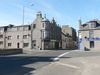
Y
Ythan View Sign Methlick

A fairly conventional sign (with a nod to a more English idiom), somewhat weathered, shows the silhouette of a fly fisherman fishing in the River Ythan, with a view of the nearby bridge.
This content was submitted by external contributors and does not necessarily reflect the views of the University of Aberdeen.