
A
Ardlui gate
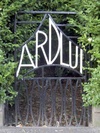
Possibly made by Emil Rzechorzek, a steel gate and house sign combined that although of a later period perfectly attunes with the 'art deco' style of which the town has such fine surviving examples.
Arnage Home Farm sign

A fairly recent addition to the regions collection of cut metal signs showing the current favourite iconography of a man with a pair of horse and a plough. Behind is an older primitive painted board sign now almost illegible.
Asleid 1
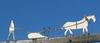
Asleid 2

A cut sheet metal sign by the same artist as Asleid 1, on another entrance to the farm this time illustrating a horseman with a box cart.
Asleid 3
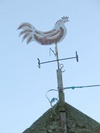
A sheet metal painted weather vane created by the brother of G Christie who made the related farm signs.
B
Beachgate House Sign

Painted Wooden Bed and Breakfast sign incorporating the Scottish Tourist Board ranking sign, sign is topped with a silhouette of a trawler called Helene.
Boot Detail
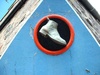
Boot sitting in a triangular, flattened, brightly painted corner of the house at Reidhaven Street, Whitehills. Looks to be cast from an actual boot and set into cement work. Former souter's (cobbler's) workshop
Bulls Head Gate Ornament
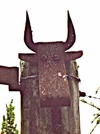
An assemblage by welding of old agricultural scrap. Although somewhat reminiscent of Pablo Picasso's treatment of the same subject using a bicycle saddle and handlebars, the different components create a more agrarian bull.
C
Coldwells Sign

A wonderful cut steel sign of a Clydesdale Horse in working harness, the harness detail suggests a working horseman's intimate knowledge, this plus the style and overall condition suggest it is of considerable age.
Cowie Mill, decorations

Original Mill; was 18th-19thC; remodelled 1920 a 2-storey and attic 11 bay main block, with a 3-storey block and a large pyramidal-roofed kiln at rear. The kiln vent is hexagonal, with revolving cap. The central low breast wheel has been removed and the lade destroyed; was recently derelict, though workings part remained. Then was converted in the late 1990's into flats. Various old wheels and gears have been used to 'decorate' the grounds as well as the pig on the kiln vent.
Crathes Castle, sundial, heraldic panels, weather vanes, doocot etc
Crathes is particularly known for its ceiling paintings. Photography is not allowed in the castle but there are excellent photographs in the RCAHMS "canmore" database see: http://canmore.rcahms.gov.uk/en/site/36693/digital_images/crathes+castle/ .
Castle; an L-plan tower-house built in the mid-16thC with a later projecting wing. It is built of granite with rounded angles and rises to four storeys and an attic. The lower storeys are plain but above the first-floor level there is a profusion of corbelling, stringcourse, angle- and stair-turrets, heraldic decoration, gargoyles, and gabling which are unique to Scottish castellated architecture. The entrance, in the re-entrant angle is protected by an iron yett. The interior is famed for its plaster & magnificent wooden painted ceilings. The castle was built for the Burnetts of Leys who received the charter for the land from Robert the Bruce in 1323. Within the castle is a jewelled ivory horn, the Horn of Leys, which is said to have been presented to Alexander Burnett by the Bruce when he received the charter. The castle came into the hands of the National Trust for Scotland in 1951. SMR
Crathes Castle NO 735 966 doocot
doocot Small square, rubble, with forestair and slated pyramidal roof. Probably early 19th century. Rebuilt on present site 1935. Inset stone from Houses of Parliament. LBR
The sundial has an interesting decoration of 4 grotesque portrait masks but I can find no record of its date or creator.
D
Double Decker Guards Van
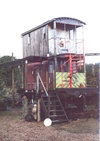
The railway guard's van has been modified by the addition of an upstairs and a spiral staircase, it is installed on a short section of track.
E
Egypt Farm Sign
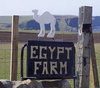
This popular cut out sign of a camel has been through more than one incarnation while keeping to essentially the same design
F
Faddonhill Farms Sign
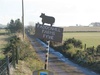
A silhouette farm sign in the shape of a fat ox. These cut out signs were once ubiquitous in the area in the forms of pigs, cattle, horses and etc. they are now becoming rare. The original 20th century sign (illustrated here for reference) was replaced in 2004 after storm damage. The new sign retains the ox of the original but the painted lettering has been replaced with gilded cut out metal lettering and 2 decorative gilded fleur de lys.
Farm sign Crovie Farm

A contemporary take on the cut steel sign tradition with a forged, welded and galvanised box section frame and a galvanised silhouette of a horse and ploughman on a black enamel ground.
Fish and chip shop bear
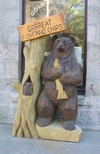
A carved and stained wooden sculpture of a brown bear holding a salmon beside a tree stump with an owl, adorned with a sign.
Fishing Temple
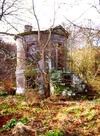
Octagonal fishing temple situated on an island in the middle of the River Deveron. Currently roofless and overgrown, original domed and surmounted by a gilded figure of fame. Category B listed
Fraserburgh Old Parish Church, fish weather vane
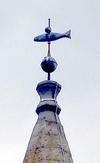
The slightly stumpy stone built spire of the church is adorned by a simple metal fish weather vane. See external link to church website for pictures of the whole building.
G
Greenden House Sign

H
Harvieston farm Sign

A farm sign in painted wrought and sheet steel. With the name Harvieston in cut steel letters, the whole surmounted by a repoussé corn sheaf. The iconography suggests that the farm name is being interpreted as 'harvest town' understandable if linguistically unlikely. In the north east of Scotland the word town or toon is still commonly used in its older sense of a farm steading as well as in the modern sense of a conurbation.
Haughton Farm sign

A painted sign in a folk art style with fine lettering reminiscent of fairground art, it shows a head of a bull and a sheep (probably intended as Limousin and Suffolk respectively), also a sheave of oats and three eggs indicating the farms enterprises.
Headiton Farm sign

A modern steel sign this one avoids the nostalgic whimsy of some recent signs, in the old local tradition with naive cut-outs of a white-faced stirk and a tractor, it simply illustrates the farm's most important stock and equipment.
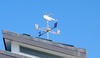
Helicopter Wind Vane
House Sign - Smithy Cottages

A painted plastic house sign of the 'guess who lives here sort', a more modern take on the local cut steel tradition, with a nicely foreshortened grand piano
House sign - Threelums

Carved oak panel showing the three lums (Scots for chimneys) with the lettered word threelums like smoke above them
House sign and Post box - Gardners Cottage
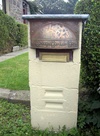
Masonry wood metal and slate house sign in the form of a miniature house with a block work postbox incorporating what looks like a copper fire-hood to protect the brass letterbox.
L
Light buoy installation
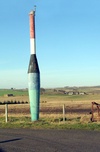
An installation in a field of a light buoy, an object one normally only sees the very top of emerging from the sea. The same track end also has surreall traffic lights which surprise the viewer as they are unexpected on a farm track.
Little Ardo sign
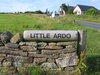
A reused old fashioned granite roller with deeply cut plain lettering "LITTLE ARDO" blacked in with paint or similar.
M
Mosaic house no Crovie
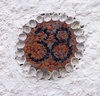
Limpet shells and coloured stones embedded in render to make a mosaic house no, in a village where the no and the name of the village are the entire address.
N
Neep Chapper Beastie

The original implement used to chop turnips for cattle feed has been given a dramatic new persona with some subtle welded and assembled additions and a paint job.
Newbigging house sign

Newbigging (std. Eng. new building) House sign in wrought iron, with scroll work and leaf decoration.
Newstead, farm sign Cuminestown

An elegant sheet metal cut out sign. The image while at first appearing to be simply an icon of the farm's livestock has an element of dark comic narrative, the tiny chick is threatened by an omnivorous and greedy sow, it is unaware of its possible impending doom while the mother hen leads it to shelter beneath the indifferent cow maybe escaping one gruesome end to suffer another.
No Sea View, house sign

A relief ceramic? plaque mounted on driftwood and suspended with a scrap of fishing net.
P
Prop of Ythsie
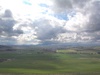
A bit of an ugly and intimidating monument to the hereditary principle and the divine right of the aristocracy/rich to rule the rest of us for their own advantage, however it is worth the climb up both the hill and the stairs for the view toward Bennachie. Erected to the memory of the Prime Minister the Fourth Earl of Aberdeen. A square tower of coursed red granite with dressed quoins and a corbelled and crenellated parapet. The lower stage is steeply battered. SMR
S
Sandyhills Dovecote
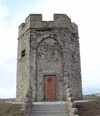
Hexagonal shaped dovecote in a fair state of preservation, interior is circular with nesting boxes all round and reaching to roof height. A battlement parapet which was probably added when the old Mercat Cross was erected on it in 1768 until 1900, probably contemporary with Duff House. Stands on the hilltop above the Deveron valley and Duff House as a folly and ornament to the landscape. Until the 1980s the dovecote stood in a field, now it is largely built over with modern residential development.Dovecote appears on John Clerk's topographical print of Banff, 1826
Shell House

A small domed oven shaped building of old bricks, lined with mosaics of shells. Set in a hard landscaping of cobbles with a small pool etc.
Sign - Ian Edwards

An enamelled metal sign with a large red arrow and blue lettering and a representation of a 1930s convertible on a white background. I do not know whether this fairly recent sign is a commercial production or home-made but it resonates with the areas legacy of art Deco.
Smithy Weathervane Dunnydeer

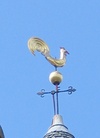
A weathervane that combines the traditional cock with an anvil leaving no doubt about the trade conducted in the premises below.
Stuartfield Bell
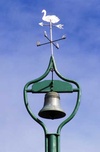
A combined seat, weather vane and bell mount, set on a cobble stone circle. The main frame in green painted tubular steel supports at its base a circular wooden seat and at its apex a bell surmounted by a weather vane in the shape of a swan.
The concept is from accounts of the (then new) village in 18th century "A bell mounted on a pole at The Square was rung three times a day to regulate the working life of the village".
T
Temple of Venus

Belvedere in the form of domed arcaded rotunda. Modern harl. 6 round headed keystone arches rising from a continuous plinth. Domed roof capped by a small ball finial. Built for the Earl of Fife on a hill over-looking Duff House, the Earl's folly once housed a statue of the goddess Venus. Built by the Earls of Fife to improve the skyline.
Tewel - Farm Signs

The unique welded lettering on the gate is in keeping with the area's vibrant art deco heritage, the mass produced cast metal sign with charolais bull is however something that at the moment could be anywhere in Britain.
The 1800 Laundry, Delgatie

A curiously and ornately decorated small cottage. With ogee window arches, gothic finials at the ends of the gables and a motif of ox yokes.
W
W. A. & S. Higgins sign

W A & S Higgins Agricultural Engineers; an unusual sign, an old farming implement (a wheel driven potato or turnip lifter), painted welded to a frame with a new sheet metal sign on the top.
Woodburn - house sign

Painted metal Bed and Breakfast sign using a lettering style reminiscent of mid-20th century trade signs.
Wrought Iron Sunflower
This content was submitted by external contributors and does not necessarily reflect the views of the University of Aberdeen.