
18th century archaic head
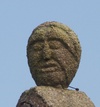
A granite carving of a human head, mounted on the south gable of the shed. This apotropaic (averting evil) carving has an extremely atavistic quality, with its appearance of a severed head it is powerfully reminiscent of Celtic Iron Age works relating to the cult of the head. Indeed if found buried in the peat bog one might think it was such. However it is presumed to date from the origin of the building to which it is attached. This is one of the oldest structures in the village one can clearly see where corrugated iron has replaced thatch, some aspects of the shed suggest it may have originally been a dwelling. It is situated near what would originally have been a major crossroad pre-dating the village square crossroad to the south and the Fraserburgh-Banff turnpike junction a mile to the north. Possibly this structure was part of the hamlet of Cyaak that preceded the village. The house on whose feu it stands No 48 High St is itself nearly as old as the foundation of the village in 1787 and was once a butchers, at which time the shed may have been used for slaughtering.
A
Aberdour cave graffiti
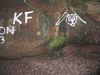
An assemblage of graffiti mostly consisting of simply painted names and dates but including the illustrated iconographic piece, showing a hound's head from an unusual straight on perspective.
Alex Patersons Ship Painters Shed

There is a tradition in this area of ship painters using the exterior of their premises try their colours and clean their brushes etc.. This results in heavily textured and intense abstract expressionist works of an impressive scale. Some might argue that they lack sufficient intentionality to be considered art works but they are definitely intended to be seen. This practice is also seen on other smaller sheds within the boatyard and even on roadside bollards.
Asleid 1
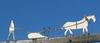
Asleid 2

A cut sheet metal sign by the same artist as Asleid 1, on another entrance to the farm this time illustrating a horseman with a box cart.
Asleid 3
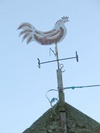
A sheet metal painted weather vane created by the brother of G Christie who made the related farm signs.
B
Bagpuss faux windows, Peterhead
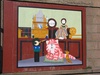
False shop window murals on plywood one is a homage to the 1970s children's TV programme 'Bagpuss' created by Oliver Postgate and Peter Firmin. The other represents an antique shop at the turn of the last century. Commissioned by the Aberdeenshire Towns Partnership to aid the regeneration of the area.
Beachgate House Sign

Painted Wooden Bed and Breakfast sign incorporating the Scottish Tourist Board ranking sign, sign is topped with a silhouette of a trawler called Helene.
Bennachie, Totem Pole

A wooden totem pole carved in the American Indian style near the Bennachie Centre, the main image being of an eagle with salmon on either side. Created by the Scottish Totem Pole Project a partnership between Royal Museum, the artist Kenny Grieve (Brotus Rural Crafts) and a group of Canadian First Nations carvers (on projects in 2002 led by XwaLackTun , Xwa works in two First Nation styles, the Northern Kwaguilth Coast Salish and West Coast Squamish). This cross cultural project involves schools and communities across Scotland investigating Northwest Coast artefacts, exploring their own heritage and natural environment, and creating uniquely Scottish totem poles.. see http://www.nms.ac.uk/totempoles/home/
Boot Detail
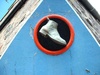
Boot sitting in a triangular, flattened, brightly painted corner of the house at Reidhaven Street, Whitehills. Looks to be cast from an actual boot and set into cement work. Former souter's (cobbler's) workshop
Bulls Head Gate Ornament
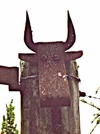
An assemblage by welding of old agricultural scrap. Although somewhat reminiscent of Pablo Picasso's treatment of the same subject using a bicycle saddle and handlebars, the different components create a more agrarian bull.
C
Carved wooden poles
Catterline Primary School Playground Shelter
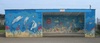
A cement shelter shed with corrugated roof, painted with murals on submarine fantasy theme depicting dolphins, seals, a mermaid, octopus, fish and etc.. A mixture of local marine wildlife with exotic and imagined species.
Coat of arms Gardenstown public hall

Coldwells Sign

A wonderful cut steel sign of a Clydesdale Horse in working harness, the harness detail suggests a working horseman's intimate knowledge, this plus the style and overall condition suggest it is of considerable age.
D
Double Decker Guards Van
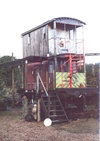
The railway guard's van has been modified by the addition of an upstairs and a spiral staircase, it is installed on a short section of track.
E
Egg sign free range neeps
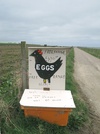
A painted and collaged eggs and neeps for sale sign, with an honesty box that has sadly been re-classified as a dis-honesty box as far as eggs are concerned.
The concept of a "free range neep" (turnip) is a little disturbing, but the hen has a definite charm.
Egypt Farm Sign
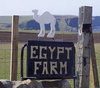
This popular cut out sign of a camel has been through more than one incarnation while keeping to essentially the same design
F
Faddonhill Farms Sign
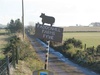
A silhouette farm sign in the shape of a fat ox. These cut out signs were once ubiquitous in the area in the forms of pigs, cattle, horses and etc. they are now becoming rare. The original 20th century sign (illustrated here for reference) was replaced in 2004 after storm damage. The new sign retains the ox of the original but the painted lettering has been replaced with gilded cut out metal lettering and 2 decorative gilded fleur de lys.
False window Pennan Harbour
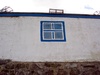
A blank white shed wall is relieved by a painted window frame that somehow evokes the view that it would have if it were real.
Far & Wide sign
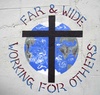
A painted globe with a superimposed cross and lettering, presumably the logo of a missionary organisation.
Farm sign Crovie Farm

A contemporary take on the cut steel sign tradition with a forged, welded and galvanised box section frame and a galvanised silhouette of a horse and ploughman on a black enamel ground.
Fintry, school shelter murals
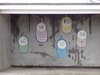
Murals to act as ball game targets the pupils of this small village school. The paintings were done by the
pupils and head teacher with support from the art specialist.
Fish and chip shop bear
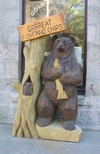
A carved and stained wooden sculpture of a brown bear holding a salmon beside a tree stump with an owl, adorned with a sign.
Flower boat, Johnshaven
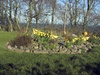
A planting scheme and rockery utilising a yellow painted old boat. These rather kitsch planting schemes (and arrangements of creels, rocks, driftwood and etc.) still seem to abound in the north east, boats on the coast and wheelbarrows and farm carts inland. I rather worry how many once serviceable (and beautiful) traditional vehicles have been destroyed for this purpose for, to my taste, no aesthetic gain.
Flower-pot men
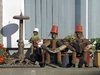
An installation of figures made from wood and flower-pots beside a ready made? sundial.
Fordyce Primary School Murals
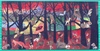
Brightly coloured naive paintings of the local landscape with rampant flora and fauna (some of the butterfly species are a bit optimistic).
G
Geordies Kist planter

Planting feature, as part of a village wide planting project. Description an installation of bedding plants in a 'horseman's kist', the lid interior featuring a painting in the local folk style of two Clydesdale horses in agricultural show harness.
Gravestone with four poster bed St Marys Kirkyard Banff
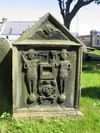
An 18th century stone carved with two angels one holding a trumpet the other an hourglass, both hold truncheon like objects in their other hands, they flank the deceased who is lying in a grand full canopied bed above a memento mori skull.
H
Hackley Bay beach sand drawing

Harbour Cafe, Fraserburgh
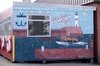
A cafe in a portakabin on the quayside decorated with seascapes and a harbour view, featuring fishing boats and the lifeboat.
The retro signwriting style is particularly interesting.
Harvieston farm Sign

A farm sign in painted wrought and sheet steel. With the name Harvieston in cut steel letters, the whole surmounted by a repoussé corn sheaf. The iconography suggests that the farm name is being interpreted as 'harvest town' understandable if linguistically unlikely. In the north east of Scotland the word town or toon is still commonly used in its older sense of a farm steading as well as in the modern sense of a conurbation.
Haughton Farm sign

A painted sign in a folk art style with fine lettering reminiscent of fairground art, it shows a head of a bull and a sheep (probably intended as Limousin and Suffolk respectively), also a sheave of oats and three eggs indicating the farms enterprises.
Headiton Farm sign

A modern steel sign this one avoids the nostalgic whimsy of some recent signs, in the old local tradition with naive cut-outs of a white-faced stirk and a tractor, it simply illustrates the farm's most important stock and equipment.
Helicopter Wind Vane

Hercules Linton Memorial, Inverbervie
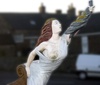
A full scale carved timber replica of the figurehead from the renowned tea clipper "the Cutty Sark" carved from Linton's original drawings 3 metres tall. with a black granite plaque engraved with the image of the ship. The figurehead depicts the young witch in Robert Burns' poem "Tam O Shanter" grasping the tail of Tam's mare, her right breast bared. In the Scot's language 'cutty sark' means a short shirt or shift, it is interesting that despite that fact and the otherwise erotic nature of the figure, the carving is actually wearing quite a long shift, perhaps the Victorian era was much more at ease with tits than with bums.
House Sign - Smithy Cottages

A painted plastic house sign of the 'guess who lives here sort', a more modern take on the local cut steel tradition, with a nicely foreshortened grand piano
House sign - Threelums

Carved oak panel showing the three lums (Scots for chimneys) with the lettered word threelums like smoke above them
House sign and Post box - Gardners Cottage
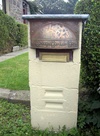
Masonry wood metal and slate house sign in the form of a miniature house with a block work postbox incorporating what looks like a copper fire-hood to protect the brass letterbox.
I
Installation of scarecrows
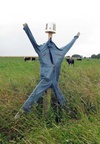
An installation of, about ten, simple tattie bogles (scarecrows) constructed of old overalls, buckets etcetera on wooden frames, these were arranged symmetrically on either side of a rectangular pasture to protect barley crops in adjacent fields.
L
Last of the Summer Wine benches
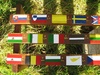
Top photographs show two benches one is a 'standard issue' park bench painted red the other assembled in situ and brightly painted with multi coloured wavy stripes, was the first installed, as of summer 2007 the red bench has been removed and the poem absent in the top 2 photos has been reinstated it reads: "The Seat. Yeve het feet, Tak a seat, Yere fer pecht, Doon yer wecht, Half wye roon, Sit ye doon, A lang wauk, Ye did tak, Jist tak care, Rest eence mair, Efter a fyle, Wauk in style, At yer best, Efter a rest. 1993" As of 2008 a second bench was re-installed, made of slats and painted with the flags of all the European Union states, with their respective population figures. Also added at this time was a tondo mounted on a post painted with what could be a conceptual representation of the EU with state names and the total population figure of 480 million in text.
Light buoy installation
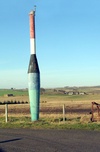
An installation in a field of a light buoy, an object one normally only sees the very top of emerging from the sea. The same track end also has surreall traffic lights which surprise the viewer as they are unexpected on a farm track.
Livestock Limo Cattle Truck
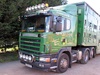
Scania tractor cab and articulated livestock trailer painted in green with pale yellow lining and red shaded yellow lettering, on panels and side windows. Motifs of thistles, tartan and cartoon cattle.
M
Mosaic house no Crovie
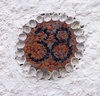
Limpet shells and coloured stones embedded in render to make a mosaic house no, in a village where the no and the name of the village are the entire address.
Mosaic Obelisk
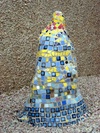
N
Neep Chapper Beastie

The original implement used to chop turnips for cattle feed has been given a dramatic new persona with some subtle welded and assembled additions and a paint job.
Newstead, farm sign Cuminestown

An elegant sheet metal cut out sign. The image while at first appearing to be simply an icon of the farm's livestock has an element of dark comic narrative, the tiny chick is threatened by an omnivorous and greedy sow, it is unaware of its possible impending doom while the mother hen leads it to shelter beneath the indifferent cow maybe escaping one gruesome end to suffer another.
No Sea View, house sign

A relief ceramic? plaque mounted on driftwood and suspended with a scrap of fishing net.
P
Pies for parking
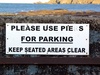
An example of that much favoured genre of vandalistic intervention that involves removing or adding to official signage text to say something more amusing or profound, in this case with a certain wit.
Postman Pat, fishing boat decoration

Postman pat and his cat Jess painted on the bow of fishing boat Pleiades BF155 photographed in Fraserburgh
Puffin carving

R
Rob Roy Statue, The Mannie on the Rock, Peterculter
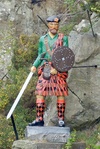
A polychrome carved wood statue in a folk style depicting the popular archetype of the 18th century highland warrior. In tartan plaid armed with broadsword, pistol and targe. Romantically situated on a rock in the side of the burn's gorge.
S
Sailboat Mobile
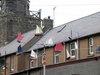
A colourful rotating exterior kinetic installation created from model sailing boats.
Shell House

A small domed oven shaped building of old bricks, lined with mosaics of shells. Set in a hard landscaping of cobbles with a small pool etc.
Ship Inn public house sign
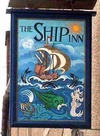
Ship Inn public house sign, mythical sea monsters and sailing ship depicted in a naive style, based loosely on early maritime chart illustrations
Skerryvore stained glass door panel
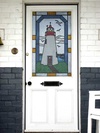
A domestic stained glass door panel depicting a lighthouse and seascape with gulls and a passing trawler.
Smithy Weathervane Dunnydeer

A weathervane that combines the traditional cock with an anvil leaving no doubt about the trade conducted in the premises below.
Stonehaven, Ship Inn Sign
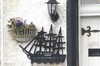
A cut (or perhaps forged) steel or iron sign in the form of a three masted schooner. The holes at the head of the fore and mizzen masts suggest the sign was originaly designed to hang.
T
Tank trap with world war II graffiti

A square concrete block of the kind that once covered much of the coasts of Britain and Europe, with carved graffiti. Blocks of concrete such as this still stretch all the way from Aberdeen to the mouth of the River Ythan at Newburgh. There are also extant examples on more northerly Aberdeenshire beaches that could have been used for landing. Built in 1940 they were designed to prevent tanks landing during the feared Nazi invasion. Some have simple graffiti on them but this one was richly decorated by Louis Lawson. There is a caricature of Churchill who is watching Hitler looking upwards at a bomb falling from the sky. At the bottom there is the chilling message "Hitler's Graveyard".
Tarlair and environs

Tarlair – Art Deco outdoor swimming pool and boating pond opened in the 1930’s, it was once very popular with tourists, now falling into disrepair, no swimming allowed any more, disused since 1995, currently only used by model boat owners. Classified ‘A’ listed in 2007 by Historic Scotland.
John C Miller (Macduff Burgh Surveyor) 1930-31 with minor later alterations. Art Deco tidal swimming pool, boating pool and paddling pool surrounded by curved walkways, with associated tea pavilion at head of boating pool and changing rooms and kiosks to side. Concrete pools and buildings.
BOATING POOL, SWIMMING POOL AND PADDLING POOL: D-plan boating pool bounded by 3 broad walkways swept round from tea pavilion at head of pool; shallow steps cut into walkways at regular intervals; ramp for boats to E of tea pavilion. Rectangular paddling pool with curved corners enclosing natural rocky outcrop within the boating pool and directly in front of tea pavilion. Rectangular swimming pool to N (sea side) of boating pool with changing rooms at W end; continuation of lower walkway divides boating pool from swimming pool; middle walkway continued round to E end of pool.
TEA PAVILION: single storey, break-fronted rectangular-plan, flat-roofed Art Deco tea pavilion with 3-bay colonnade between taller end pavilions; steps at outer bays leading to roof terrace; simple horizontal railings to roof. Later 2-bay addition to W. Doors and windows boarded up (2006).
CHANGING ROOMS: low, flat-roofed group of 4 linked blocks with slightly advanced outer bays. Strip windows at eaves level (boarded up, 2006).
KIOSKS AND FENCE: probably early 1950s. 2 1-bay, roughly square-plan kiosks at pool entrance. Curved concrete fence with perforated top extends towards tea pavilion.
Tarlair Well – Tarlair Well a chalybeate spring east of Macduff was discovered in 1770 and ten year later in 1780 the Earl of Fife built the ‘Well House’ and the croft. The well was once renowned for its medicinal properties and was very popular for the ‘taking of the waters’ in the 19th century. The well ceased to flow after a German mine exploded when it came ashore in ‘World War Two’. Local drinks manufacturer Sangs traced the source of the well and are said to make all their drink products with this water. The well-house remains although in poor condition, nothing remains of the croft. The well house is category C listed.
Later 18th-early 19th century. Small rectangular rubble wellhouse with later harling. Blocked entrances in E and W gables. Small soak-away vent in base of N elevation. Piended bellcast concrete roof, probably replacing earlier stone slab covering.
INTERIOR: vaulted rubble interior; dished stone gutter runs through centre; rough stone benches against W wall.
A cottage/crofthouse once stood nearbye but during WW2 the same mine which came a shore destroyed it.
The Crazy Frog (Face in the rocks)
A natural face in the rocks which has had its mouth eyes and nostrils added to bring it out.
Painted in 2007.
Cleaved Head, Macduff – Site of a promontory fort, typical in type of the iron age, a scheduled ancient monument, two ditches and traces of a third are evident. The construction of a golf course (Tarlair Royal Golf Club) has altered the landscape around the ditches, but the easternmost ditch is still the best preserved, having a scarp 1.5m high and a counterscarp 0.5m high; no evidence of fortification was seen on the flattish top of the promontory . Grid ref NJ 721 647. Spectacular views of the rugged coastline eastward to Troup Head can be had from here.
Tasmanian Devil, fishing boat decoration
A painting of a Tasmanian Devil in the style of the well known cartoon character "Taz", It is obviously desired to keep the original rendering as it predates the last painting of the wheelhouse as indicated by some overpainting of the left leg.
The Cat at the Window
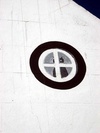
Tigger, trawler decoration
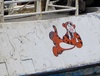
Another cartoon character used as a trawler decoration. The 2007 photo on www.trawlerphotos.co.uk is interesting in showing just how much damage to a paint job less than a year at sea can do.
Tolquhon Tomb and 17th/16th - century tombstones
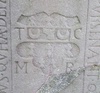
The Tolquhon Monument, built by Thomas Leper in 1589, of a chocolate- coloured sandstone, to commemorate William Forbes of
Tolquhon (perhaps to Forbes' design) and his wife Elizabeth Gordon, is supposed to be the relic of the S. aisle of the old kirk. Rich arched altar tomb mixed gothic and Renaissance motifs inspired by Dunbar tomb at St. Machar's, Cathedral.
It is somehow very Scottish in style.
Present pedimented setting probably of 1798. The monument is housed in a classical surround believed to be of 1798 in date, though a large porch has been erected by Historic Scotland consisting of sheets of perspex with bronze structural supports. The tombstone is remarkably well preserved with its representative figures, though the structure preserving it rather resembles a domestic green house.
Coats of arms as shown for William is 'Forbes quartered with Preston' and shown for his wife is 'Forbes impaled with Gordon'.
The charges on the shields show, heads of boars, unicorns and muzzled bears. The unicorns appear again at the top of the arch either side of the crown flanked by hounds hunting on the right a deer and on the left another animal I cannot definitely identify (perhaps a fox or martin).
W
W. A. & S. Higgins sign

W A & S Higgins Agricultural Engineers; an unusual sign, an old farming implement (a wheel driven potato or turnip lifter), painted welded to a frame with a new sheet metal sign on the top.
W. Bruces ship painters shed
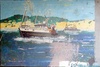
There is a tradition in this area of ship painters using the exterior of their premises try their colours and clean their brushes etc. This results in heavily textured and intense abstract expressionist works of an impressive scale. Some might argue that they lack sufficient intentionallity to be considered art works but they are definitely intended to be seen.
W. Bruce's shed has developed a degree of impasto that makes it almost sculptural with sections reminiscent of Anish Kapoor's early pieces, this is contrasted with a naive figurative painting on the door of a trawler in front of the nearby dunes.
This content was submitted by external contributors and does not necessarily reflect the views of the University of Aberdeen.