
| 18th century archaic head |
|---|
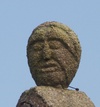
A granite carving of a human head, mounted on the south gable of the shed. This apotropaic (averting evil) carving has an extremely atavistic quality, with its appearance of a severed head it is powerfully reminiscent of Celtic Iron Age works relating to the cult of the head. Indeed if found buried in the peat bog one might think it was such. However it is presumed to date from the origin of the building to which it is attached. This is one of the oldest structures in the village one can clearly see where corrugated iron has replaced thatch, some aspects of the shed suggest it may have originally been a dwelling. It is situated near what would originally have been a major crossroad pre-dating the village square crossroad to the south and the Fraserburgh-Banff turnpike junction a mile to the north. Possibly this structure was part of the hamlet of Cyaak that preceded the village. The house on whose feu it stands No 48 High St is itself nearly as old as the foundation of the village in 1787 and was once a butchers, at which time the shed may have been used for slaughtering. |
A
| Aboyne Millennium Gates |
|---|
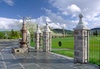
Pair of double wrought iron gates with masonry pillars with ornamental capstones, decorated with a bronze relief showing the Marquis of Huntly's Crest (being used as the Gordon clan badge?) with a ten tined stag's head and neck affrontee issuing from a coronet and the motto Bydand. Following a suggestion from the Marquis of Huntly, the Games' Chieftain, it was decided to echo the design of the tops of the gate pillars at the Parish Church across the Green, on the gates leading on to the Green and on to Huntly Road. (A similar pair exists in the grounds of Aboyne Castle). The more 'cylindrical' form of the Fountain was also incorporated by making the tops more circular in plan with a view to reflecting that influence thus effecting a degree of compatibility. The main parts of the pillars are constructed with local stone and blend well with surrounding buildings, particularly the Huntly Arms Hotel. |
| Agnews office railing |
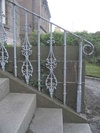
A surviving example of highly decorative Victorian or Edwardian decorated cast iron work |
| Archway with Mask Detail |
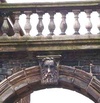
Listed Category A. Italianante building by Thomas Mackenzie, Elgin 1851-4 , with unusual queen-head capitals and Corinthian pilastered triparte with shell motif over centre light. Linked at south by tall round headed archway incorporating carved bearded head. The interior has 1st floor hall which takes up the entire frontage, the ceiling being supported by 6 pairs of draped female figures clasping laurel wreaths. The Town Hall was originally built as the St. Andrew's Lodge of Masons Hall. |
| Ardlui gate |
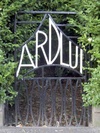
Possibly made by Emil Rzechorzek, a steel gate and house sign combined that although of a later period perfectly attunes with the 'art deco' style of which the town has such fine surviving examples. |
| Art-deco Shops |
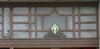
Possibly Colonel Tawse and Messrs Hall, 1936. Single storey and 2-storey with attic, 6-bay, terraced, Art Deco style former Co-operative building adjoining separately listed Carron Restaurant, Cameron Street. Fine decoratively-astragalled top-lights, coloured glass medallions and original shop doors with brass door furniture. Granite ashlar shop fronts, with crenellated, crowstepped darker ashlar 1st floor bays; harl and coursed rubble to side. Oversized stylised keystone and capitals. |
B
| Banchory-Ternan Watchtower in Kirkyard |
|---|
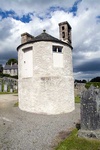
A circular white harled 2 story tower. Conical slated roof with round finial, a lum (for a fire to keep watchers warm) and bellcote (for bell to raise the alarm). Recently restored by the Banchory Rotarians. The warning bell is dated 1664 and probably came from an early church on the site, established as a missionary base by St Ternan around 490AD. |
| Banff Castle and Banff Castle Gates |
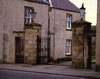
The new Banff Castle mansion, was built by Lord Deskford in 1749-52 the architect was John Adam, stands on the grounds of the original fortified castle. The Oglvies of Findlater and Deskford held Banff Castle and the ruins of the old remained beside the new for 70 years until demolished in 1820. All that now remains of the medieval Castle are the northern and eastern curtain walls, ditch and rampart, and the postern. The pavilion roofed mansion has flanking two-storey pavilions, and a 19th century porch. |
| Banff Museum and Library Interior |
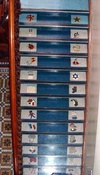
Two pictures of the staircase, lino cuts produced by the children at Banff Academy in the 1950's in association with the linoleum company each image representing a letter of the alphabet. |
| Battle of Harlaw Memorial Monument |

Erected in 1911 by the Burgh of Aberdeen a large polygonal tower shaped monument of coursed roughly dressed stone blocks with cornerstones in a contrasting redder stone. It has an outstepped base the angles of the main section are set with large square decorative bosses and it has a stepped top with protruding rainwater spouts. The lettering of the inscriptions in particular and the overall design in general has much of the 'arts and crafts' movement about it. |
| Boyndie Kirk bellcote |
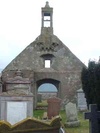
Category C listed, Scheduled monument . 17th century gable with ball capped bellcote, the sole remains of the kirk. Contains 58 table top stones of which 9 are significantly decorated and over 100 upright stones from the early 19th - 20th century. A high proportion of these stones are decorated with symbols of mortality, immortality and trade emblems. |
C
| Cairness House |
|---|
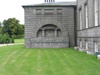
Cairness House is considered one of the finest examples |
| Carron Terrace Houses |
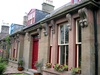
Single storey and attic, 5-bay terraced pair of boldly detailed, late classical houses; No 8 with late 19th to early 20th century single storey, single bay wing. Ashlar. Base and eaves courses. Consoled cornices to doors and to 3 advanced tripartite windows, latter with coupled outer consoles and block pediments rising above eaves. |
| Carved Marriage Datestone |
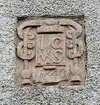
Listed Category B. Boyndie House 1740, an unusual house with a delicately shaped Dutch-gable, with two round eyes below the chimneys, and carved marriage stone as a shaped cartouche bearing the initials IG MS. Marriage stones appear to have been particularly popular in Banff. It was customary for the sons and daughters of town worthies to have an initialled datestone built into their houses in honour of their union. |
| Carved Stones, Fetternear House |

Photo 1:Carved sandstone, fragmented, set in the front of Fetternear House which was destroyed by fire in 1919. |
| Christians house Doorway Arch |
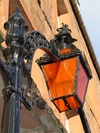
An ornate decorative cast iron arch supporting a large lantern of orange-red glass, which presumably was once illuminated by an oil or gas lamp. |
| Church of the Immaculate Conception , various architectural decoration, windows and, soup kitchen |
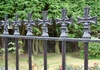
The Church of the Immaculate Conception is the last remaining place of worship in Stonehaven's Old Town. It boasts details recognised as deriving from Notre-Dame-le-Grand, Poitiers and Chartres and despite the loss of some original glazing is nevertheless an important quiet place on its island site surrounded by roads and behind the High Street. The building date varies from 1875 to 1879 depending upon the source, but it is a certainty that funds for this fine church and the nearby Rickarton Cottages were provided by Mrs Eliza Maria Hepburn of Rickarton, as a memorial to her daughter. A sketch in Christie's 'Haven Under The Hill', entitled 'Church of St Mary' shows decorative ridge detail and a ship weathervane, neither of which are evident today (2004). He also mentions an American organ which was installed in April 1880. The priest´s house is located at the nearby (separately listed) Rickarton Cottages and is accessible from the church grounds. The nearby soup kitchen was presented to the church by George Blackie in 1905. |
| Clunie Street School Bellcote |
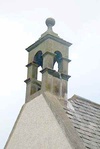
Former school, dated 1804 with ball- finialled apex bellcote which crowns the gable of the building. Datestone bears the inscription 'FREE SCHOOL Endowed by Alexander Pirie,1805'. |
| Cupola, Weather Vane, etc |
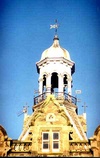
Extravagant Neo-Jacobean, tall gabled hospital with timber arcaded cupola with faceted lead roof and weathervane, 1860. Alexander Chalmers of Clunie (Marnoch, Banffshire) wine Merchant and ship owner in Banff left 'the site of his residence' and a bequest of £70,000 to build and endow the hospital. |
D
| Dog statue, Delgatie |
|---|

Gatepost ornament, Red sandstone carving of a dog? holding a shield. The late Captain Hay of Delgatie was an inveterate collector and the castle has many decorative elements that are now difficult to attribute to exact dates and provenances. |
| Duff House Pediment |
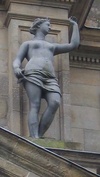
Substantial Baroque mansion 3 story on raised basement fluted Corinthian pilasters to tower heads, pediment to principal floor. The South (principal) elevation has the pedimented centre piece with exuberant armorial carving Duff Arms and Motto. The original lead statues are preserved in the house and have been replaced by fibre glass copies which stand above the pediment, representing Mars, Apollo and Minerva. On the north elevation Bacchus, Mercury and Diana. |
| Duff House, the Fife Gates |
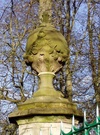
Pair of polished ashlar octagonal gate piers with moulded stepped caps supporting fine carved stone urns. Decorated with acanthus and swags of fruit and flowers. Gates probably made by the Banff Foundry (James Fraser) a firm which provided similar to other local country house estates, including Castle Fraser. House open to the public. See their website for details. |
| DUFF HOUSE, BANFF, BRIDGE STREET, BRIDGE OF BANFF LODGE |
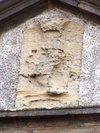
A small classical pedimented pavilion with Venetian windows (now blocked and painted with false panes). A solitary survivor of a pair that guarded the eastern entrance of the Duff House policies. It has been relocated and truncated and is now used as an electricity sub-station and the basement for supermarket trolleys. |
| Dunnottar School, schoolhouse decoration |
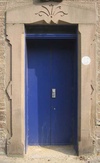
A rather dour late Victorian piece of public architecture in sandstone with some nice decorative details. |
E
| Ellerslie - door, ironwork & stained glass |
|---|
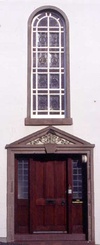
House dated 1892, altered and extended. 2-storey, 5-bay, rectangular-plan, end terrace house (sub-divided) with keystoned and pedimented moulded door-piece, tall round-arched stair window with decorative astragals and coloured glass (the round medallions containing portrait heads) and some fine interior detail; on ground falling to S and E. Painted ashlar with ashlar margins, quoin strips and base course to W; ashlar with 1st floor cill course and eaves cornice to E. |
| Embossed Lums |
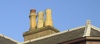
Chimney pot in a cream colour ceramic embossed with a foliage design. |
F
| Façade, Trinity and Alvah Church |
|---|
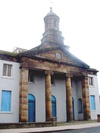
Listed category C. Designed by Robert Raeburn of Edinburgh in the Ionian mode of that city, with portico and cupola. Enlarged in 1876, fortunately the façade was left intact, it has a most unusual beamed roof inside. |
| Fanlight |
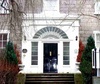
Listed category B. |
| Features at Tolquhon castle |

Apart from the original Preston tower this is not a building with serious defensive intent, more a stylish country palace. As with the tomb for the same client and the other castles he was involved in the design of, Leper has combined what was then modern style with older traditions to create a fusion that is peculiarly Scottish. He has an approach that resonates with C. R. Mackintosh in a much later era. |
| Fetterangus cemetery gate / war memorial |
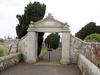
An unusual 14-18 war memorial which also functions as a gate to the old kirkyard, |
| Fettercairn the Royal Arch |
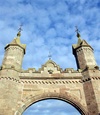
A triumphal arch of Rhenish Romanesque style; round arch between two high buttressed octagonal towers with short gabletted spirelets and wrought-iron finials. The top of the arch is finished with a crenellated parapet with a curvilinear gablet feature at the centre. It was the winner of a competition, assessed by Queen Victoria, to commemorate a visit by Victoria and Albert in 1861. |
| Fetteresso Castle Gates |
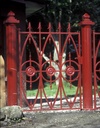
Modern painted ironwork gates, with a relief cast flower motif. |
| Fetteresso New Cemetery, Stonehaven: Gravestones,and wrought iron gates |
Large municipal cemetery on the outskirts of Stonehaven opened in 1902 to serve the increasing population of the area. There are about 1600 gravestones within Fetteresso New, the majority of which are constructed from local granite, the three illustrated are however later 20th century (80s and 90s) stones of imported black granite. They are of interest in showing a modern take on visual iconography, two of them illustrating occupations as do the gravestones of earlier times from some older graveyards. The grounds were extended to the north-west in the late 20th century with a new entry gate constructed for easy access. |
| Fetterresso Parish Church Door Stonehaven |
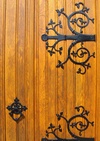
2-leaf, vertically-boarded timber door (replaced 1995), large decorative ironwork hinges, and deep timber-traceried, pointed-arch fanlight with diamond-pattern, leaded glazing and modern wall-mounted carriage lamps flanking. |
| Fyvie stone carved relief figure holding head |

Stone carved figure covering face with hand, the other hand appears to be cradling the head of an infant at waist height. Interpretation is slightly speculative as the stone is quite badly eroded. |
G
| Gates at Gourdon / Inverbervie Cemetery |
|---|
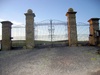
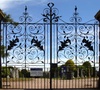
Elegant wrought iron gates on stone piers surmounted by balls |
| Grotesque Human Mask, Date Stone |
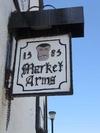
Category B listed building. The Market Inn is dated 1585 on a painted lunette stone with grotesque moustachioed head - you can see it by going through the pend arch. The building in it's present form could be as late as 18th century but incorporating earlier fabric, but it is certainly the oldest building in continuous occupation in Banff. |
| Grotesque Lion Mask, Lintel Decoration |
Category B listed building. Incorporated in this symmetrical fronted building, centre corniced door with shoulder lintel with carved grotesque head and heavily quoined jambs, there is hint of Adam Senior influence in the doorpiece. |
H
| Harbour Cafe, Fraserburgh |
|---|
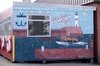
A cafe in a portakabin on the quayside decorated with seascapes and a harbour view, featuring fishing boats and the lifeboat. |
| Heraldic Panel, Drum |

Carved stone panel on the exterior of the castle with the arms of the Irvines of Drum Family The crest is a banded sheaf of nine holly leaves. The motto is "Sub sole sub umbra virens" Increasing both in sunshine and in shade |
| Hotel Sign - Royal Hotel, Allardice Street |
Decorative metalwork parapet with 'ROYAL HOTEL' lettering, |
| House with Decorative Datestone and Angle Mural sundial |
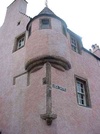
Category A listed building. Interesting and unusual survival of an early town house, the angle turret is a very rare feature, this distinguished dwelling also has a polygonal stair to the rear. The corbel stone bears the date 1675 and is decorated with two leaves. The building also incorporates an angle mural sundial. The building was restored by Banff Preservation Society circa 1970 and is now privately owned. |
I
| Interior of Banff town hall, Coffered Ceiling Supported by 6 Pairs of Female Figures Clasping Laurel Leaf |
|---|
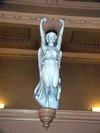
Listed Category A. Italianante building by Thomas Mackenzie, Elgin 1851-4 , with unusual queen-head capitals and Corinthian pilastered triparte with shell motif over centre light. Linked at south by tall round headed archway incorporating carved bearded head. The interior has 1st floor hall which takes up the entire frontage, the ceiling being supported by 6 pairs of draped female figures clasping laurel wreaths. The Town Hall was originally built as the St. Andrew's Lodge of Masons Hall. |
J
| Jubilee Bridge Inverbervie, alternative names Bervie Water; Inverbervie, the New Bridge, Bervie Jubilee Bridge |
|---|
Built on a curve, Bervie Jubilee Bridge is a fine reinforced concrete viaduct taking the main road (A92) from Montrose to Stonehaven over the Bervie Burn on seven spans. The bridge was completed in 1935 (the silver jubilee of George V) and by-passed an earlier single-arched masonry bridge built in 1799, which still survives adjacent to the north abutment. |
K
| Kincardine ONeil, street decorative feature |
|---|

The backdrop to the old restored St Erchard’s Well with the ruins of the old 1st Century Kirk across the road. Recent addition provided by Aberdeenshire Council along with traffic calming and more defined lay-by’s for parking. |
| King David of Scotland Episcopal Church |
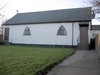
A corrugated iron church with truncated, gothic pointed cut out windows. A unusual bell support at one end of felted roof. Now becoming rare corrugated iron buildings were once something of a feature of the rural Scottish landscape. Village halls, churches, shops and houses were all produced in this material. |
| Kirkside House Gatepiers |

Probably early 19th century. Four ashlar piers, inner piers with eagle finials, outer pair with acorns (according to LBR but they look more like cones to me). category c listed. piers also bear armorial decorations. |
L
| Leopard |
|---|
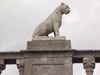
3d stone carving of a leopard decorating a balustrade. The late Captain Hay of Delgatie was an inveterate collector and the castle has many decorative elements that are now difficult to attribute to exact dates and provenances. |
M
| Macduff Parish Church or Doune Church |
|---|
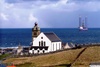
Incorporating 3 story domed tower, in 1865 the church was re-modelled and the original steeple replaced by a Italliante square tower with lead domed roof and cupola into which was installed the town clock. |
| Mannie |

Stone carving, used as a gate post decoration, of a caricatured human figure. The late Captain Hay of Delgatie was an inveterate collector and the castle has many decorative elements that are now difficult to attribute to exact dates and provenances. |
| Marine Hotel carved heads |
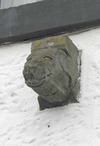
(possibly 17th century, certainly older than the 1884 date of the building) carved heads thought to have originated at the nearby Dunnottar Castle, situated to the south of Stonehaven. Although badly weathered, the fine carving can still be seen on those of the human and lion heads. |
| Mosaic entrance - Unique shop |
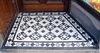
A well preserved example of a late 19th or early 20th century black and white mosaic shop entrance |
| Mosaic entrance - Unique shop |
|
A well preserved example of a late 19th or early 20th century black and white mosaic shop entrance |
| Mounthooly dovecot |
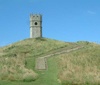
A tall dovecot with chamfered angles forming an octagonal plan. It is built of harl pointed rubble with tooled granite ashlar dressings and margins with heavy boulder footings. It is built in two stages with long elevations on the N, S, E and W with doorway in the west. There is an oval oculus in the E, W and S elevations above a continuous alighting ledge. The wallhead is slightly corbelled and crenallated wallhead with each merlon capped by ball finial (12 in number). The wallhead masks a pyramidal slate roof. Inside the interior is lined full-height with approximately 300 brick nesting boxes with the base of each box constructed of brick slabs. A tall potence ladder still survives although some of the rungs are missing. Dated 1800. It was built by Lord Garden of Gardenstown when he bought the Pitsligo Estate. Each ball finial is said to represent one for each of his 12 Estates. |
| Mural Sundial |
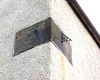
Angle mural sundial and date stone enscribed "George Massie, Elspet Morrison 1739 Gods Providence is ourInheritance." |
| Myrus Cemetery Gates |

Highly ornate wrought iron cemetery gates, bearing winged angels and painted town emblem with rider on horseback, also featured on MacDuff Town Cross and Town Hall. |
N
| New Street, Railings & serpent and eagle wall ornaments |
|---|
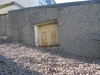
There are two sets of interesting railings opposite each other. The right hand one is composed of equal armed crosses, pommée, (bottom photograph) there is additional iron work relief set inside the garden wall to the left with a matched pair of eagles, painted black, in conflict with serpents painted red. They are in a cement wall which has railings on top. The figures are cast iron, they sit on an iron rail and the back of the recess is also lined with iron or steel. The recess in which they sit is mirrored on the opposite wall of the joint garden with No.10. That recess has rust marks which show that another pair of similar figures resided in that recess |
O
| Old post office Banff, decorative carving |
|---|

ER Royal insignia above window and ‘Post Office’ above doorway. |
| One of a Pair of Female Sphinxes on the Gate Piers |
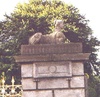
Cairness House is an important work by James Playfair the gate piers and sphinxes were added to mark the centenary of its building. |
P
| Peterhead, Late Victorian Datestone |
|---|
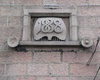
One of several ornate carved 19th century datestones on buildings in the town centre. The pink Peterhead granite is the towns signature material. The metal spikes are an attempt to limit nesting places for the Herring Gulls that throng this fishing port in huge numbers. |
| Possible Hindu Sculpture |
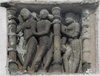
Built into house wall above entrance door on east side of street. A small stone carving showing two female and one male nude figures. This is a small sculpture about a foot across and set quite high up. The female figure on the left has suffered some unfortunate censorship (unintentional I hope) by cement render. |
| Prop of Ythsie |
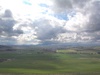
A bit of an ugly and intimidating monument to the hereditary principle and the divine right of the aristocracy/rich to rule the rest of us for their own advantage, however it is worth the climb up both the hill and the stairs for the view toward Bennachie. Erected to the memory of the Prime Minister the Fourth Earl of Aberdeen. A square tower of coursed red granite with dressed quoins and a corbelled and crenellated parapet. The lower stage is steeply battered. SMR |
Q
| Queens Head Capitals Detail |
|---|
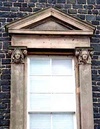
Listed Category A. Italianante building by Thomas Mackenzie, Elgin 1851-4 , with unusual queen-head capitals and Corinthian pilastered triparte with shell motif over centre light. Linked at south by tall round headed archway incorporating carved bearded head. The interior has 1st floor hall which takes up the entire frontage, the ceiling being supported by 6 pairs of draped female figures clasping laurel wreaths. The Town Hall was originally built as the St. Andrew's Lodge of Masons Hall. |
R
| Railway bridge heraldic Shields / Crests |
|---|

Carved sandstone shields with a lion holding a falchion type sword, The inscription is virtute et opera "by virtue and deeds" |
| Ramsays shop door, house entrance, mosaic and other details |
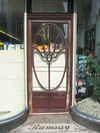
Full-width scroll-consoled fascia over ground floor shop with deep-set doors, with mosaic-tiled step, comprising bevelled glazing with beaded oval and curved astragals below deep plate glass fanlight, and flanking curved lights to bays. |
| Rickarton Cottages -cast iron railings - cast-iron parapet + memorial stone |
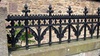
Single storey and attic, 8-bay, short terrace of cottages with rusticated porches and pavilion centre with timber verandah. decorative cast iron railings No 5 low saddle-back-coped ashlar boundary walls with battered ashlar gatepiers to No 3, and decorative cast-iron railings to No 5, cast iron parapet at No 3 and the memorial stone, it is inscribed "erected as a memorial of William Rickart Hepburn Esq of Rickarton who died 30th May 1873" |
| RNLBI building and carved stones Deveron Bridge |
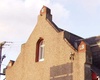
Painted decorative carved house shaped stones on the points of the gable wall, the central stone is a datestone while the other 2 have the letters RN (left) LBI (right). |
S
| Sandstone carving Municipal Building Turriff |
|---|

A small sandstone carved figure holding a scroll. The seated pose with scroll in both hands and the outfit, naked except for a kilt/sarong type garment is similiar to a carving at Delgatie Castle (see related artefacts link 'Mannie' below) |
| Shell Detail Seafield Street View |
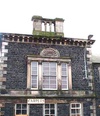
Listed Category A. Italianante building by Thomas Mackenzie, Elgin 1851-4 , with unusual queen-head capitals and Corinthian pilastered triparte with shell motif over centre light. Linked at south by tall round headed archway incorporating carved bearded head. The interior has 1st floor hall which takes up the entire frontage, the ceiling being supported by 6 pairs of draped female figures clasping laurel wreaths. The Town Hall was originally built as the St. Andrew's Lodge of Masons Hall. |
| Shoemakers Land Plaques |
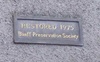
Listed category B. Plaque above pend entrance inscribed '1716. Rebuilt by the incorporation of shoemakers 1787' motif of a leather workers crescent shaped knife surmounted by a crown. Small lower plaque reads 'Restored by Banff Preservation Society 1975. The plaques were restored and painted by the Society in 2000 |
| Skerryvore stained glass door panel |
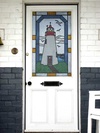
A domestic stained glass door panel depicting a lighthouse and seascape with gulls and a passing trawler. |
| South Colleonard House |
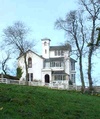
Privately owned and not accessible to the public. |
| St Drostans Church Insch Bellcot |

All that remains of the old kirk of Insch, said to be gifted to the Abbey of Lindores before 1195, is the W. gable complete with a stunning example of a 17th - century pedimented bellcote, in ornately carved red sandstone. The elaborate carving includes the letters M I L , The minister John Logie and the date 1613 |
| St James the Great, Episcopal Church Stonehaven, general |
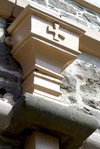
Architects Sir Robert Rowand Anderson, nave 1875-7; Anderson with Arthur Clyne, chancel, organ chamber and vestry 1883-5, builder John Morgan; Arthur Clyne, narthex and baptistery 1906, latter with Sir Ninian Comper glass of 1929. Transitional church with 5-bay nave, low buttressed side aisles and clerestorey, crowstepped lean-to narthex and semi-octagonal baptistery with prismatic roof. NE organ chamber, SE sacristy and choir vestry of semi-octagonal plan, adjoining slim tower with circular belfry stage; apsidal choir. Squared and snecked rubble with some Aberdeen bond, and ashlar dressings. Deep base course, continuous hoodmoulds forming string courses, eaves course and blocking courses to baptistery and vestry. Principally round-arched openings, quatrefoil and trefoil-headed to vestry, pointed-arch to NW aisle openings, and vessica to NW gablehead of nave. Squat, 2-stage coped buttresses; voussoirs; hoodmoulds with label stops; raked cills; chamfered reveals. 2-leaf vertically-boarded timber doors with decorative ironwork hinges. INTERIOR: fine arcaded Romanesque interior with round columns and uncut capitals, clerestory windows and hammeberbeam roof to nave; tall chancel arch and ribbed timber-lined barrel-vaulted roof to chancel and apse. Fixed timber pews. Narthex with 2-leaf screen door in pointed-arch opening with decoratively-astragalled leaded panels and fanlight. Apse with high altar and elaborately sculptured reredos. |
| St James the Great, Episcopal Church Stonehaven, pulpit |
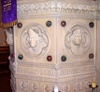
Decoratively carved Caen stone pulpit designed by Arthur Clyne, built under the supervision of sculptor James Bremner of Broughty Ferry, incorporating quatrefoil panels with carved heads of (according to the Listed Building Record): St. James, King David of Scotland 1124-1153, Bishop Forbes, Bishop Keith and Bishop Jolly bishop of Moray 1798-1838. This above information is contradicted by the information given in the church and Booklet on the history of St. James Church, available in the church, this lists the heads on the pulpit as: St Ninian (of Candidacasa aka Whitehouse) 397-432, St David King of Scotland 1124-1153, John Sinclair bishop of Brechin 1565-66, Alexander Jolly bishop of Moray 1798-1838, and Alexander Penrose Forbes bishop of Brechin 1847-75 (my own view based on the clothing/facial hair, much more like a Victorian interpretation of Middle Eastern clothing than Brythonic Celtic, is that the LBR is right about the first head being intended as St. James). Carved with the quote "heaven and earth shall pass away but my words will not pass away". The green marble balls at the angle of the panels above and below come from Egypt and the red from Victoria in South Africa. |
| St James the Great, Episcopal Church Stonehaven, Reredos |
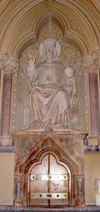
Elaborately sculptured reredos by Gambier Perry of London, memorial to Mrs Annette Maria Baird of Ury, nee Palk (1884), incorporating 4 crocketted and finialled, pointed-arch, trefoil-headed niches supported by columns of Devonshire stone, with five alabaster figures, of Sts Andrew, Peter, James and John (brother of James), flanking larger niche with seated Christ carved in high relief above an alabaster tabernacle, with brass bound wooden doors. |
| St Lesmos Church (new) |

Church; 19thC; built over the ruins of the little mansion of the Lairds of Braeloine. The west extension of the church incorporates an arch and to the north a small bell-tower from this 17th C building. Still in use as a church. To the south of it a small farmstead called Braeloine, consisting of three buildings, is depicted on the OS map of 1867 but not on the 1888 edition. |
| St Peter’s Fraserburgh Episcopal Church plaque |
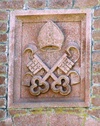
A deep relief carved red granite plaque showing the attributes of St. Peter (crossed keys and mitre) in ecclesiastical heraldry. |
| St. Bridgets Church , Stonehaven |
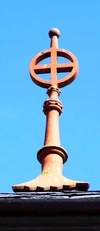
G P K Young, Perth, 1886. Arts and Crafts style church converted as church hall, with 6-bay buttressed nave, large shallow-pitched roof with canopied bell-housing, jerkinhead dormers and decoratively-finialled square-plan spirelet; piended session room and porch. Squared and snecked rubble with smooth ashlar dressings. Base course and cill course at gablehead window. Voussoired, round-headed door. 2-stage coped buttresses. Chamfered reveals, raked cills and timber mullions to cusped 3-light windows in rectangular openings. Modern flat-roofed hall. |
| St. Ciaráns Kirk Stonehaven, bellcote detail |
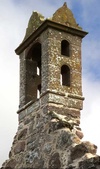
A nice little bellcote in dressed stone with ornate gableing, but lacking a bell |
| St. Meddans, Sacramental Recess |
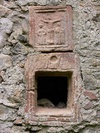
The sacramental recess for the communion cup in the ruin of St Meddans Church, Carved relief calvary in dark pink granite c. 15th century, showing the crucifixion with 2 Saints? |
| Stonehaven Art Deco Open Air Swimming Pool |
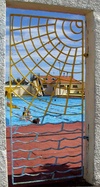
Rectangular-plan, 320,000 gallon, open air heated seawater swimming pool (55 yards x 20 yards) with long, single storey, pantiled, Art Deco, entrance range comprising turnstiles, café and flanking changing rooms; stepped buttressed enclosure walls. Painted poured concrete. |
| Stonehaven Court House Roof Railings |
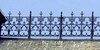
19th century gothic revival decorative ironwork based on a trefoil motive, installed along the roof ridge. The more recent seagull defences of chicken wire somewhat spoil the overall effect. |
| Stonehaven Railway Station Canopy |
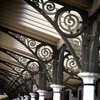
Station; opened c1850 by the Aberdeen Railway; a 2 platform through station, with the main offices on the up platform, in a 2-storey ashlar building, with the platform at first floor level. There is an unusually heavy cast iron-framed platform awning. Still in use. Cast by Saracen Foundry Glasgow manufactured by Walter Macfarlane & Co. The supporting brackets are decorated with ornate scrollwork. |
| Stonehaven Tolbooth Gates |
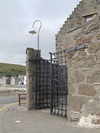
Heavy wrought iron gates in a grid pattern with protruding scrolls at top and bottom of the vertical bars. The building dates from the 1500s but I do not know if the gates are contemporary with it. |
| Stonehaven War Memorial |
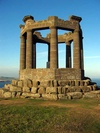
Sandstone and Granite The Stonehaven war memorial stands on a hill to the southeast of the town overlooking the bay. It commemorates the dead of both World War I & II. It is built to represent a ruined Greek temple, and is octagonal in shape with Doric columns supporting an entablature. It sits on a raised dais with eleven steps leading up to a small wrought iron gate. Stone benches run around the interior between the pillars. The names of battles are carved into the lintels over the pillars. The architect was John Ellis of Aberdeen and the memorial was dedicated on the 23rd of May 1923 at 3pm. |
| Sunshine Plaque Torphins |

Polychromed stone relief showing a griffin holding a star and quarter section of a solar disc. Built into a fascinatingly |
T
| Tarlair and environs |
|---|

Tarlair – Art Deco outdoor swimming pool and boating pond opened in the 1930’s, it was once very popular with tourists, now falling into disrepair, no swimming allowed any more, disused since 1995, currently only used by model boat owners. Classified ‘A’ listed in 2007 by Historic Scotland. |
| The 1800 Laundry, Delgatie |

A curiously and ornately decorated small cottage. With ogee window arches, gothic finials at the ends of the gables and a motif of ox yokes. |
| The Carron Restaurant |
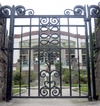
Colonel Tawse and Messrs Hall, 1936; renovated 1999-2000 by Hall and Tawse. Tall single storey and basement, 3-bay, piend-roofed, Art Deco restaurant with bowed concrete-pillared loggia/verandah and bowed front comprising Art Deco glazing to large windows combining vertical and horizontal patterning with Deco symbols, set on terrace above period garden. Banded brick and reinforced concrete. S (PRINCIPAL) ELEVATION: symmetrical. Double stair leading to loggia with Art Deco metalwork balustrade railing, centre bay of set-back face with large bow comprising narrow-centre 5-part full-height window with decoratively-astragalled top-lights, similarly-detailed 4-part windows to outer bays with outer lights as doors. W ELEVATION: tall piended bay at centre with tall raised-centre 5-light window, flat-roofed loggia to right with later infill glazing, and lower piended bay to left with symmetrical glazing. N (EVAN STREET) ELEVATION: listed separately as Art-deco Shops 26 to 32 Evan Street. Metal framed windows with decoratively-astragalled glazing patterns to S combining vertical and horizontal patterning with Deco symbols; largely multi-pane glazing elsewhere. Grey slates. INTERIOR: fine Art Deco interior comprising main apartment with vaulted ceiling, horizontal panelled walls incorporating some decorative metalwork panels, and counter with clock incorporated behind; E end wall with Art Deco engraved 'Picasso glass' mirror and tall curved mirrored supports (with lights?). Original light fittings. Toilets with original decorative floor and wall tiles and fittings. Wood floors reclaimed from Aberdeen College of Commerce. Top-lit link corridor leading to N entrance (Evan Street). TERRACED GARDEN, BOUNDARY WALLS, GATEPIERS AND GATES: rubble and brick terracing to ornamental garden, garden walls to street with period gate- and end-piers, ironwork archway incorporating name 'CARRON RESTAURANT' and boldly detailed wrought-iron gates. |
| The Cat at the Window |
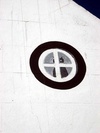
A painted faux window in a house gable with a lucky black cat peering through it. |
| The Faux Doocote, Delgatie |
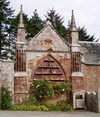
The facade of a Gothic style doocote rebuilt beside the castle. |
| The Mill Inn |
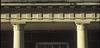
Late 18th century and circa 1830, converted to flats in 1998. 2-storey and attic, 7-bay, L-plan former coaching inn converted to flatted dwellings late 20th century, with hexastyle colonnade. Red sandstone ashlar with coursed squared rubble to sides, squared and snecked rubble and some harl to rear. Cornice and blocking course. |
| The White Bridge Stonehaven |
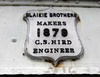
A highly decorative late-Victorian footbridge. Single span, shallow segmental-arched, cast-iron footbridge over Carron Water. Cast in 3 sections with dated makers plaque to centre of riveted girder, wrought-iron quatrefoil parapet, cast-iron standards with wrought-iron arch at centre, and pyramidally-coped, stop-chamfered ashlar terminal piers. |
| The Wine Tower |
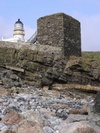
The oldest building in Fraserburgh, probably named from a past use as a wine cellar or possibly a corruption of "wynd tower". |
| Thistle decorated corbels |
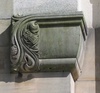
Corbels with deeply carved thistle decorations left entrance to legal offices as described below. |
| Thistle Garden Gates |
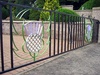
Painted welded steel decorative garden gates incorporating large Scottish thistle emblems. |
V
| Various cast iron gates railings and etc in Victoria Terrace, Montrose Road and Castle Terrace , Inverbervie |
|---|
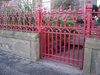
An unusually good group of cast iron railings all in the same area of this small town. Many such railings in the urban and suburban Scottish landscape were removed 'for the War Effort' in the 1940s, along with all those saucepans that were allegedly needed to make Spitfires. The collecting teams must have missed this little area leaving it with something of its original Edwardian appearance. Also noteworthy is the Inverbervie Church gate overthrow see the external links. |
W
| Weavers Cottage Stained glass House Door |
|---|
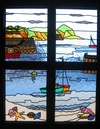
A contemporary front door with four inset stained glass panels forming a harbour landscape in naive style |
| Wrought Iron Sunflower |
An exuberant wrought iron sunflower |
This content was submitted by external contributors and does not necessarily reflect the views of the University of Aberdeen.