
A
Alford Bull
Roadside life size naturalistic bronze of an Angus bull on a shallow stone plinth, surrounded by a small area of paving enclosed, on the field side, by a mortared rubble wall with cairn like pillars.
First Plaque reads:
ABERDEEN ANGUS
This bronze sculpture was commissioned by the community of Alford in 2001 to symbolise the historic connection between the the celebrated Aberdeen Angus breed and the village of Alford.
One of the founders of the breed, Wm. McCombie farmed at Tillyfour, Alford from 1820 to 1880 and was one of the most distinguished agriculturalists of his time.
"He found a purely local breed: he left a breed known and valued throughout the cattle countries of the world."
The model for this bull, Jeremy Eric of Bridgefoot, was bred by A. Fordyce & sons, Bridgefoot, Kemnay, Aberdeenshire, and purchased by F. J. Fraser & son Newton of Idvies, Forfar, at the Perth bull sales in February 2000 for 28,000 guineas.
Sculpter: David Annand
Casting: Powderhall Bronze Edinburgh
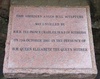
The second plaque is a list of notable financial contributors and the third in pink granite commemorates the royal unveiling. Also shown is a portrait head after an engraving of William McCombie.
Animals and People
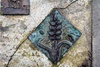
Installation of 3 relief carved pink granite boulders by Louise Gardner, showing people and animals, with small ceramic tiles by local schoolchildren set into the pavement.
B
Banff Abstract Sculpture
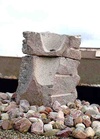
An abstract sculpture in granite, drawing to some extent on the traditional iconography of a broken column.
Bennachie typewriter sculpture

A sculpture composed of three carved wooden elements (spruce wood). Set under large conifers Making a visual pun between the letter keys of a qwerty keyboard and the seed cones of conifers. It comments on the commercial use of the trees to produce wood pulp for paper and the subsequent use of that paper.
Bennachie, Totem Pole

A wooden totem pole carved in the American Indian style near the Bennachie Centre, the main image being of an eagle with salmon on either side. Created by the Scottish Totem Pole Project a partnership between Royal Museum, the artist Kenny Grieve (Brotus Rural Crafts) and a group of Canadian First Nations carvers (on projects in 2002 led by XwaLackTun , Xwa works in two First Nation styles, the Northern Kwaguilth Coast Salish and West Coast Squamish). This cross cultural project involves schools and communities across Scotland investigating Northwest Coast artefacts, exploring their own heritage and natural environment, and creating uniquely Scottish totem poles.. see http://www.nms.ac.uk/totempoles/home/
Burns garden, second Burns bust and Laura Anne memorial stone
A small civic garden near the Cowie River crossing on the north side of the town centre.
The steel fabricated railings were created by 'The Stonehaven Horizon' a team volunteers when the garden was revamped in 2006. Various themes from Burns's poems are used in this garden, as well as the 'moosie' and the Thistle, along with the 'sun' logo of the Horizon Project Group. The plants in the garden are also those with Burns associations. The 'sun' logo is used throughout the town on various improvements that the group have been involved with.
The Laura Anne memorial a small sandstone memorial relief carved with a rose, inset with a granite plaque bearing the dedication (artist unknown) late 1990s.
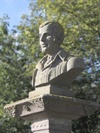
The pre eminent raison d'être of the garden is the sandstone Bust of Scotland's most famous poet Robert Burns (b. 25 Jan 1759 Alloway d. 21st July 1796 Dumfries, at the age of 37). The entire piece is covered with references to Burns's poems - each of the four sides of the pedestal has a grotesque mask of one of his many characters along with an associated text. It was carved by Robert Taylor 'Ghosty Bob' - a local monumental mason and sculptor (his nickname a result of his work carving many gravestones).
This is the mark 2 version. Both works ultimately derive from the 1787 portrait by Alexander Nasmyth (1758-1840). This seems to be regarded as the definitive image of Burns and has been used as a source for most of the huge number of later representations, it is certainly more flattering than the portrait painted by Peter Taylor in 1786.
C
Carers Garden Mosaics
Changing environment
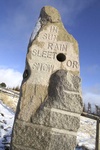
A large granite menhir inscribed "in sun rain sleet or snow" the quarry drill marks left as a feature. The sculpture contains a couple of monocular telescopic lenses that gives the viewer a close-up look of the surrounding countryside and Corgarff castle.
COAST 2013 banners
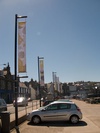
David Blyth worked with local school children as part of this commission. Two major source inspirations were a 1960 paper doll toy found in a local charity shop (the kind one used to cut out the clothes for with the little tabs that fold over) and the Macduff Marine Aquarium. The human/sea animal hybrid is also a concept widespread in Scottish folklore here however David focuses on corals, polyps, urchins and etc rather than the more traditional seals and fish of sylkies and merfolk.
Coast Festival
Coast Festival, benches installation
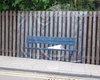
As part of the first Coast Festival (23rd-26th May 2008 ). One of three commissioned temporary public art works. A series of 5 separate installations of digitally printed banners each was a trompe l'oeil image of a bench in place where one might have been the background to match the wall. On each bench was a montage of objects on closer inspection one can see the distortion of scale used in these objects. For instance while the herring gull is life size, the abandoned plastic carrier bag it looks as though it is going to scavenge from is full of tiny street lights and other street furniture.
A comment is made on the surrounding landscape which a person sitting on the illusory bench might survey and inhabit, an interesting contrast between the objects that give our places unique character and those such as road signs and street lights that tend to homogenise the environment.
Coast Festival, Helen Denerley sculpture park
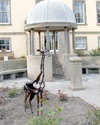
As part of the first Coast Festival (23rd-26th May 2008 ). The artist kindly loaned a number of her animalier works.
While many artists world wide produce sculptures of animals using the technique of welded assemblage Helen's pieces are outstanding in her apprehension of both the basic anatomy and the movement and expression of each species. She is also careful not to completely lose the original identity of the materials used in the works construction. The nature of the scrap used often add considerably to the numinous qualities of the finished piece. In my personal view the best of her works are those pieces that evoke rural Scotland (deer, sheep, horses, hunting dogs, native birds etc.) given extra poignancy by being made of the detritus of the rural economy of the recent past.
Coast Festival, installation at Macduff Pier
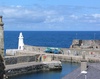
As part of the first Coast Festival (23rd-26th May2008 ). One of three commissioned temporary public art works. It consisted of 5 uprights in polished steel. These created a complex visual environment of reflections, shadows and reflected light beams. Constantly changing in accordance with the light and the viewers position.
Coast Festival, sculptures by Rob Mulholland
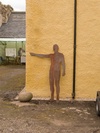
For COAST 2009 Rob created an installation of figures standing in the grounds of Banff Castle looking down toward the bay, with a lone figure down by the sea wall at Greenbanks pointing out to sea.This installation is a play on the seafaring traditions of Banff and Macduff, with the townsfolk looking out in search of the returning fleet and the distinct relationship that fishing families have with the sea. The figures have been cut in mild steel and riveted together to resemble the plate used in fishing boats; this choice and use of materials creates a resonance with our community and visitors alike.
Coast Festival, video piece
As part of the first Coast Festival (23rd-26th May 2008 ). One of three commissioned temporary public art works. A screen based piece using images and recollections from local residents, specifically about Tarlair Lido but also Banff and Macduff in general. You will notice many artefacts illustrated in this database in the stills shown here. A large part of the artist's creative contribution rests on his custom written 'slipstream' computer programme used to display the images and audio elements in continuously changing combinations.
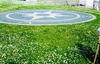
Compass Rose
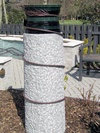
Continuum
Crovie Sculpture
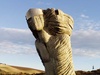
Large ash wood carving 12 foot high, with metal elements. The artist's title is "Scottish Athena" - Athena being the ancient Greek - "Goddess of wisdom, practical skills and prudent Warfare" hence the metal head piece.
"I called her that because of the prudent warfare bit because of Crovie being the place where people went during the clearing of the highlands - I thought she could be a protector therefore up on that cliff top ready with her helmet piece. The steel eyes were to reflect the sky or sunset etc to give that timeless expression. Also because in another definition she was termed patron of the arts and the piece was done as part of a Thankyou to the companies who had donated or supported the Scottish Sculpture Workshop at Lumsden."
Culsh Monument Viewpoint
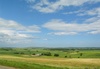
A sculptural granite, viewing and orientation point, located next to a steepled tower built as a memorial.
D
Daniels piece
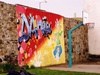
Deer Abbey, commerative plaque to St Mary and St Drostan
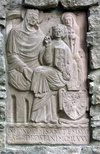
A carved stone relief. St Drostan is a legendary evangelist of the area, his name a Pictish form of Tristram.
Dolphin sculpture, Stonehaven
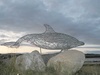
A Dolphin created from a network of steel rods in the characteristic style of many of this artist's public projects in Scotland, Australia etc.
Double Head sculpture Huntly
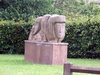
A contemporary stone carving of a double head also making a feature of the subjects hands.
E
Eider Duck bench Forvie
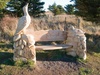
A carved wood bench the side supports representing the eider ducks, for which the reserve is famous, on columns of shell and weed encrusted rock, the back board is carved to suggest the estuary landscape the bench faces.
F
Fisher Jessie sculpture
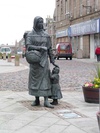
Naturalistic bronze cast statue of a fish-wife and little girl, the woman carrying a creel and a basket.
Fishermens Memorial, Peterhead
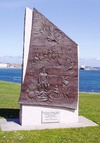
Size overall: 180cm x 350cm x 50cm, sail shaped cast bronze relief modelled with scenes of early 20th century fisher life, mounted on a granite slab.
Flying Visit

Large welded metal sculptures of a 'Family' of Crows feeding outside a supermarket. Each is made from parts from former farm implements - ploughs, dividers, links, grubber wheels, bolts etc
Fordyce Millennium Sculpture (Fordyce, Fuar Deas, The Cold South)
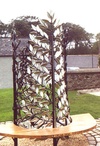
A sculpture based on a leaf and branch motif in welded metal surrounded by a bench with an inscription "Fordyce, Fuar Deas, The Cold South". The wooden seat has been replaced in metal by the original artist as it did not stand the exposure to the weather.
Fraserburgh entrance, lighthouse models
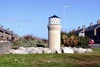
Large model lighthouses at the entrance to the town of the Banff and Strichen Roads surrounded by boulders and planting.
Fraserburgh Fish Sculpture
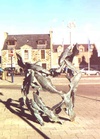
A sculpture in bronze in the form of shoaling fish. Has been used as a location for for pre-nuptial blackening rituals.
Fraserburgh, Beach tunnel murals
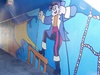
Brightly coloured cartoonish mural decoration in a style that many adults seem to regard as appealing to children.
Fruits of Labour

Carved from Indian Black Granite, a partial sphere with two larger hemispherical shapes suggestive of a sliced fruit, a peach for instance, each has a hemispherical void in its centre that matches the smaller sphere which is itself suggestive of the fruit stone. Contrast is provided by polished and unpolished surfaces.
G
Gold Close 7 Kirk St Peterhead
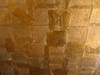
The rough walls of a narrow close (a covered alley) 20' feet long 4' wide and 10' high, in a street of pink and grey granite tenements. The artist has covered the walls with gold lead thus creating a light installation when the sun illuminates it. The reflected light emphasises architectural features that were previously obscured by the general deriliction and old surface coatings. The work creates an intense visual impact on the street in the right light conditions.
Golf View sculpture

Metal and Granite, modernist sculpture with an iconography related to the game of golf. The sculpture is a reminder that the surrounding housing development is built on land that formed part of Inverurie old Golf Course.
H
Hercules Linton Memorial, Inverbervie
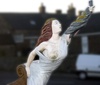
A full scale carved timber replica of the figurehead from the renowned tea clipper "the Cutty Sark" carved from Linton's original drawings 3 metres tall. with a black granite plaque engraved with the image of the ship. The figurehead depicts the young witch in Robert Burns' poem "Tam O Shanter" grasping the tail of Tam's mare, her right breast bared. In the Scot's language 'cutty sark' means a short shirt or shift, it is interesting that despite that fact and the otherwise erotic nature of the figure, the carving is actually wearing quite a long shift, perhaps the Victorian era was much more at ease with tits than with bums.
I
In the beginning, Tarland
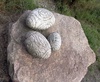
Sculpture using engraved granite one large and three smaller stones, that clearly references local precedents particularly from the neolithic and megalithic periods in both the style and decoration of the piece and, of course, the title.
Insect Sculptures
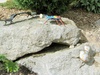
Welded metal insects decorating a garden dedicated to 'carers in the community'. Designed and made by "Just Bohemian" and painted by young carers from throughout the Grampian region.
M
Mary Bourne pieces at COAST 2010
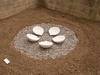
An exhibit of several recent pieces by the artist in a variety of natural stones, marble Caithness stone etc.
Mosaic Telecom access covers, Stonehaven
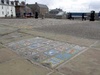
Mosaic tiles on a steel cover plate, arranged in a grid of 24 squares showing nautical and marine iconic imagery.
N
National Cycle route marker, Stonehaven
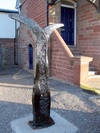
Cast metal Way-Marker erected to indicate a point on the national cycle route network. Contains images relating to local geology. The important fossil bearing strata of the local. Part of a millennium cycle route project funded by the Millennium commission. The shape of the whole piece is obviously intended to suggest the tail of a fish or a whale, I am not sure which.
New Strains at COAST 2010
Hanging acrylic panels engraved with Latin botanical names the English translations of which are used as women's names.
O
Old Road, Bennachie Centre

Carved words "THE TRAMPLING TO INVERURIE" and "THE TRUNDLING TO INSCH" on each side of a large granite stone next to the path just above the Bennachie Centre. In addition there is a hole drilled through the stone providing a sight line along the path.
Otter sculpture Ellon
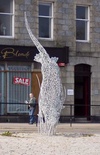
A 3.6 metre high steel otter in the town of Ellon, which celebrates the environmental regeneration of the River Ythan.
P
Part of Art, Space & Nature, at COAST festival 2010
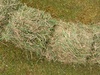
Three circular assemblages of neatly arranged bundles of cut grass, on the lawn in front of the castle.
Peterhead Pends
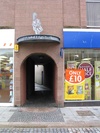
As part of an attempt to regenerate the area and preserve the historic associations of the pends and closes running back from the street they were given these canopies with cut metal signs,
1: Smithy Close: named after a smiddy that was there in the 19th and early 20th century, the canopy depicts a Clydesdale horse and a representation of show harness is inset into the close threshold stone.
In the comparatively short period of its ascendancy, between the period of the ox plough and the tractor, the horse had a huge impact on local culture (reaching its apotheosis in the magico/religious elements of the "Horseman's Word" secret societies) and still exerts an influence although it has gone from most people's everyday life.
2: Proclamation Pend: Shortly after the beginning of the 1715 Jacobite Rebellion, George Keith, 9th Earl Marischal of Scotland, read out a proclamation, at the nearby Peterhead Tolbooth, stating that James Stuart (father of Bonnie Prince Charlie), was the rightful King of Britain. The Earl was accompanied by his younger brother James Keith, later to become a field marshal in Frederick the Great's Prussian army.
James Stuart landed at Peterhead from France on the 22nd of December 1715 and stayed overnight before proceeding South. He returned to France in February 1716 after the failure of the rising.
The canopy shows three figures at the reading of the proclamation and the Keith clan crest is inset into the threshold.
3: Tolbooth Close: named after the Tolbooth which was nearby on the site of the present Townhouse. The Tolbooth was the centre of administration, justice and ceremonial life, where tolls and customs were collected. It was also used for meetings of the burgh council and court and as a prison for remanded criminal suspects and debtors.The original Peterhead Tolbooth was erected in the Longate toward the end of the 16th century, a new one was built in the Broadgate in the 1660s, this was demolished in 1786 and the present Townhouse erected in 1788. The canopy shows a prisoner behind bars and a representation of a James VI eight penny peice is inset into the threshold.
4: Empress Close: named after the Empress Ballroom which occupied the ground floor of the Music Hall that once stood here, the canopy shows a dancing couple, dance step patterns are inset into the threshold.
5: Drummer's Close: named after Drummer's Corner which was situated at the other side of Marischal Street. Woollen mill worker James Milne was an army drummer in the Crimean War (1853-56) he returned to Peterhead and kept a small shop, at the corner of Marischal Street and Albion Street, as well as being the town drummer, his premises became known as 'Drummer's Corner', the canopy shows a drummer with a series of pipe band drummers inset into the threshold.
Peterhead video piece
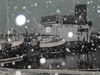
The artist (Dutch film maker, Jean Bei Ning) filmed local residents walking in front of a mobile blue screen. This footage was then mounted into slides showing landmarks in Tibet, Africa, Scotland, Thailand, Syria and Indonesia. This created the effect that local people were travelling in 'other worlds'. The artist also produced a sound piece located elsewhere in the town consisting of stories recorded in interviews with local people.
Portsoy Wheat Sheaf and Anchor
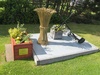
Assemblage of a painted welded metal representation of a wheat sheaf and anchor with planters on a concrete base beside the main road. The plaque reads "Wheat sheaf & fishermans anchor - sculptured by John McGrath, Sandend - Gifted to the people of Portsoy October 2008
R
Rainbow Maze at COAST festival 2010
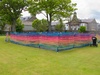
A maze constructed of various coloured yarn woven round wooden posts. This piece used thousands of yards of yarn much of it donated by the local community.
Rob Roy Statue, The Mannie on the Rock, Peterculter
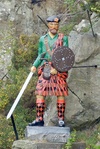
A polychrome carved wood statue in a folk style depicting the popular archetype of the 18th century highland warrior. In tartan plaid armed with broadsword, pistol and targe. Romantically situated on a rock in the side of the burn's gorge.
S
Salmon Above The Flood , Don-Ury Ury-Don

A Stainless Steel sculpture designed by Alison Simpson celebrating the town created on the confluence of the rivers Don and Ury. The salmon symbol evokes the Pictish symbol that is extant in sculptures still apparent in the local environment and thus the continuity of the settlement's cultural heritage.
Sculpture at the Watchie
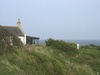
A painted steel sculpture in the grounds of this venue, it maintains a vigil that evokes the original raison d'être of the building.
Seagulls sculpture Fraserburgh
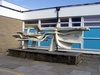
A reinforced concrete sculpture of seagulls/waves, quite appropriately for Fraserburgh. It was designed and made by Sydney James Burnett in the ? late sixties and won a Saltire Award in 1972. Sydney at the time was head of Gray's School of Art (Aberdeen) Sculpture Department.
Sydney Burnett was born locally and his father was an Art Teacher at the Fraserburgh Academy.
Seatree sculpture Banff
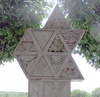
Commissioned by Aberdeenshire Council, with funding from Mobil? A stone sculpture in the form of a polygonal pillar with a capitol based on a 6 pointed star. Carved in relief with symbols, fish, shells, whales, ships, Pegasus and a mermaid included and inscriptions. It is inscribed with the motto "touch not the cat but a glove", this is the motto of several clan names: Chattan, MacIntosh, Gow, MacPherson, MacGillivray and etc. In this case I presume it is a reference to the outlaw MacPherson.
Shelter shed murals Banff links
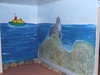
Mural painted inside one of the shelters at Banff links, a seascape showing a seal, a boat and a dolphin these were painted by young people as part of a Princes Trust project during November 2006.
Shorehead Information board
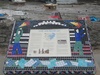
A sloping mosaic panel that surely draws on the local wealth of 'art deco' design, artefacts and buildings. With an inset information panel. It is set on a contrasting plinth of rough masonary.
Slate cairn, Bervie Braes information point
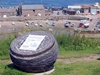
A hemispherical slate cairn with a, metal bound, circular slate-mosaic upper surface with an inset information panel.
Stephen Healy & Sperm Whale
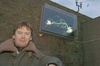
Glasgow based Stephen came to an outsider’s conclusion, based on the architectural layout and history of Peterhead that he had observed, that “Peterhead is and has always probably been an unpretentious working class community. Taking into account the town's social and economical history and its reliance and existence on the fishing industry, there seems to be a functional no nonsense attitude when it comes to the towns general look." He also noted a lack of any decadence with the town’s character, in the form of frills, “aesthetics for aesthetic sake”. His intervention aimed to address some of these issues that the granite town portrays.
His artwork, an animated neon light depicting a sperm whale in motion, introduced a suggestion of colour to the granite town. Neon light was chosen because of its cultural use in other British coastal towns, notably Blackpool’s illuminations. Presented in the style of a 3ft by 2ft boxed exterior shop feature and located outside a traditional local fishmonger's, the whale quietly pulsated, attracting attention and curiosity to the location. The whale is a reminder to the inhabitants of the town that their
forefathers, on regular expeditions to Greenland, would have witnessed these magnificent creatures in the last true wilderness of the planet; a natural phenomena which only a few of us are likely to see in our life times.
Stonehaven Beach Waveform
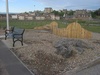
A dry garden of shingle, cut timbers and boulders, in a style derived at some distance from Japanese Zen dry gardens that seems to have become popular for public installations.
Stonehaven Boardwalk furniture
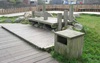
Public seating area with decking and modernist bench constructed from massive sawn timber
Stonehaven Boardwalk Bird with Fish sculpture
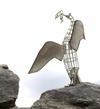
A new welded metal sculpture depicting a Common Shag, Phalacrocorax aristotelis (identifiable by its distinctive breeding crest that distinguishes it from the Great Cormorant Phalacrocorax carbo). It is holding a fish in its beak.
Stonehaven Boardwalk Salmon
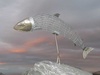
A welded metal sculpture of a cock salmon, if it was inspired by Andy Scott's nearby work I think the anonymous creator outdid that work with this piece that while being thoroughly contemporary has the resonance of the ancient Pictish Salmon symbol. It is to be hoped that its disappearance does not mean it has been destroyed by the sea or vandalism.
Stuartfield Bell
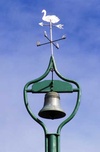
A combined seat, weather vane and bell mount, set on a cobble stone circle. The main frame in green painted tubular steel supports at its base a circular wooden seat and at its apex a bell surmounted by a weather vane in the shape of a swan.
The concept is from accounts of the (then new) village in 18th century "A bell mounted on a pole at The Square was rung three times a day to regulate the working life of the village".
T
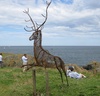
Temporary Installation of Horse and Stag sculptures, Portsoy
THE CALLING OF THE CUCKOO IS THE OTHER SIDE OF SPRING

Made of various stones the work consists of the carved words "THE CALLING OF THE CUCKOO IS THE OTHER SIDE OF SPRING" on a low dyke. In addition there is a carved 'egg' with an incised crack. It celebrates the adjacent Goukstane ("Cuckoo stone"), which is signposted just off the walk to the summit, a large boulder. According to legend it is said to be visited by the first cuckoo to return to Bennachie after spending winter in Africa. Other people believe that this large stone was thrown down the hill by the mythical giant Jock O' Bennachie.
The name and similar stories are applied to several Scottish megaliths one of them only about 3 miles north west at NJ 676 257 (the last surviving stone of a stone circle at the village of Oyne).
The Eternal Present
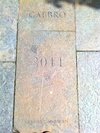
A sculpture consisting of three large spheres of granite, gneiss and gabbro; sourced from Aberdeenshire quarries. Carved in designs based on the enigmatic neolithic stone balls known as 'petrospheres' that are estimated to have been produced between 5,000 and 2,000 B. C. These neolithic objects, of hand holding size, and of unknown function are peculiar to Scotland (except for 1 Irish and 4 Northern English finds) and have been found in considerable number particularly in the North-east, currently 425 known . They are decorated with varied numbers of knobs or more precisely convex discs anything from 3 to 160. Perhaps the best known because one of the most highly decorated is the Towie Ball. See external link to NMS
The Felling of the Timber, is the making of the home

Tree stump carved in the shape of a cupboard with an open drawer and the words "THE FELLING OF THE TIMBER IS THE MAKING OF THE HOME"
The folding of the land

OS ref is approximate. A serpentine arrangement of lengths of round timber set upright in the ground. Each post is branded with a letter on the top so that the whole piece spells out the aphorism "The folding of the land is the unfolding of the way"
Turra Coo
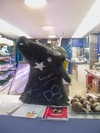
A life size bronze cow decorated with cast garlands and a rope halter, behind the cow is a series of cast cow footprints. On the right flank in slightly raised and differently coloured metal representing the painted lettering on the historical "Turra Coo" at her return, are the words "FREE !! DIVN'T YE WISH THAT YE WERE ME". The sculpture was created by a casting process from an actual cow's body. The historical coo was an Ayrshire cross Shorthorn, no suitable cow of that variety could be obtained so the animal used, a Jersey-Blonde cross, was picked as similar looking to photographs of the original beast. Also illustrated are examples of the "Coo Heads" created by Turriff Academy pupils during the education package associated with the sculpture project and exhibited in the town shops during the month of the unveiling.
W
Walking Way
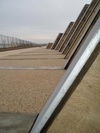
Fraserburgh’s former rail links have inspired a unique pathway with sculptural structures that connect the town to its seafront.
The 'Walking Way' is the creation of Scottish artist Jane Kelly. The winding pedestrian pathway of cast white concrete was laid late summer 2007. It covers an area from the grassy Links beside the town’s Leisure Centre car park, to the crossing at South Harbour Road. The shape has been influenced by the town’s former rail routes.
Eye-catching oak and steel structures have been used as points of interest to attract folk to the new-look public space. A seated area of timbers, inspired by railway sleepers, have been introduced to take advantage of magnificent views looking out across the sweep of the bay. Soft landscaping featuring white wild flowers, silver birch and wild cherry trees have been planted to either side of the pathway.
The Walking Way is the second of two artist-led interventions in the north east harbour town that have been designed to enhance the pedestrian route between the town centre and its waterfront. Work by landscape artist Julia Barton to brighten up the main shopping area was implemented in early summer 2007.
Funding for the Walking Way project was secured by Aberdeenshire Towns Partnership through the EU RevitHar programme (Revitalisation of Harbour Towns) and was supported by Fraserburgh Futures Partnership and Aberdeenshire Council.
This content was submitted by external contributors and does not necessarily reflect the views of the University of Aberdeen.