

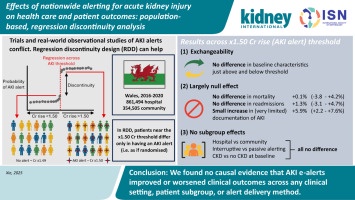

This was new work using an under-utilised method in healthcare research, published in print in Kidney International this month, led by Simon Sawhney at the University of Aberdeen in collaboration with Heidelberg Global Health, Stanford, Calgary, Manchester, and Swansea universities.
Previous randomized trials and real-world observational studies have shown mixed results for whether electronic alerts (e-alerts) for acute kidney injury (AKI) improve outcomes.
The team evaluated a nationwide AKI e-alert initiative in Wales using regression discontinuity design (RDD), a method gaining interest in clinical research.
RDD can effectively replicate trial-like conditions in real-world settings where clinical actions are triggered by a specific measurement threshold, such as AKI criteria.
This evaluation found no causal evidence that AKI e-alerts improved or worsened outcomes regardless of clinical setting, patient subgroup, or how alerts were delivered.
Poor outcomes and deficiencies in documentation and post-AKI care were consistently found — even in the presence of e-alerts.
These findings highlight the ongoing need for an improved clinical response to AKI, beyond alerts alone.
This article was published alongside two independent commentaries:
Electronic AKI alerts at a crossroads: is it time to move on? - Kidney International
Please get in touch if you would like more information about our work: BHDS@abdn.ac.uk