Anthropology and French (MA)
Introduction
Anthropology and French at Aberdeen is a great study combination and will enhance your grounding in what it means to ‘be human’. With an in-depth study of a major modern European language and culture and the opportunity to study abroad, you will develop your language and cultural familiarity skills. The language, perspective and skills you will develop will enable you to pursue a wide range of career options with an international flavour.
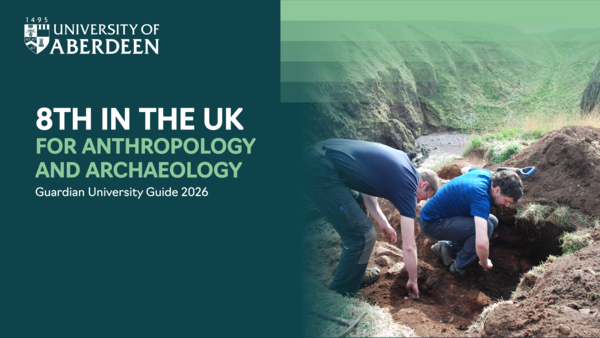
Aberdeen is ranked 3rd in the UK for Anthropology and Archaeology (Guardian University Guide 2025)
Study Information
At a Glance
- Learning Mode
- On Campus Learning
- Degree Qualification
- MA
- Duration
- 48 months
- Study Mode
- Full Time
- Start Month
- September
- UCAS Code
- RL16

French & Francophone Studies at Aberdeen has a long-standing reputation for teaching and research. The programme explores the diversity of French and Francophone culture and the complex global influence of France and the French language over the centuries. You will add to your growing language skills with diverse courses in contemporary society and politics, philosophy and history, film and visual culture, advanced translation skills, and literature from the Renaissance to the present day.
Through your Anthropology courses you will be able to examine the connections among all aspects of life – family and kinship, economic systems, political and religious institutions, human-animal and ecological relations – and the way in which they come together to create whole ways of living within an increasingly global and postcolonial world.
You will also develop essential skills in critical thinking and analysis, and gain a deeper understanding of human behaviour, all of which can be applied in business and many other fields. Many of our graduates now work in research, teaching, media, politics, or in business or public sector organisations in a host of roles with international and cultural contexts.
What You'll Study
- Year 1
-
Year 1: Compulsory Courses
- Getting Started at the University of Aberdeen (PD1002)
-
This course, which is prescribed for level 1 undergraduate students and articulating students who are in their first year at the University, is studied entirely online, takes approximately 2-3 hours to complete and can be taken in one sitting, or spread across the first 4 weeks of term.
Topics include University orientation overview, equality & diversity, MySkills, health, safety and cyber security, and academic integrity.
Successful completion of this course will be recorded on your Transcript as ‘Achieved’.
- Introduction to Anthropology: Peoples of the World (AT1003)
-
15 Credit Points
Anthropology explores ways of life in societies and cultures around the world. Through fieldwork in the places people live, anthropologists connect global issues with everyday lives. In this course you’ll learn about the key topics of anthropology and its research methods. Lectures introduce anthropological research topics such as ritual, climate change and indigenous rights. Small group tutorials will allow you to debate the issues and share your perspectives.
- Introduction to Anthropology: Questions of Diversity (AT1502)
-
15 Credit Points
In this course students will be offered an extended introduction to social anthropology and will focus on topics: language and culture, belief and religion, gender and sex, kinship, and race. Students will develop and refine their understanding of major issues in the discipline of social anthropology through staff lectures, tutorials, and ethnographic films.
- Academic Writing for Social Sciences (AW1006)
-
This compulsory evaluation is designed to find out if your academic writing is of a sufficient standard to enable you to succeed at university and, if you need it, to provide support to improve. It is completed on-line via MyAberdeen with clear instructions to guide you through it. If you pass the evaluation at the first assessment it will not take much of your time. If you do not, you will be provided with resources to help you improve. This evaluation does not carry credits but if you do not complete it this will be recorded on your degree transcript.
Year 1: Optional Courses
Beginner
- EITHER Beginners French Language 1 (FR1028) and French Culture and Society: from Occupation to Decolonisation (FR1031)
- AND/OR Beginners French Language 2 (FR1528) and The Global City in Text and Film (LA1501)
Qualified
- EITHER Qualified French Language 1 (FR1029) and French Culture and Society: from Occupation to Decolonisation (FR1031)
- AND/OR Qualified French Language 2 (FR1529) and The Global City in Text and Film (LA1501)
Select further credit points from level 1 courses of choice to reach 120 credit points
- French Culture and Society: from Occupation to Decolonisation (FR1031)
-
15 Credit Points
This course introduces students to twentieth and early twenty first century French and Francophone culture and society, focusing on the occupation of France during World War II, gender issues, and the impact and aftermath of colonialism and decolonisation. Students will explore the socio-historical and socio-political context by engaging with literature, film, writing from the period and visual materials. Texts will be available in translation for those with limited or no knowledge of French.
- The Global City in Text and Film (LA1501)
-
15 Credit Points
Focusing on major cities in Europe and the Americas, this course unit uses a range of texts, including films, poetry and fiction, to investigate urban spaces as sites of promise, power and loss. Representations of global cities, and experiences of urban dwellers, highlight themes such as empire, identity, leisure, labour and love. Set amid glittering facades and gritty back streets, the texts studied in this course explore the many meanings of the urban experience across place and time. These urban encounters also provide a way of understanding key social, political and cultural moments in the past and present.
- Beginners French Language 1 (FR1028)
-
15 Credit Points
This intensive language course is designed for students with limited or no previous knowledge of French, whether or not they intend to complete a degree in French.
The aim of the course is to introduce the fundamentals of French grammar and a basic working vocabulary and to give extensive practice in reading, writing, listening, and speaking. If they choose to do so, students who take this course and the follow-on Term 2 course, FR1528, will have sufficient knowledge of French to proceed to study at Level 2 and beyond.
Individual cases will be considered, however, it is recommended that:
- Students who have no or limited experience of French register for FR1028: Beginners French Language 1
- Students who have studied French up to a Higher at grade B (or equivalent) register for FR1028: Beginners French Language 1
- Students who have studied French to a Higher at grade A (or equivalent) or above, register for FR1029: Qualified French Language 1
- Students who wish to discuss their individual situation should e-mail: llmvc.enquiries@abdn.ac.uk or speak directly to relevant staff members as soon as possible and ahead of the deadline for changing courses (Friday of teaching week 2)
- Beginners French Language 2 (FR1528)
-
15 Credit Points
This course is intended for students who have successfully completed and passed FR1028 – Beginners French Language 1.
The course builds on the work done in FR1028, extending students’ knowledge of the fundamentals of French grammar and continuing to build their vocabulary and communication skills. This will enable students to consolidate and further develop the core language skills of reading, writing, listening, and speaking, working towards a level equivalent to CERF Intermediate A2/B1. The course is open to all students with the relevant experience, whether or not they intend to complete a degree in French. If they choose to do so, students who complete and pass this course will have an adequate command of French to proceed to study at Level 2 and beyond.
- Qualified French Language 1 (FR1029)
-
15 Credit Points
This course is intended for students who have studied French to Higher (Grade B or above) or equivalent level or above.
This course will enable students to consolidate and extend their knowledge of French, written and spoken, working towards a level equivalent to CERF intermediate B1 by the end of the follow-on course in the second semester. The course is open to all students with the relevant experience. For students registered for a degree with French, this will be a significant step in their training and preparation for the required residence abroad in a French-speaking country after level 2.
Individual cases will be considered, however, it is recommended that:• Students who have no or limited experience of French register for FR1028: Beginners French Language 1• Students who have studied French up to a Higher at grade B (or equivalent) register for FR1028: Beginners French Language 1• Students who have studied French to a Higher at grade A (or equivalent) or above, register for FR1029: Qualified French Language 1• Students who wish to discuss their individual situation should e-mail: llmvc.enquiries@abdn.ac.uk or speak directly to relevant staff members as soon as possible and ahead of the deadline for changing courses (Friday of teaching week 2)
- Qualified French Language 2 (FR1529)
-
15 Credit Points
This course is intended for students who have successfully completed and passed FR1029 - Qualified French Language 1.
This course will enable students to consolidate and extend their knowledge of French, written and spoken, to achieve a level equivalent to CERF intermediate B1 by the end of the course. The course is open to all students with the relevant experience. For students registered for a degree with French, this will be a significant step in the students’ training and preparation for their required residence abroad in a French-speaking country after level 2.
- Year 2
-
Year 2: Compulsory Courses
- Key Debates in Anthropology (AT2010)
-
30 Credit Points
This course explores some of the key questions that anthropologists have debated: what it is to be human, the nature of human interaction with other humans and with other species, the role language plays in thought and culture, and the different ways that people perceive the world and act within it. Themes that will be discussed in this course include rationality, language, species difference, race, and place and community.
- Reimagining Colonialism (AT2515)
-
30 Credit Points
This course will explore contemporary colonial expressions from an anthropological perspective. It will be split into two main themes: Material Histories; and Mediated Histories. Within these themes it will address topics such as the "capturing" of cultures in museums, kinship and politics, gendered colonialism, economic development, media, aboriginal rights and contemporary resistance movements.
- (De)centering France: Social Movements and Cultural Transformation (FR2017)
-
15 Credit Points
The course introduces students to the history, culture and identity of contemporary France by examining key moments and themes in the development of France as a political and cultural entity from the Early Modern period to the present.
FR2017 explores the history, culture and identity of modern France and its place in the Francophone world through topics such as:
- The French Revolution (1789-1799)
- The Dreyfus Affair (1894 to 1906)
- Feminisms in Modern and Contemporary France (1970s to present day)
- The legacies of colonialism (post-World War II to present-day)
- The role of the French language in the contemporary world
- World - Changing Protests: History, Culture, Politics (LA2501)
-
15 Credit Points
The course will span a century of protests across Europe, the Americas and North Africa, with causes including peace, democracy, human rights, anti-racism, labour rights, equality for women and LGBTI+ communities, climate change and decolonisation. Students will learn about the history, culture and politics of the countries where protests erupt, including of the social movements that lead protests. Approaches will include history, literary, film and media analysis, material and visual culture, music and social science methods.
Year 2: Optional Courses
- Advanced French Language 1 (FR2002) AND Advanced French Language 2 (FR2502)
- Advanced French Language 1 (FR2002)
-
15 Credit Points
This course is open to students who have successfully completed and passed FR1528 OR FR1529. Building on the work done in FR1528 and FR1529, it will consolidate and extend students’ knowledge of French language. Grammatical and linguistic analysis will develop further language skills, both receptive (listening, reading comprehension and translation into English) and productive (translation into French; oral language). Students will work towards a level equivalent to CERF Advanced B2 by the end of the follow-on course, FR2502 in Term 2.
FR2002 and FR2502 are both the required French language courses for students to enter the French Honours programme and will prepare them to complete the required period of residence abroad in a French-speaking country. These courses are also open to students with the relevant experience who do not intend to complete a degree in French.
- Advanced French Language 2 (FR2502)
-
15 Credit Points
This course is open to students who have successfully completed and passed FR2002. It will further consolidate and extend students’ knowledge of French language. Continued grammatical and linguistic analysis will enhance language skills, both receptive (listening, reading comprehension and translation into English) and productive (translation into French; oral language). Students will work towards a level equivalent to CERF Advanced B2 by the end of the term.
FR2002 and FR2502 are both the required French language courses for students to enter the French Honours programme and will prepare them to complete the required period of residence abroad in a French-speaking country. These courses are also open to students with the relevant experience who do not intend to complete a degree in French.
- Year 3
-
Year 3: Compulsory Courses
Second half-session will be spent in a French-speaking country.
- Anthropological Theory (AT3027)
-
30 Credit Points
This course explores theoretical issues and key debates in contemporary anthropology. We begin with the questioning of the central concepts of culture and society in anthropology during the 1980s. Following this, we ask: how can anthropology proceed if the targets of its investigation can no longer be understood as objective entities? How can anthropology proceed if the anthropologist themselves is inevitably implicated in and part of those very targets? To look for possible answers, the course examines current anthropological interest in power and history, political economy and phenomenology, experience, embodiment and practice, ontology and things that speak.
- Level 3 French Language (Mode B) (FR3026)
-
15 Credit Points
Building on the skills gained during their first two years of study of French, this course will improve the students' French language skills in all four areas of listening, speaking, reading and writing, whilst increasing their grammatical and lexical knowledge, as well as their sensitivity to linguistic variety.
Year 3: Optional Courses
First half session: 30 further credits from level 3 courses in French, and 30 credit points from level 3 courses in Anthropology
Second half session:
- To be spent in a French-speaking country either Studying OR Working
- Working option: Work Experience: Employability Skills Development (FR3597) AND Junior Honours Project 1 (FR3596)
- Work Experience: Employability Skills Development (FR3597)
-
30 Credit Points
This course, open to Mode B students, provides an opportunity for students to build on their French language ability and cultural understanding of French society through either a placement, personal development project or volunteering activity based within any French speaking country during the first half session. Students work towards a range of personal, educational or work-related outcomes over the course of their time abroad. All external engagement activities require the approval from the student’s academic School and must be verified by the external organisation.
- Junior Honours Project 1 (FR3596)
-
15 Credit Points
This course, open only to mode B Junior Honours students working in a French-speaking country, complements FR3089 and aims to develop receptive and productive skills in French.
- Roads, Mobility, Movement, Migration (AT3061)
-
30 Credit Points
In this course students will be introduced to the topical themes in contemporary anthropology: roads, automobility, car cultures, migration, road narratives, and roads in film and literature. The course is based on the notions of movement and mobility and will incorporate the ethnographic material from the North, including Scotland and Siberia. During the course students will conduct their own research on the road of their choice. The course includes: a fieldwork element, screenings of documentary films about roads, and weekly student-led discussions.
- Comparative Constitutional Systems (AT3057)
-
30 Credit Points
This course will examine anthropological theories of the state, political organization and violence. Through an analysis of both modern and historical case studies from Europe, Asia, Africa and the Americas, we will critically examine theories of state of modern and non-modern state formation and organisation, and the nexus of religion and colonial history. In the second half of the course, particular attention will we paid to the ethnography of violence as a mode of state and proto-state political action.
- Year 4
-
Year 4: Compulsory Courses
- Level 4 French Language (FR4027)
-
30 Credit Points
Building on the skills gained in their third year of study of French, this course will help the students' French language gain very high skills in all four areas of listening, speaking, reading and writing, whilst increasing their grammatical and lexical knowledge, as well as their sensitivity to linguistic variety.
Year 4: Optional Courses
You must choose one of the following dissertation courses:
- Dissertation in Anthropology by Scholarship (AT4065) and One Term 2 Level 4 Anthropology Course.
- Dissertation in Anthropology by Fieldwork (AT4563)/Dissertation in Anthropology by Scholarship (AT4565) and One Term 1 Level 4 Anthropology Course.
- Final Year Project (LA4006), One Term 1 Level 4 Anthropology course, and One Term 2 Level 4 Anthropology Course.
Plus, further credit points from level 4 courses in French to gain a total of 60 credit points in each discipline
- Roads, Mobility, Movement, Migration (AT4026)
- Dissertation in Anthropology By Scholarship (AT4065)
-
30 Credit Points
In this course students will write a dissertation based on scholarship in Anthropology (e.g. library research) but not on primary fieldwork. The course is available to single honours students who decide not to do a fieldwork-based dissertation and to joint honours students who wish to do a dissertation in Anthropology. This dissertation can be taken by joint honours students who have not previously taken AT3538: Anthropological Research Methods and Research Design.
- Final Year Project (LA4006)
-
15 Credit Points
The Final Year project offers students the opportunity to undertake in-depth independent study on a topic of their choosing. The topic is chosen by the student, in conjunction with the dissertation coordinator and an individual programme supervisor, both of whom approve the topic. The project can either take the form of an extended piece of writing; a creative output with reflective commentary or an extended translation with accompanying commentary.
- Roads, Mobility, Movement, Migration (AT4061)
-
30 Credit Points
In this course students will be introduced to the topical themes in contemporary anthropology: roads, automobility, car cultures, migration, road narratives, and roads in film and literature. The course is based on the notions of movement and mobility and will incorporate the ethnographic material from the North, including Scotland and Siberia. During the course students will conduct their own research on the road of their choice. The course includes: a fieldwork element, screenings of documentary films about roads, and weekly student-led discussions.
- Anthropology of the North (AT4562)
-
30 Credit Points
Through a series of lectures and a mix of tutor and student led tutorials, this course focuses on the sometimes difficult history of anthropology and the circumpolar north. Misconceptions (sometimes intentionally created) about the people who live there and their relationships to the environment have informed both state policy and anthropological theory and now is the time for a new anthropology of the north to set the record straight. Students will be encouraged and expected to do their own research on topics of their own choosing and bring these insights back to the course through lively tutorial discussions.
- Emotion, Self and Society (AT4558)
-
30 Credit Points
This course addresses the anthropological study of emotion and self. It covers the different theoretical approaches to emotion, self and subjectivity. The broad questions addressed revolve around the cultural construction of emotion and self, and the entanglement of psychodynamic processes and power in the formation of the subject. The topics covered include anger and fear, grief and compassion, personhood, technologies of self and subjectification, identification and melancholia.
- The Political Anthropology of Indigenous Rights (AT4559)
-
30 Credit Points
Indigeneity is one of the more controversial relations created by globalisation. Widely criticised for being ‘essentialist’ and ‘anti-liberal’, it is one of the more quickly growing identities recognized by the United Nations and defended in the constitutions of many nation-states. Using anthropological insight, this course survey the history of the term, study its expansion from the ‘salt-water colonies’ and ‘settler states’ to the heartland of Europe, and explore some of the challenges and advantages of the term. The seminar will explore how the term has come to be used in different post-colonial situations from the classic “heartlands” of indigeneity in North America, Latin America, and Northern Fennoscandia, to new contexts in China, India, Africa. The course will also explore how the politics of aboriginal rights has become closely linked to struggles for recognition, environmentalism, and collective struggles against neo-liberalism. The course is run in a seminar format with students encouraged to weigh and evaluate the results of their reading.
- More Than Human (AT4560)
-
30 Credit Points
This course explores new directions in how we think about humans and other species. Recent years have seen an upsurge in interest in how the social sciences and humanities deal with animals, plants and other organisms and we scrutinise these cutting edge ideas in depth. A lot of emphasis is placed on trying to think through real life encounters and issues, from a walk in the park to new revelations about life from the bottom of the ocean. Although the focus is on anthropological work, the course should appeal to students from a wide range of backgrounds.
- Dissertation in Anthropology By Fieldwork (AT4563)
-
30 Credit Points
This course involves a dissertation based on anthropological fieldwork. It builds on the research proposal developed in AT3538 Anthropological Research Methods and Research Design.
- Dissertation in Anthropology By Scholarship (AT4565)
-
30 Credit Points
In this course students will write a dissertation based on scholarship in Anthropology (e.g. library research) but not on primary fieldwork. The course is available to single honours students who decide not to do a fieldwork-based dissertation and to joint honours students who wish to do a dissertation in Anthropology. This dissertation can be taken by joint honours students who have not previously taken AT3538: Anthropological Research Methods and Research Design.
We will endeavour to make all course options available. However, these may be subject to change - see our Student Terms and Conditions page. In exceptional circumstances there may be additional fees associated with specialist courses, for example field trips.
How You'll Study
Learning Methods
- Individual Projects
- Lectures
- Research
- Tutorials
Assessment Methods
Students are assessed by any combination of three assessment methods:
- Coursework such as essays and reports completed throughout the course.
- Practical assessments of the skills and competencies they learn on the course.
- Written examinations at the end of each course.
The exact mix of these methods differs between subject areas, years of study and individual courses.
Honours projects are typically assessed on the basis of a written dissertation.
Why Study Anthropology and French?
- Aberdeen is one of the fastest-growing Anthropology departments in the UK
- Study at a nationally and internationally renowned university for Anthropology. The University of Aberdeen is ranked 3rd in the UK for Anthropology and Archaeology (Guardian University Guide 2025) and in the Global Top 100 for Anthropology (QS World University Rankings by Subject 2026)
- Our core staff specialise in regions as diverse as Canada, the Central Asian Republics, Iceland and Scandinavia, Siberia, Scotland and the UK, South America, Tibet and the Himalayas
- We offer innovative ideas and a fresh vision of the subject, with an emphasis throughout on work at the cutting-edge of the discipline and research
- A vibrant student anthropology society regularly organises academic and social events bringing together undergraduate and postgraduate students with staff outside the classroom
- We offer language courses both for students with qualifications in French and for beginners or near-beginners
- The discipline has an international reputation for research, covering not just France, but Francophone Africa and the Caribbean - the wide range of our research interests is reflected in the Honours options courses we offer
- We are a medium-sized, friendly department and the student-run French Society organises a range of social events
Interested in this programme?
Entry Requirements
Qualifications
The information below is provided as a guide only and does not guarantee entry to the University of Aberdeen.
General Entry Requirements
- 2026 Entry
-
SQA Highers
Standard: BBBB
Applicants that present with BBBB will usually receive an unconditional offer.
Where we have more applicants than places we may need to ask for more than the minimum so continued engagement in school is recommended.
Widening Access: BBC
Applicants who meet one or more of our widening access metrics and present with BBC, are guaranteed an unconditional offer.
Foundation Apprenticeship: One FA is equivalent to a Higher at A. It cannot replace any required subjects.
Note: We do not double count a Higher and Advanced Higher in the same subject, but we do consider that a B grade at Advanced Higher is equivalent to an A grade at Higher.
National 5 English (or equivalent) is required at Grade C or above.
A LEVELS
Standard: BBC
Widening Access: CCC
GCSE English (or equivalent) is required at Grade C/4 or above.
BTEC LEVEL 3 EXTENDED DIPLOMA
DMM in related subjects.
Note: BTEC Level 3 Extended Certificate (Subsidiary Diploma) achieved at Distinction level, is normally acceptable in lieu of one A Level at grade B.)
GCSE English (or equivalent) is required at Grade C/4 or above. GCSE Mathematics at Grade C/4 is also required for Accountancy, Economics and Finance programmes.
IRISH LEAVING CERTIFICATE
Five subjects at Higher at H3.
INTERNATIONAL BACCALAUREATE
32 points including 5, 5, 5 at HL.
SL in English is also required.
- 2027 Entry
-
SQA Highers
Standard: BBBB
Applicants that present with BBBB will usually receive an unconditional offer.
Where we have more applicants than places we may need to ask for more than the minimum so continued engagement in school is recommended.
Widening Access: BBC
Applicants who meet one or more of our widening access metrics and present with BBC, are guaranteed an unconditional offer.
Foundation Apprenticeship: One FA is equivalent to a Higher at A. It cannot replace any required subjects.
Note: We do not double count a Higher and Advanced Higher in the same subject, but we do consider that a B grade at Advanced Higher is equivalent to an A grade at Higher.
National 5 English (or equivalent) is required at Grade C or above.
A LEVELS
Standard: BBC
Widening Access: CCC
GCSE English (or equivalent) is required at Grade C/4 or above.
BTEC LEVEL 3 EXTENDED DIPLOMA
DMM in related subjects.
Note: BTEC Level 3 Extended Certificate (Subsidiary Diploma) achieved at Distinction level, is normally acceptable in lieu of one A Level at grade B.)
GCSE English (or equivalent) is required at Grade C/4 or above. GCSE Mathematics at Grade C/4 is also required for Accountancy, Economics and Finance programmes.
IRISH LEAVING CERTIFICATE
Five subjects at Higher at H3.
INTERNATIONAL BACCALAUREATE
32 points including 5, 5, 5 at HL.
SL in English is also required.
The information displayed in this section shows a shortened summary of our entry requirements. For more information, or for full entry requirements for Arts and Social Sciences degrees, see our detailed entry requirements section.
Fees and Funding
You will be classified as one of the fee categories below.
- EU / International students
-
- Tuition Fees for 2026/27 Academic Year
- £20,800
- Tuition Fees for 2026/27 Academic Year (Self-funded Students *)
- £14,800
-
The above fee includes the £6,000 Aberdeen Global Scholarship provided to self-funded international students. Full terms and conditions apply.
- Home Students
-
- Tuition Fees for 2026/27 Academic Year
- £1,820
- England, Wales, Northern Ireland, and Republic of Ireland
-
- Tuition Fees for 2026/27 Academic Year
- £9,790
-
The UK Government has confirmed that the RUK fee cap will continue to increase each year to reflect inflation. Tuition fees will increase in line with the Government fee cap each year, and this should be taken into account when budgeting.
Scholarships and Funding
UK Scholarship
Students from England, Wales and Northern Ireland, who pay tuition fees may be eligible for specific scholarships allowing them to receive additional funding. These are designed to provide assistance to help students support themselves during their time at Aberdeen.
Aberdeen Global Scholarship
The University of Aberdeen is delighted to offer eligible self-funded international on-campus undergraduate students a £6,000 scholarship for every year of their programme. More about this funding opportunity.
Funding Database
View all funding options in our Funding Database.
Careers
- Anthropology Education, Research, Consultancy.
- Social Research.
- Museum and Gallery Curator.
- Social Work.

Our Experts
Information About Staff Changes
You will be taught by a range of experts including professors, lecturers, teaching fellows and postgraduate tutors. However, these may be subject to change - see our Student Terms and Conditions page.
Discover Uni
Discover Uni draws together comparable information in areas students have identified as important in making decisions about what and where to study. You can compare these and other data for different degree programmes in which you are interested.
Get in Touch
Contact Details
- Address
-
Student Recruitment & Admissions
University of Aberdeen
University Office
Regent Walk
Aberdeen
AB24 3FX